
Levelling post-war Dunstable floors for LVT
Put LVT or sheet vinyl over an uneven base and each ridge and hollow shows through. Manufacturers of these finishes generally want SR1 under BS 8204: with a 2m straightedge laid on the floor, nowhere more than 3mm beneath it. SR2 allows 5mm and SR3 10mm, and those looser classes suit thicker finishes.
A floor in a post-war Dunstable semi can fall short of SR1 for several reasons: an original screed that has worn unevenly, patched areas from old plumbing work, or the join between the house and a newer extension. Homes built between 1973 and 1999 make up 19% of the town too, and an extension on one of those can also meet the old floor with a lip.
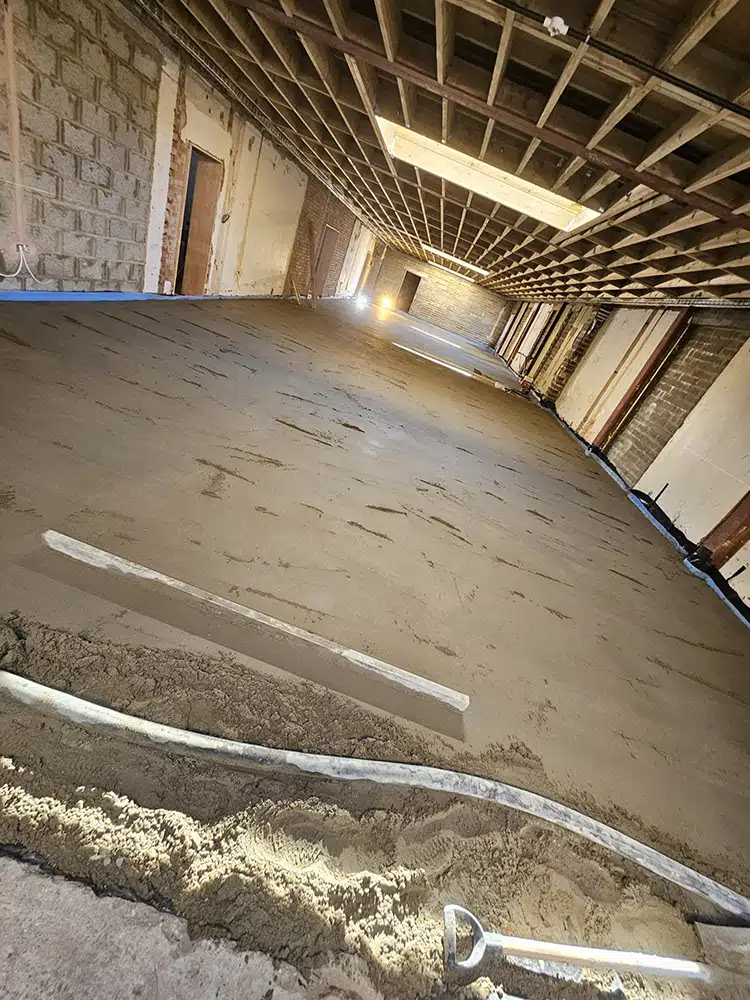
Levelling starts with preparation. We scrape away old adhesive, paint and any loose screed, fill cracks, and prime with a product matched to the base. Each base, whether concrete, a cement screed or calcium sulphate, needs its own primer, otherwise the compound will not grip. Only after that is the compound mixed and poured out. Most goes on between about 2mm and 10mm, spreading itself into a smooth, level finish. The aim is SR1 for LVT and sheet vinyl.
If the base itself is weak or contaminated, floor preparation comes first. For very shallow work over a small area, latex screed can be enough.
Quadrant shop refits and Woodside Estate industrial floors
Commercial floors in Dunstable get levelled when they change hands. A unit in the Quadrant Shopping Centre, which opened in 1966, or the Eleanor's Cross precinct, from 1985, may have layers of old adhesive, tile and patch repairs from earlier fit-outs. Stripping back to the slab, priming and laying compound gives the new shop floor a flat base for vinyl, carpet tile or large ceramic tiles. We time the levelling to the fit-out schedule, so the shopfitters find the floor ready when they arrive.
On the Woodside Estate, industrial floors are a different matter. A Woodside factory or warehouse floor is more likely to need repairing, grinding or rescreeding than a skim of compound. See concrete floor repair for that work.
The limit on compound is depth. Go far past what the product is made for, trying to save a floor that ought to be rescreeded, and it may crack and part from the base. When a floor is beyond what compound can correct, we will tell you, and recommend rescreeding in sand and cement instead.
How we price floor levelling in Dunstable
A fixed written price within 24 hours, once we know the area and the base. See our floor screeding cost guide.
Who levels your floor in Dunstable
K & B Screeding’s own team, led by director Donatas Bardisevicius. Founded 2019, company 12298780.
See what customers say in our Google reviews and on our testimonials page.
Floor Levelling from Slough to Dunstable
On the map, Dunstable sits north of Slough, about 25.1 miles from our base in a straight line (postcodes including LU6 and LU5), next to Houghton Regis (1.3 miles), Luton (4.6 miles), Leighton Buzzard (6.2 miles) and Flitwick (8.1 miles).
More on floor levelling, part of our screeding services. Not sure whether you need a thin compound or a full flowing screed? See self levelling screed explained.