
Heated rear extensions on Dunstable's post-war semis
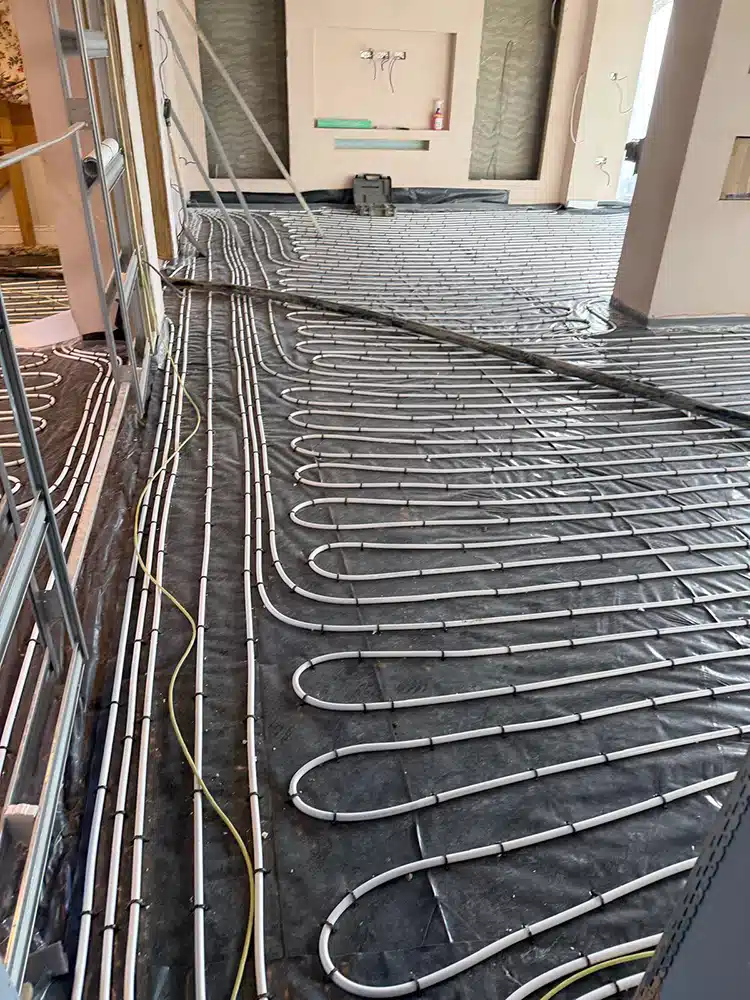
A heated floor only works as well as the screed over it. The screed holds the pipes, spreads the warmth evenly and gives the flooring a firm, flat base. Skimp on depth and cracks follow the pipe lines; overdo it and the room takes ages to heat.
Poured liquid has to cover the pipes by 25mm at the very least, so the finished layer comes to about 45 to 50mm. Sand and cement calls for around 45mm above them, and the floor comes out thicker. A flowing mix leaves no air gaps around the pipes, one reason heated floors so often get liquid. See pumped liquid screed in Dunstable for how that works.
A single storey rear extension is the classic place for it. On a post-war semi, heating in the extension floor frees wall space and suits a kitchen or family room opening onto the garden. The new floor has to line up with the old house at the threshold, so insulation depth, pipe height and screed thickness are worked out together.
Newer Dunstable homes follow the same principles. Homes built since 2015 make up 10% of the town, and when one of those is extended, the new floor build-up is matched to the modern one next to it. The loops need filling and pressure testing beforehand, then keeping pressurised through the pour so any leak is spotted at once. For the boards and sheet that sit beneath the loops, see our insulation and membrane work.
Tight floor heights on the Northfields Estate
Putting heating under a ground floor that is already there is a tougher job than designing it into a new extension. The Northfields Estate's 1930s houses are a good example: their ground floors may be uninsulated, and the finished floor height is fixed by door heights, stairs and thresholds. There is seldom the height to stack insulation, pipes and screed over what is there, so out comes the old floor.
Where height is tight, a thinner liquid screed helps, and an alpha hemihydrate product can cut the depth further within the limits of its own data sheet.
Warm-up must be gradual. Calcium sulphate can generally take its first heat around 7 days in, whereas sand and cement must wait 21 days or longer. Begin low and climb in small steps across several days. Rushing this is a common reason new heated floors crack.
In a flat, the build-up also has to leave room for sound insulation between floors, so every layer is agreed before the pour. Day-by-day timings for each screed type are in our guide to drying times.
Underfloor Heating Screed prices in Dunstable
Liquid screed over underfloor heating: £20 to £35 per m² supplied and laid (trade2base, June 2026), so £700 to £1,230 for 35 m². trade2base gives these figures excluding VAT. See our floor screeding cost guide or screed calculator.
Who lays your underfloor heating screed in Dunstable
K & B Screeding’s own team, led by director Donatas Bardisevicius. Founded 2019, company 12298780.
See what customers say in our Google reviews and on our testimonials page.
Underfloor Heating Screed from Slough to Dunstable
On the map, Dunstable sits north of Slough, about 25.1 miles from our base in a straight line (postcodes including LU6 and LU5), next to Houghton Regis (1.3 miles), Luton (4.6 miles), Leighton Buzzard (6.2 miles) and Flitwick (8.1 miles).
More on underfloor heating screed, part of our screeding services.
