
Why flowing screed suits Dunstable extensions and flats
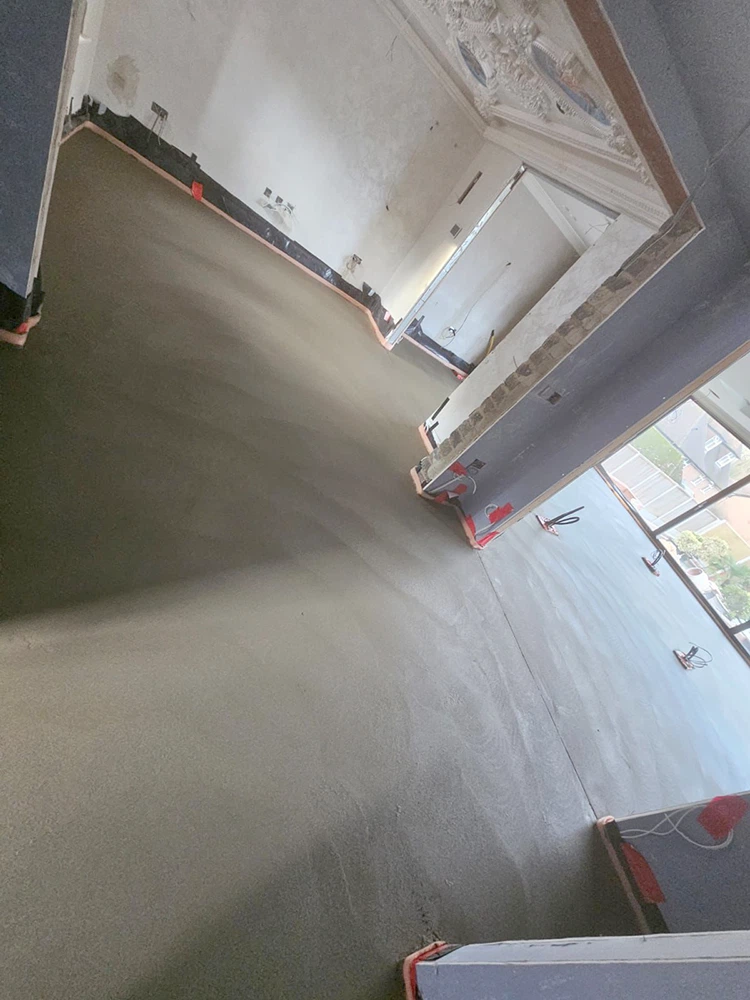
A flowing screed is poured, not trowelled. It spreads under its own weight, settles dense and flat, and can reach a surface regularity of SR1 or SR2 without the hand finishing a sand and cement floor needs. Large areas go down in a single day, and low shrinkage means far fewer joints.
Open floors gain the most from that speed. Where a single storey rear extension on a Downside or Lake District semi is opened into the old kitchen, the result is one long room to pour. A flowing screed fills it in one go, including round heating pipes, with no voids. If the room is heated, the heated floor screed page explains how much cover the pipes need.
Newer building is part of the picture too. Only 20% of Dunstable's homes date from 2000 or later, but that newer stock, and the 5,150 homes planned north of neighbouring Houghton Regis, are the kind of building where a flowing screed is often designed in from the start. See liquid screed in Houghton Regis for that side of the boundary.
Depth follows the build-up. Floating on insulation, a domestic liquid screed begins at about 35mm thick; commercial floors start nearer 40mm. Heating loops change that: they need a minimum 25mm blanket of screed on top, so a heated extension floor on the Downside estate ends up 45 to 50mm in total. You can have a liquid screed made with calcium sulphate or with cement. Which one fits depends on the room: a bathroom or utility at risk of water needs the cement based kind, while specified anhydrite grades have their own page.
Pumping to upper floors and tight Dunstable streets
Nobody barrows anything: the pump is parked on the road and the screed travels in by hose. To reach a back extension, the hose usually takes a side passage or runs through the house itself, and we cover floors and doorways on the way. For an upper floor flat, it goes up the communal stair or through a window, which saves dozens of trips with heavy loads.
What makes pumping awkward is parking. Tell us about permit zones, narrow access or a long walk from the road to the room when you ask for a price, wherever the address is, from Oldhill Down to Borough Farm. We can plan a longer hose run or a different pump position if we know in advance.
On the day, the area must be sealed, with edge strip fixed, membrane taped and doorways dammed. After the pour, keep doors and windows shut for about 24 to 48 hours, then ventilate to help drying. Drying before flooring takes longer than walking time, and our guide to liquid versus sand and cement screed compares the two. Pump hire alone is not something we offer; the screed pumping service is part of a laid and finished floor.
Liquid Screed prices in Dunstable
Liquid screed: £24 to £31 per m² supplied and laid (MyJobQuote, August 2026), so £960 to £1,240 for 40 m². MyJobQuote does not say whether these figures include VAT. See our floor screeding cost guide or screed calculator.
Who lays your liquid screed in Dunstable
K & B Screeding’s own team, led by director Donatas Bardisevicius. Founded 2019, company 12298780.
See what customers say in our Google reviews and on our testimonials page.
Liquid Screed from Slough to Dunstable
On the map, Dunstable sits north of Slough, about 25.1 miles from our base in a straight line (postcodes including LU6 and LU5), next to Houghton Regis (1.3 miles), Luton (4.6 miles), Leighton Buzzard (6.2 miles) and Flitwick (8.1 miles).
More on liquid screed, part of our screeding services.