
Liquid screed in Harpenden's open plan conversions
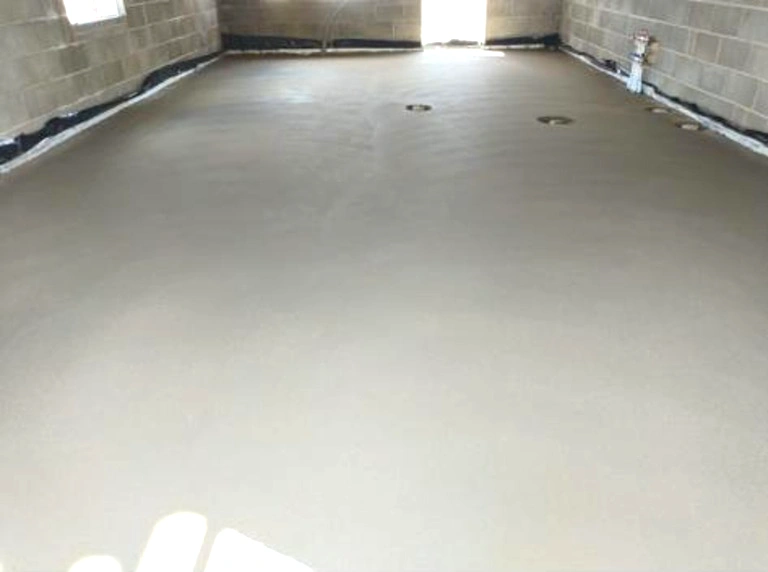
When a kitchen, dining room and hall are knocked into one space, the floor becomes one long run through several old rooms. Hand-laid screed across that area means many bays and joins. A liquid screed is pumped in from one end and flows to a level across the whole space, reaching SR1 or SR2 flatness readily, with low shrinkage and far fewer joints.
Houses from the late twentieth century are well represented here, with 24% of Harpenden's homes built between 1973 and 1999. A conversion often lifts old tiles, lays new insulation and finishes with a thin floating liquid screed from about 35mm. That keeps the finished height close to the original, so doors and thresholds still work without trimming. It also leaves more of the available depth for insulation, which a cold old slab usually lacks.
Liquid screed is made in calcium sulphate and in cement based versions. The right one depends on the rooms involved and the flooring planned, and we advise on that at the survey. A room that may get wet, for example, points towards a cement based mix.
Flats account for 18% of homes in Harpenden. On an upper floor, the pump hose is run up the stairs or through a window, and the screed's thin section and fast coverage mean less disruption in a shared building. For the case either way, see our comparison of liquid and sand and cement screed.
Pumping and drying on a Harpenden pour day
The mixer lorry and pump arrive together, and the pump sends screed through a hose to the room. The lorry needs to park within reach of the hose for a few hours, normally on a Harpenden drive or at the kerb outside. Before the day we walk the route: through the front door, down the side or through a rear opening. On a narrow or busy street we agree where the lorry can stand safely.
Preparation comes first. Insulation is laid, a membrane taped over it and an edge strip fixed round the walls. The screed is poured to depth, dappled to release trapped air and left to settle. You can usually cross it on foot 24 to 48 hours later.
Drying for flooring takes longer. Think of a millimetre a day until you are 40mm down, slower beyond, with a moisture test fixing the actual date. Where pipes run through it, calcium sulphate can generally take gentle heat from about 7 days.
For heated floors see underfloor heating screed in Harpenden, and about 4.5 miles away, liquid screed in St Albans.
Liquid Screed prices in Harpenden
Liquid screed: £24 to £31 per m² supplied and laid (MyJobQuote, August 2026), so £960 to £1,240 for 40 m². MyJobQuote does not say whether these figures include VAT. See our floor screeding cost guide or screed calculator.
Who lays your liquid screed in Harpenden
K & B Screeding’s own team, led by director Donatas Bardisevicius. Founded 2019, company 12298780.
See what customers say in our Google reviews and on our testimonials page.
Liquid Screed from Slough to Harpenden
Harpenden is about 23.2 miles north-north-east of our Slough base as the crow flies, with postcodes including AL5 and AL3. The nearest towns to it are St Albans (4.5 miles), Luton (5.1 miles), Welwyn Garden City (6.5 miles) and Hemel Hempstead (6.6 miles).
More on liquid screed, part of our screeding services.
