
Hollow and cracked screeds on Downside and Lake District semis
Semi-detached houses make up 35% of Dunstable's homes, and on the Downside and Lake District estates the post-war semi is the typical house. Floors of that age often have an original sand and cement screed, and after decades of use it can crack, curl at the edges or lose its bond with the slab below. Tap it and a hollow patch sounds dull and drummy.
Where only a small patch has come loose, cutting it out and patching may be enough, as our screed repair work explains. Where the problem is widespread, or a new floor finish needs a sound base throughout, the old screed comes up and a new one goes down.
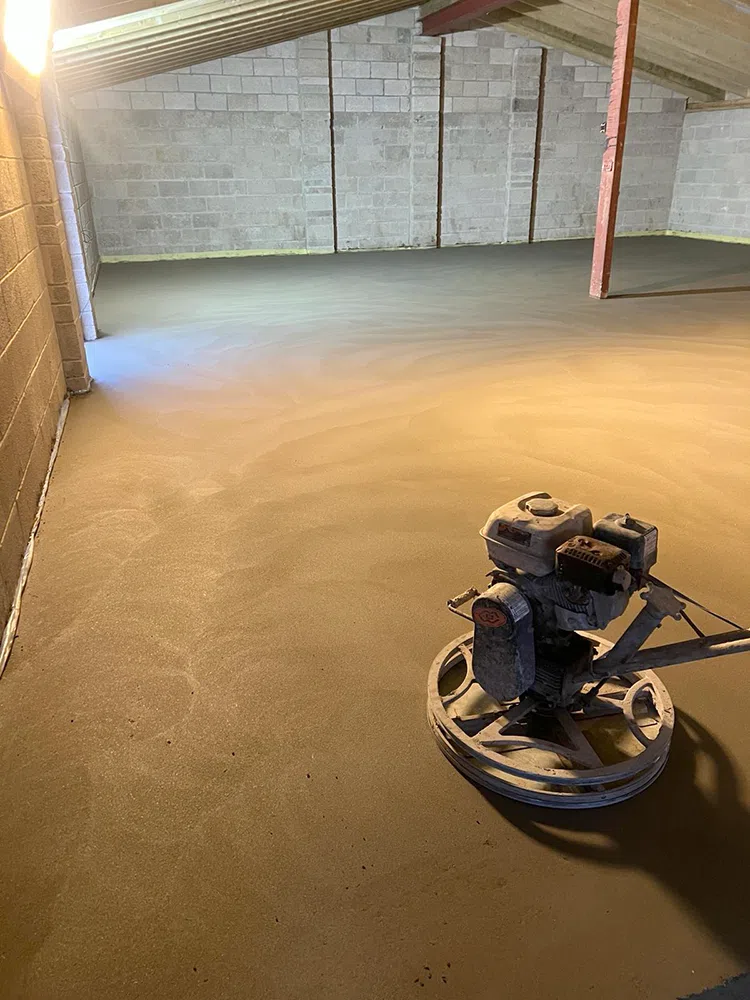
New screed is batched on site for the depth each room needs. In a house it goes down 65mm thick when floating on insulation; on commercial work, 75mm. A bonded screed, fixed to a clean, prepared slab, can be 25 to 40mm and is useful where floor height is limited. The mix is compacted and floated to a dense, level surface that takes tiles, wood or vinyl once dry.
Houses on the Northfields Estate are older still, from the 1930s, and their ground floors may have no insulation at all. To rebuild one, we take out the old floor, put in insulation and a membrane, then screed on top. Our guide to screed depths breaks down how thick each layer is.
Wet rooms, garages and small Dunstable rooms
In certain rooms only a cement screed will do. A walk-in shower or wet room needs falls towards the drain, formed by hand so the water runs the right way, and calcium sulphate screeds do not belong where water may sit. A utility with a washing machine is safer on sand and cement for the same reason.
Garages are another job for a hand-laid mix. Converting one to a room means building the floor up to the level of the house, and keeping it as a workshop or for a car means a floor that can take early load. Sand and cement handles both.
Older property counts here too. Pre-1919 houses account for 11% of Dunstable's homes. Narrow halls, small back rooms and awkward steps in houses of that age are easier to screed by hand than to pump.
It does dry more slowly than liquid: count on around one day for each millimetre up to 40mm, with the rate easing off after that. Where time is short, fast drying sand and cement helps. About 6 miles away, the same service covers sand and cement screed in Leighton Buzzard.
Sand and Cement Screed prices in Dunstable
Sand and cement screed: £18 to £25 per m² supplied and laid (MyJobQuote, August 2026), so £450 to £630 for 25 m². MyJobQuote does not say whether these figures include VAT. See our floor screeding cost guide or screed calculator.
Who lays your sand and cement screed in Dunstable
K & B Screeding’s own team, led by director Donatas Bardisevicius. Founded 2019, company 12298780.
See what customers say in our Google reviews and on our testimonials page.
Sand and Cement Screed from Slough to Dunstable
On the map, Dunstable sits north of Slough, about 25.1 miles from our base in a straight line (postcodes including LU6 and LU5), next to Houghton Regis (1.3 miles), Luton (4.6 miles), Leighton Buzzard (6.2 miles) and Flitwick (8.1 miles).
More on sand & cement screed, part of our screeding services.
