
Retrofitting heat into Berkhamsted's older ground floors
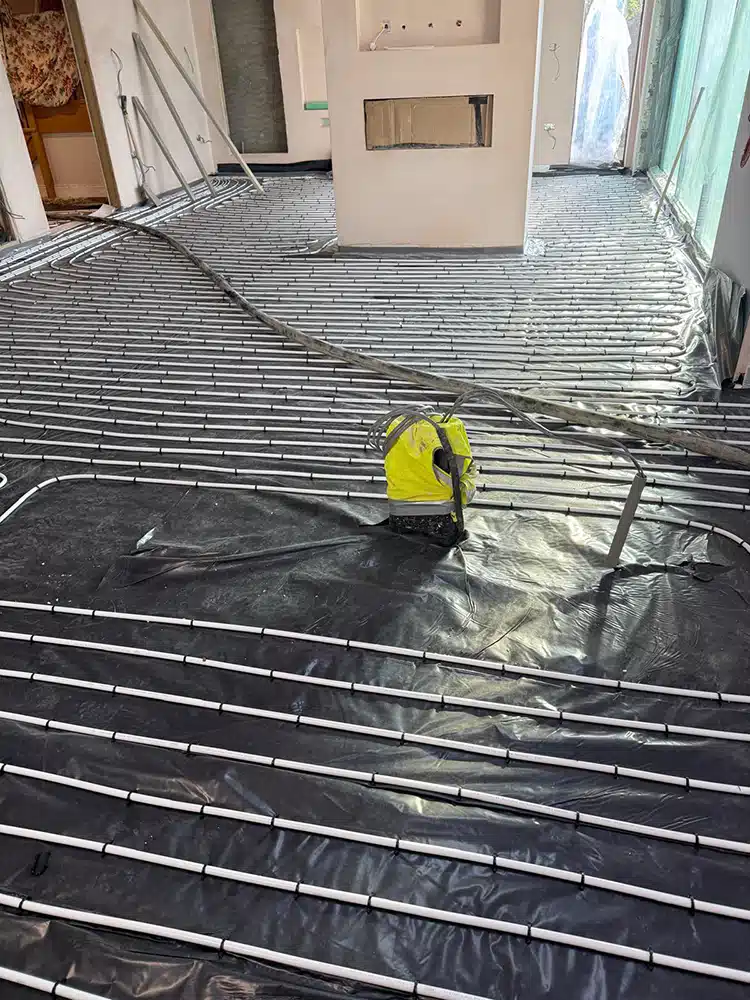
In the Victorian villas south of the High Street, renovating the ground floor is often the moment to add underfloor heating. The old suspended or solid floor comes out, insulation goes down, the pipes are clipped in place, and the screed goes over the top. The challenge is height. The finished floor has to meet existing thresholds, skirting and stairs, so every layer is measured before anything is ordered.
So the screed you pick makes a real difference. A flowing liquid screed must have 25mm or more above the pipes, which comes to about 45 to 50mm overall, and it fills beneath and around each one without leaving gaps. Trowelled sand and cement has to be about 45mm deep over the pipes, which pushes the whole floor higher. Where height is tight, liquid often wins; where the rooms are small or broken up, a hand-laid sand and cement screed over pipes can still be the practical option.
Homes built from 1945 to 1972 account for 28% of Berkhamsted. Floors of that era were rarely built with insulation underneath, so a retrofit usually means digging down rather than building up.
Extensions and garden rooms are simpler because the build-up can be designed from scratch. Either way, a sound membrane under the insulation is sensible in a valley with a river and a canal running through it. Typical depths for each build-up are listed in how thick a screed should be.
Commissioning a heated floor in Berkhamsted
The pipes should be pressure tested before we arrive, and the system left full and under pressure while the screed is poured, so any damage shows up straight away. When we arrive we look over the insulation and membrane, and pay particular attention to the edge strip, because it gives the floor room to expand as it heats up.
Resist reaching for the thermostat straight away. Day 7 is roughly the earliest a calcium sulphate floor can be warmed; a cement one has to sit for three full weeks first. From there, the heating maker's commissioning schedule sets the pace, starting the water cool and edging the flow temperature upwards. Rushing it risks cracks and a floor that never performs properly. Keep a written record of each step, because the flooring fitter and the heating installer will both want to see it.
Once commissioned and dry, a heated screed gives a flat base for tiles, LVT and engineered wood, and the heat spreads evenly across the room. For a liquid screed over heating pipes, published UK figures for 2026 sit at £20 to £35 per m².
For homes in Hemel Hempstead, see Hemel Hempstead's underfloor heating screed page.
Underfloor Heating Screed prices in Berkhamsted
Liquid screed over underfloor heating: £20 to £35 per m² supplied and laid (trade2base, June 2026), so £700 to £1,230 for 35 m². trade2base gives these figures excluding VAT. See our floor screeding cost guide or screed calculator.
Who lays your underfloor heating screed in Berkhamsted
K & B Screeding’s own team, led by director Donatas Bardisevicius. Founded 2019, company 12298780.
See what customers say in our Google reviews and on our testimonials page.
Underfloor Heating Screed from Slough to Berkhamsted
As the crow flies, our yard in Slough is about 16.3 miles from Berkhamsted, which lies to the north. Postcodes here include HP4, and Tring (4.3 miles), Hemel Hempstead (4.5 miles), Chesham (4.5 miles) and Amersham (6.2 miles) are close by.
More on underfloor heating screed, part of our screeding services.
