
Heated extensions on Amersham's larger homes
Post-war detached homes in Amersham are regularly extended, and a large kitchen and family room is the usual result. Radiators take up wall space that the new room needs for units and glazing, so heating the floor instead is a natural choice. Owners often pick a liquid screed for it, because a thin screed responds quickly when the heating comes on.
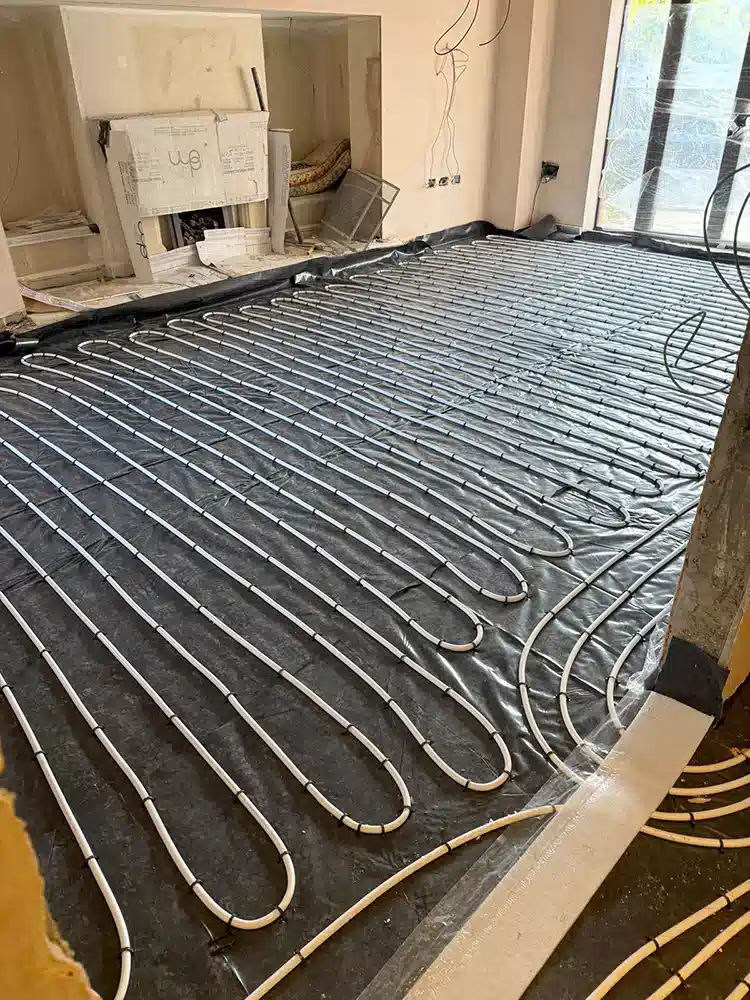
The screed has two jobs. It has to cover the pipes to the right depth so the floor is strong enough, and it has to surround them completely so heat reaches the surface evenly. With pumped liquid screed, 25mm over the pipes is the least we lay, and the whole layer is normally 45 to 50mm. Hand-laid sand and cement wants around 45mm above the pipes, which means a thicker slab that takes longer to warm.
The build-up under the pipes matters too. The insulation keeps heat from escaping downwards, the membrane keeps screed and insulation apart, and the perimeter strip gives the screed room to expand at the walls. We check these before the pour, and if any layer is missing or damaged we say so.
Inter-war houses on the Hill are a different case. Where an old ground floor is being replaced anyway, insulation, pipes and screed have to fit into the depth the old floor occupied, so measure that before choosing the system.
Heating up an Amersham screed without cracking it
However cold the house is, switching on the day after the pour is out. Calcium sulphate floors can usually begin commissioning after about 7 days, and sand and cement ones need a minimum of 21. That gap is worth building into the programme from the start, particularly if the extension is due to be finished in winter, when the owners will want the room warm as soon as possible.
Commissioning should be gradual. The heating engineer starts at a low flow temperature and raises it in steps over several days, holds it, then brings it back down before the flooring goes down. Going straight to full heat dries the surface too fast and can crack the screed, and cracks over pipes are difficult to repair neatly once flooring is down. We hand over written guidance so your engineer and flooring fitter know what has been laid.
Heating also speeds up drying, which is useful on a tight programme, but the floor still needs a moisture test before flooring. Tiles, LVT and engineered wood each have their own limits, and the flooring maker's instructions take priority over any general rule of thumb. Our guide to screed drying times walks through the tests. For heated floors a little to the east, see underfloor heating screed in Chorleywood.
Heated floors in Amersham flat conversions
Flat conversions and refurbishments in Amersham need level floors with sound insulation, and when wet underfloor heating is part of the plan, the screed has to do three jobs at once: cover the pipes, keep the floor flat and sit within a build-up that controls noise between flats.
The structure decides what is possible. A ground floor on a concrete slab can usually take a full heated build-up if there is height for it. An upper floor is often a different matter, especially in an older building with timber floors, and whether it can carry a screed at all is a question for a structural engineer, not the screeder.
Where a screed is approved, the designer sets the build-up: an acoustic layer, insulation, the pipes, and the screed on top. Liquid is the usual choice because it needs less depth over the pipes and flows round them without voids. Edge strip around each room keeps the screed off the walls, and the acoustic layer must be continuous, with every joint taped so screed cannot leak through and form a hard link to the floor below.
Each flat is then commissioned on its own, on the schedule for its screed type. Recording the heat-up dates for each unit helps the flooring contractor, who will want to see them before testing, and it lets the flats be handed over one at a time rather than waiting for the whole building.
Underfloor heating screed prices in Amersham
Liquid screed over underfloor heating: £20 to £35 per m² supplied and laid (trade2base, June 2026), so £700 to £1,230 for 35 m². trade2base gives these figures excluding VAT. See our liquid screed cost per m² guide, the floor screeding cost guide or the screed calculator.
Who lays your underfloor heating screed in Amersham
K & B Screeding’s own team, led by director Donatas Bardisevicius. Founded 2019, company 12298780.
See what customers say in our Google reviews and on our testimonials page.
Underfloor heating screed from Slough to Amersham
As the crow flies, our base in Slough is about 10.1 miles from Amersham, which lies to the north. Postcodes here include HP6 and HP7, and Chesham (1.9 miles), Chorleywood (4 miles), Beaconsfield (4.9 miles) and Berkhamsted (6.2 miles) are close by.
Where the screed lorry must park in a marked bay in Amersham, a bay suspension from Buckinghamshire Council (parking suspension) covers it; the quote tells you if it is needed. For an extension in Amersham, the floor usually needs building regulations approval, including Part L insulation in England. Local building control is Buckinghamshire Council Building Control.
More on underfloor heating screed, part of our screeding services. For every screed we lay locally, see floor screeding in Amersham.
Further reading: screed thickness guide and underfloor heating on a concrete floor.