Getting pipe cover right in High Wycombe extensions
In a heated floor, the screed is what holds and spreads the warmth. Skimp on cover over the pipes and the floor may crack or show warm stripes; overdo it and the room is slow to heat. So the build-up needs planning before the slab is cast, ideally with the heating engineer and builder settling the finished floor level between them.
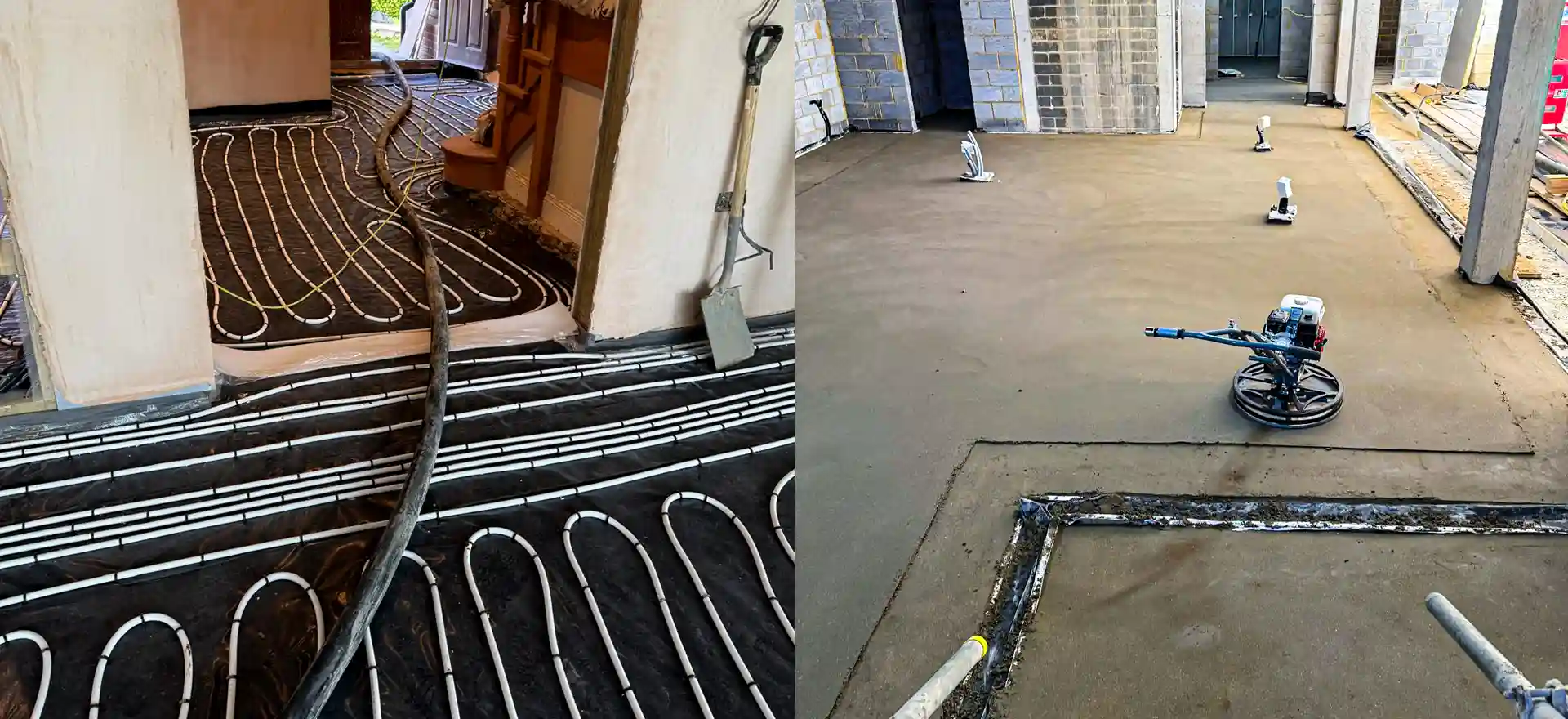
Over the pipes in a High Wycombe extension, pumped liquid screed needs a minimum of 25mm, so the finished floor ends up about 45 to 50mm deep. Pumped in, it fills every gap around each pipe, leaving no voids, so the room warms up sooner. Sand and cement wants about 45mm of cover, compacted carefully round every pipe. Our liquid screed page for High Wycombe walks through the pumped method.
Homes from 1919 to 1944 account for 16% of the town, and extending one means the new heated floor has to meet a floor level fixed nearly a century ago. Measure down from there: finish, screed, pipes, insulation and membrane all need to fit. If the sums do not work, change the insulation or screed before the slab goes in rather than after; a thinner liquid screed or a slimmer high performance insulation board will often win back the few millimetres missing.
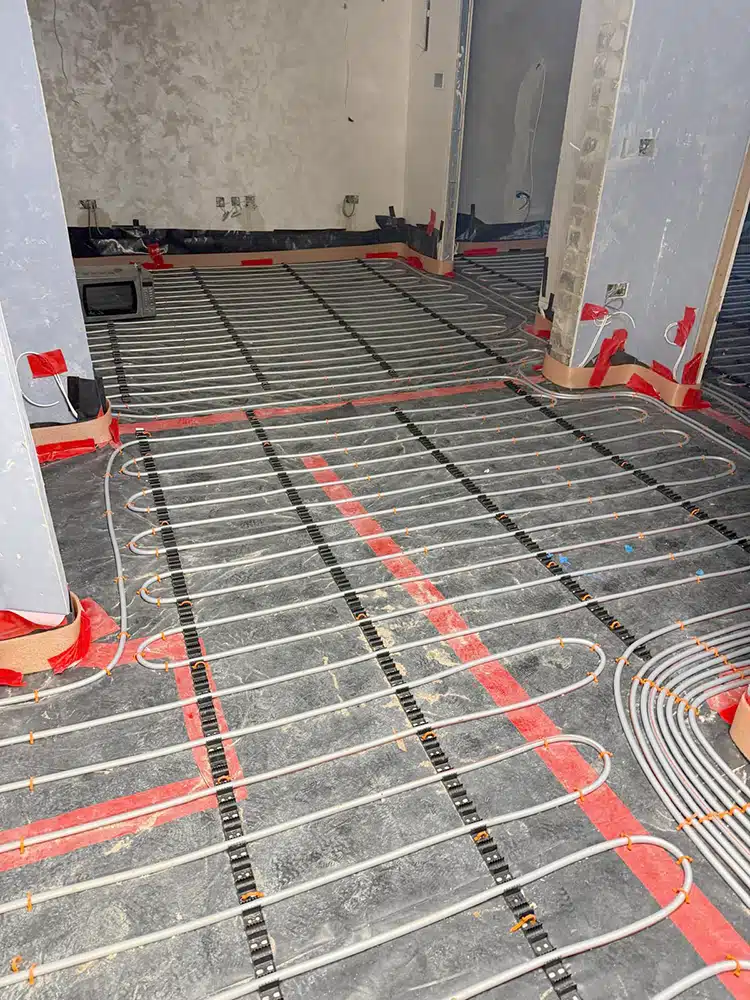
We look over the edge strip, membrane and insulation ahead of the pour, and if you need the full build-up supplied, our insulation and membranes service provides it.
Switching on the heating in a High Wycombe home
Since the year 2000, 22% of High Wycombe's homes have gone up. Recent plot or new extension, the weeks after a heated pour run to exactly the same rules.
Calcium sulphate can usually take its first warmth at around 7 days, whereas sand and cement keeps the heating off for no less than 21. Then, for either one, set the flow temperature low and creep it up over several days, hold it steady, and bring it down again. Turning the system up high on the first day risks cracking the screed and spoiling the finish that follows.
Warming the floor helps it dry, but a moisture test is still needed before any flooring goes down. How depth and screed type change the wait is covered in our drying times guide.
Bathrooms on the heating circuit are the exception to a pumped calcium sulphate floor: give them a cement based screed, as calcium sulphate is not meant for floors that may get wet. A hand-laid sand and cement screed also works for smaller heated rooms where setting up a pump is awkward.
Heated side extensions on High Wycombe's semis
Semis in High Wycombe are extended at the side as well as the rear, and a side extension brings its own questions for a heated floor. The room can be long and narrow, it may open onto both the hall and the kitchen, and the screed has to finish flush with two existing floors that were laid at different times.
Start with the levels. The finished heights of the hall and the kitchen are measured before the slab is cast, and the insulation, pipes and screed are fitted into the space below. If the two old floors do not quite agree, the new floor is set to the one that matters most and the other doorway is dealt with by a threshold or a thin levelling layer.
Heating zones follow the room. A long extension may be split between a utility at one end and a living or dining area at the other, and each zone with its own circuit needs a joint in the screed where the zones meet, with the bay layout agreed against the heating plan before the pour.
Access is often simpler than for a rear extension. The pump stands at the front of the house, and the hose can usually run straight in from the drive to the new room rather than through the existing hall and kitchen, which keeps the rest of the house clear on the day of the pour.
Underfloor heating screed prices in High Wycombe
Liquid screed over underfloor heating: £20 to £35 per m² supplied and laid (trade2base, June 2026), so £700 to £1,230 for 35 m². trade2base gives these figures excluding VAT. See our liquid screed cost per m² guide, the floor screeding cost guide or the screed calculator.
Who lays your underfloor heating screed in High Wycombe
K & B Screeding’s own team, led by director Donatas Bardisevicius. Founded 2019, company 12298780.
See what customers say in our Google reviews and on our testimonials page.
Underfloor heating screed from Slough to High Wycombe
As the crow flies, our base in Slough is about 8.1 miles from High Wycombe, which lies to the north-west. Postcodes here include HP11, HP12 and HP13, and Marlow (4.1 miles), Beaconsfield (4.7 miles), Amersham (6.9 miles) and Maidenhead (7.4 miles) are close by.
Your quote will say whether the screed lorry needs road space in High Wycombe. If it does, a bay suspension can be requested from Buckinghamshire Council (parking suspension). The council building control service for High Wycombe is Buckinghamshire Council Building Control. A new extension floor usually needs building regulations approval, and Part L covers its insulation in England.
More on underfloor heating screed, part of our screeding services. For every screed we lay locally, see floor screeding in High Wycombe.
Further reading: screed thickness guide and underfloor heating on a concrete floor.