
Retrofitting underfloor heating in Slough's extended semis
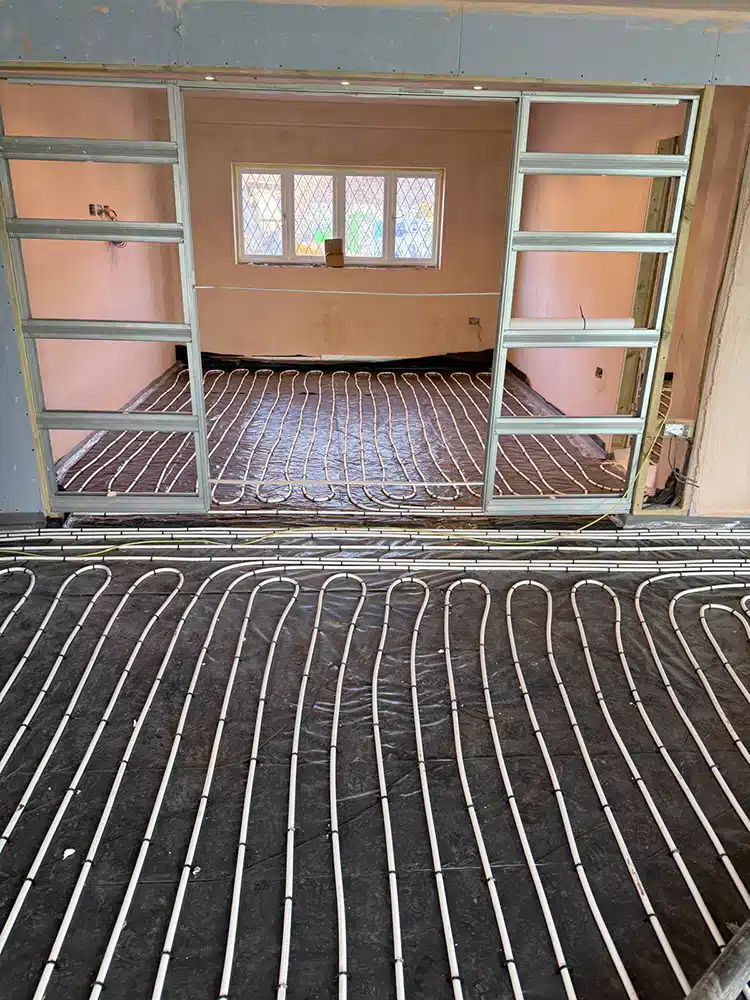
The typical Slough project is a semi from the inter-war years or the 1950s with a new rear extension. The owners want underfloor heating in the new kitchen and family room, and often want it carried into the original rooms too. The extension floor can be designed with the depth it needs, but the old floor was never built for insulation, pipes and screed, and it still has to finish flush with the extension.
That makes pipe cover the key number. With liquid, a minimum of 25mm has to sit over the top of the pipes, which puts the total depth at 45 to 50mm. A traditional sand and cement screed wants about 45mm over them, so the whole build ends up deeper. Where the old part of the house is short of height, liquid usually leaves more room for insulation, and insulation is what stops the heat disappearing into the ground.
A flowing screed also wraps the pipes completely, leaving no voids, so the floor warms faster and more evenly. Sand and cement can work over heating, particularly where a cement base is needed, but it has to be compacted thoroughly around every pipe.
If a small step remains between old and new floors after screeding, levelling compound can close it before tiles or LVT. Our page on liquid screed in Slough explains how the pour is carried out.
Heat-up schedules for newer Slough homes and garden rooms
Newer homes are simpler. Of Slough's homes, 9% were built since 2015, and a new build floor usually has its insulation and depth planned from the start. Insulated garden rooms follow the same logic on a smaller scale, provided the base is level and the build-up is planned before the pipes go down.
New build or old, nobody should switch the heating on straight after the pour. Calcium sulphate screed is normally ready for gentle warmth about 7 days in, while sand and cement needs 21 days as a minimum. Start with the flow temperature turned well down, then raise it in small steps over several days. Cranking it to maximum on day one is how plenty of new floors end up cracked.
We write that warm-up plan down for you, and your heating engineer follows it. The screed must also be dry before flooring goes down, and a careful warm-up is part of getting there; see screed drying times explained.
Heated liquid floors are published at between £20 and £35 per m². The floor screeding cost guide explains what pushes a price up or down.
Underfloor Heating Screed prices in Slough
Liquid screed over underfloor heating: £20 to £35 per m² supplied and laid (trade2base, June 2026), so £700 to £1,230 for 35 m². trade2base gives these figures excluding VAT. See our floor screeding cost guide or screed calculator.
Who lays your underfloor heating screed in Slough
K & B Screeding’s own team, led by director Donatas Bardisevicius. Founded 2019, company 12298780.
See what customers say in our Google reviews and on our testimonials page.
Underfloor Heating Screed across Slough
Our yard is on Lynch Hill Lane in Britwell, in the SL2 part of Slough, so every Slough postcode (SL1, SL3 and SL2) is on our doorstep. The closest towns around it are Windsor (2.1 miles), Maidenhead (5.6 miles), Egham (5.7 miles) and Staines-upon-Thames (6.3 miles).
More on underfloor heating screed, part of our screeding services.
