
Refits at Queensmere, The Curve and Slough Trading Estate
Commercial levelling in Slough falls into two groups. In the town centre, retail and mixed-use spaces at the Queensmere Shopping Centre and around the Heart of Slough schemes, including The Curve, are fitted out and refitted as tenants change. On Slough Trading Estate, older units sit alongside replacement buildings, and floors are prepared again when occupiers change.
In both cases the finish sets the standard. Flatness is judged with a 2m straightedge against BS 8204, which permits gaps of 3mm for SR1, 5mm for SR2 and 10mm for SR3. Thin sheet vinyl and LVT typically need SR1, which older retail and office floors often miss without work.
Most compound goes on between roughly 2mm and 10mm thick, with certain products rated for more. Preparation decides whether it stays down. The base is cleaned of old adhesive, dust and weak material, then primed with the primer suited to it, which differs between concrete, sand and cement, and calcium sulphate. On a trading estate floor with damaged concrete, concrete floor repair or floor preparation such as shot blasting comes first.
Fast drying products are used on refits so the programme keeps moving and the flooring contractor can follow on quickly. Larger floors can be done zone by zone to keep part of a building in use, with each area handed back to the flooring team as soon as it is ready.
Where old meets new in Slough's extended semis
In homes, the most common reason to level is a mismatch. An extension floor is laid new and flat; the original floor next door may have dipped, cracked or been built slightly out of level decades ago. Feathering compound across the join lets new LVT or tiles carry on from kitchen to extension with no step at the threshold.
Houses built between 1973 and 1999 make up 22% of Slough's homes, and their floors often carry old sheet vinyl, tile adhesive or patch repairs. Those layers must come off, and any hollow areas must be cut out and repaired, before compound goes down, or the new floor inherits the old one's faults.
Compound has limits. It is a smoothing layer, and pouring it deep to cure a floor that needs replacing can lead to cracking and debonding. When the dip is too deep for compound or the floor beneath is crumbling, it needs re-screeding with traditional sand and cement in Slough; a sound base that only needs a little height can take a latex screed instead.
How we price floor levelling in Slough
A fixed written price within 24 hours, once we know the area and the base. See our floor screeding cost guide.
Who levels your floor in Slough
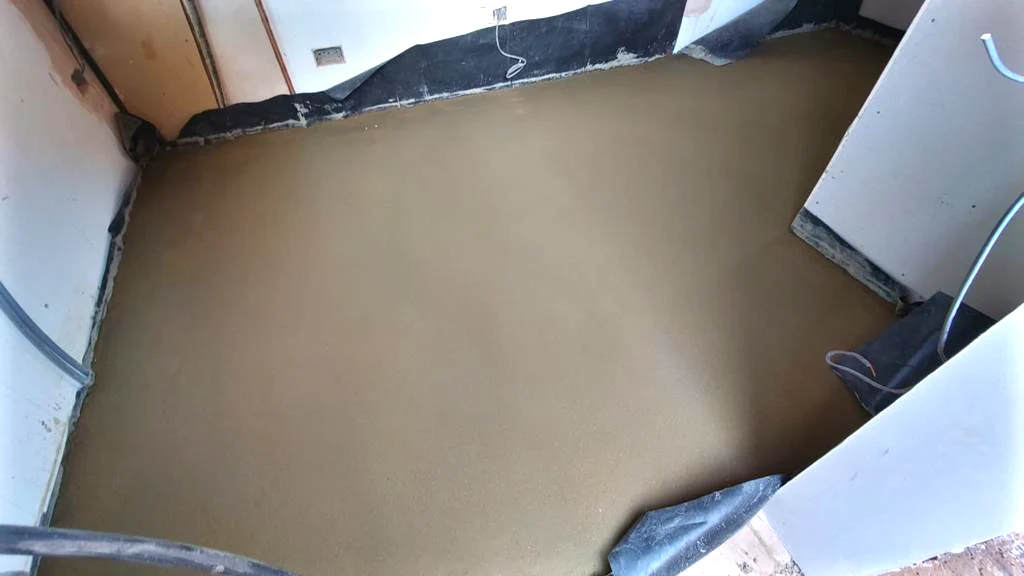
K & B Screeding’s own team, led by director Donatas Bardisevicius. Founded 2019, company 12298780.
See what customers say in our Google reviews and on our testimonials page.
Floor Levelling across Slough
Our yard is on Lynch Hill Lane in Britwell, in the SL2 part of Slough, so every Slough postcode (SL1, SL3 and SL2) is on our doorstep. The closest towns around it are Windsor (2.1 miles), Maidenhead (5.6 miles), Egham (5.7 miles) and Staines-upon-Thames (6.3 miles).
More on floor levelling, part of our screeding services. Not sure whether you need a thin compound or a full flowing screed? See self levelling screed explained.