
Heated extensions in Cox Green, Furze Platt and Pinkneys Green
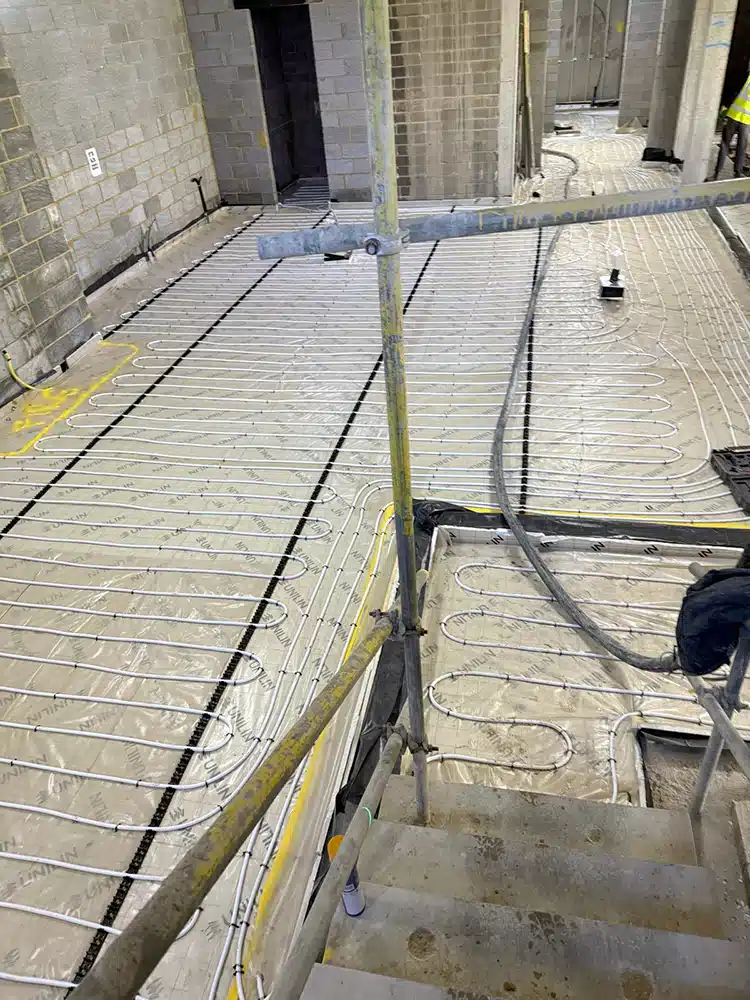
In the suburbs, underfloor heating often comes with extension and kitchen remodel work, and the screed decides how well it performs. Every pipe has to be wrapped completely, with no trapped air, and buried deep enough for the floor to be strong and the warmth to spread evenly.
The figures are specific. With a pumped screed the pipes want a minimum of 25mm on top, and the finished build normally measures 45 to 50mm. Trowelled sand and cement needs closer to 45mm over the same pipes, so that floor ends up thicker. When a Cox Green or Furze Platt extension has to finish flush with the existing house, those extra millimetres can settle which screed to use.
Liquid screed suits heating well. It flows beneath and around every pipe with no voids and gives a faster warm-up. Sand and cement is still used where the room may get wet or the heating installer's specification calls for it. Whichever is chosen, the heating should be designed with the finished floor in mind: the covering, whether tiles, LVT or engineered wood, affects how the system is set up, so share it with both trades early.
Fitting the pipework is not part of our job: your heating engineer puts it in along with the manifold and controls, then pressure tests the system before the screed date. When we arrive we go over the insulation, membrane and perimeter strip, and if you still need those layers we can bring them as part of our insulation and membranes service. For more on the pour itself, read liquid screed for Maidenhead extensions.
Retrofits and first warm-up in older Maidenhead homes
Adding heating to an older Maidenhead house is trickier, since the doors, thresholds and stairs have already fixed how high the floor can be. In the Victorian houses around Boyn Hill, the old ground floor often needs replacing anyway, and that is the moment to add insulation and heating. The thinner build-up of a liquid screed often makes the difference between fitting heating and not.
Newer homes are simpler. 11% of Maidenhead's homes were built in 2015 or later, and a new home may have its floor planned around heating from the start.
Patience after the pour protects the floor. Give a calcium sulphate pour about 7 days before the heating runs at all, and a sand and cement one 21 days or more. From there, bring the temperature up in stages spread over several days. We give your heating engineer clear guidance on the heat-up. Budget-wise, pumped screed over a heated floor is priced from £20 up to £35 per square metre in 2026 UK published figures. Homes in Windsor have their own heated screed page.
Heated screeds in Maidenhead's new town centre apartments
Town centre schemes such as The Landing and Chapel Arches are adding apartments to Maidenhead, and in those buildings acoustic screeds and floating floors are part of the specification. Where the apartments are heated through the floor, the screed has to do three jobs at once: cover the pipes, spread the heat and sit on the acoustic build-up without bridging it.
The order of layers is set by the scheme's design. In many designs an acoustic layer and insulation sit on the structural slab, the heating pipes are clipped above them and the screed floats on top. An edge strip runs round every wall so the screed is kept off the walls and can move as it warms. Before we pour, we check that the membrane is continuous, the edge strip is unbroken and the pipes are pressure tested, because a gap in any of those cannot be fixed once the screed is down.
A pumped liquid screed suits apartment floors, because the hose can run from the pump at street level up to each floor and a flat's open living area goes down in one pour. On a town centre scheme the pump position, delivery times and site access are set by the main contractor, so the pours are planned around their programme.
Each flat is then tested with a hygrometer before its flooring goes down, so a late pour on one floor does not hold up the rest of the building.
Underfloor heating screed prices for Maidenhead floors
Liquid screed over underfloor heating: £20 to £35 per m² supplied and laid (trade2base, June 2026), so £700 to £1,230 for 35 m². trade2base gives these figures excluding VAT. See our liquid screed cost per m² guide, the floor screeding cost guide or the screed calculator.
Who lays your underfloor heating screed in Maidenhead
K & B Screeding, led by director Donatas Bardisevicius. Founded 2019, company 12298780.
See what customers say in our Google reviews and on our testimonials page.
Underfloor heating screed from Slough to Maidenhead
As the crow flies, our base in Slough is about 3.3 miles from Maidenhead, which lies to the west-south-west. Postcodes here include SL6, and Marlow (4.2 miles), Slough (5.6 miles), Windsor (5.6 miles) and Beaconsfield (6.9 miles) are close by.
Where the screed lorry must park in a marked bay in Maidenhead, a suspension or dispensation from the Royal Borough of Windsor and Maidenhead (parking suspensions and dispensations) covers it; the quote tells you if it is needed. The council building control service for Maidenhead is Royal Borough of Windsor and Maidenhead Building Control. A new extension floor usually needs building regulations approval, and Part L covers its insulation in England.
More on underfloor heating screed, part of our floor screeding service. For every screed we lay locally, see floor screeding in Maidenhead.
Further reading: underfloor heating on a concrete floor and screed depth for underfloor heating.