
Floating floors and CA grades at The Landing
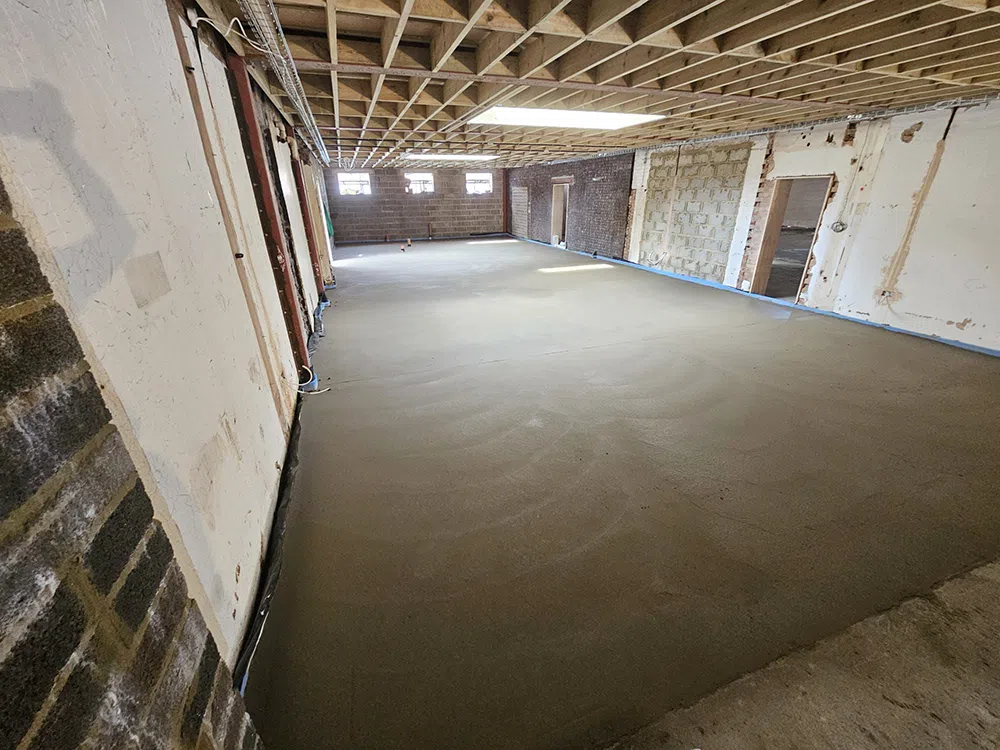
Apartment floors suit calcium sulphate screed well. Because it barely shrinks, big bays can go down with hardly any joints, and the material levels itself into a dense, even layer on top of insulation or an acoustic layer. For a floating floor, that means a continuous slab sitting on the resilient layer below, not touching the walls, with edge strip all round.
The grade comes from the specification. The lowest grade, CA-C20-F4, covers homes where the floor sees only light traffic. CA-C25-F5 sits in the middle and is the default for the bulk of homes, apartments and offices, while CA-C30-F6 takes heavier wear. Read each code as two strengths in N/mm2, compressive after the C and flexural after the F. Whatever grade the drawings give is the grade that goes down.
Alongside these sit alpha hemihydrate products, which earn their place where a programme needs quicker drying or the build-up is shallow. Their depths and drying times are taken from each product's own data sheet, not from the general figures above.
On a scheme of any size, planning the bays comes first. Before pouring we mark out where bays and joints fall, putting joints wherever the specification or the structure needs them, and the build-up underneath is prepared by our own team. On a town centre scheme such as Chapel Arches, send the floor specification with the drawings so the grade and bays are priced together. For background, see anhydrite screed explained.
Finishing anhydrite floors in Maidenhead apartments
A freshly poured apartment floor needs three things done before the flooring contractor can start. The first is laitance. As the screed cures, a fragile crust builds up on top, and it has to be sanded back once the floor is dry. Next comes priming, using a primer made to work on calcium sulphate, before any adhesive or levelling compound touches the sanded surface.
The third is moisture. Covering manufacturers often allow less moisture in calcium sulphate than in cement screed, so each floor gets a hygrometer reading checked against that maker's figure before anything goes down. In heated apartments the pipes can normally force dry it from about 7 days, keeping a block on programme. For heated apartments, underfloor heating screed in Maidenhead covers the pipe cover and warm-up.
Keep it out of wet areas. Bathrooms with level access showers, wet rooms and any floor likely to get wet need a cement based flowing screed instead, which is pumped the same way. We mark those areas on the drawings before pricing. Where a floor needs a thin skim after sanding, floor levelling in Maidenhead covers compound work. We also pour anhydrite flow screed in Slough.
Anhydrite & Flow Screed prices in Maidenhead
Liquid flowing screed (which includes anhydrite): £24 to £31 per m² supplied and laid (MyJobQuote, August 2026), so £960 to £1,240 for 40 m². MyJobQuote does not say whether these figures include VAT. See our floor screeding cost guide or screed calculator.
Who lays your anhydrite and flow screed in Maidenhead
K & B Screeding’s own team, led by director Donatas Bardisevicius. Founded 2019, company 12298780.
See what customers say in our Google reviews and on our testimonials page.
Anhydrite & Flow Screed from Slough to Maidenhead
As the crow flies, our yard in Slough is about 3.3 miles from Maidenhead, which lies to the west-south-west. Postcodes here include SL6, and Marlow (4.2 miles), Slough (5.6 miles), Windsor (5.6 miles) and Beaconsfield (6.9 miles) are close by.
More on anhydrite screed, part of our screeding services.