
Plot screeding to specification in South Wokingham
Plans identify a calcium sulphate screed by a code that comes from the European screed materials standard. The letters CA mark it as calcium sulphate; the number after C gives the compressive strength and the number after F the flexural strength, measured in N/mm2. Lightly used rooms in houses take CA-C20-F4. CA-C25-F5 is what most homes, flats and offices get. Floors that will take heavier wear get CA-C30-F6.
On a housebuilder's plot the grade is fixed by the engineer and written on the drawings. That is the grade we pour, with no swapping in something close. Where a plot needs quicker drying or a slimmer floor, the specification may call for an alpha hemihydrate product, and its own product sheet then sets depth and drying, which we follow.
The material suits new build because it shrinks very little as it sets. Wide bays go down with hardly any joints, letting a whole flat or an open-plan ground floor be poured in a single visit. Any joints that are needed, usually at door thresholds and where heating zones meet, are agreed before pouring.
Purpose-built blocks hold 14% of Wokingham's homes, and flats like these suit this material well. Their floors are open and normally sit on insulation, which is where a screed that barely shrinks and can be laid in wide bays pays off. Our guide to anhydrite screed explained sets out what the designations mean in practice.
Moisture testing anhydrite before Wokingham floors go down
While it dries, calcium sulphate grows a fragile surface layer known as laitance. Before any adhesive or levelling compound is applied, that skin is sanded off, otherwise the new floor is bonded to a crust. The sanded floor is then primed with something designed for calcium sulphate.
Then comes the moisture test. Flooring makers are often stricter on moisture when the base is calcium sulphate, so a reading that passes on sand and cement might still fail here. A hygrometer reading decides it, not the calendar. Heating, if fitted, can usually be put on at about 7 days to help the floor dry.
When owners of new build homes change floor finishes a few years after handover, a sanded, primed anhydrite floor may need a coat of compound for new LVT; our page on levelling floors in Wokingham covers that.
Calcium sulphate is the wrong choice for any floor that could get wet, so walk-in showers and wet rooms need a cement flowing screed. For specified work nearby, see anhydrite flow screed in Reading.
Anhydrite & Flow Screed prices in Wokingham
Liquid flowing screed (which includes anhydrite): £24 to £31 per m² supplied and laid (MyJobQuote, August 2026), so £960 to £1,240 for 40 m². MyJobQuote does not say whether these figures include VAT. See our floor screeding cost guide or screed calculator.
Who lays your anhydrite and flow screed in Wokingham
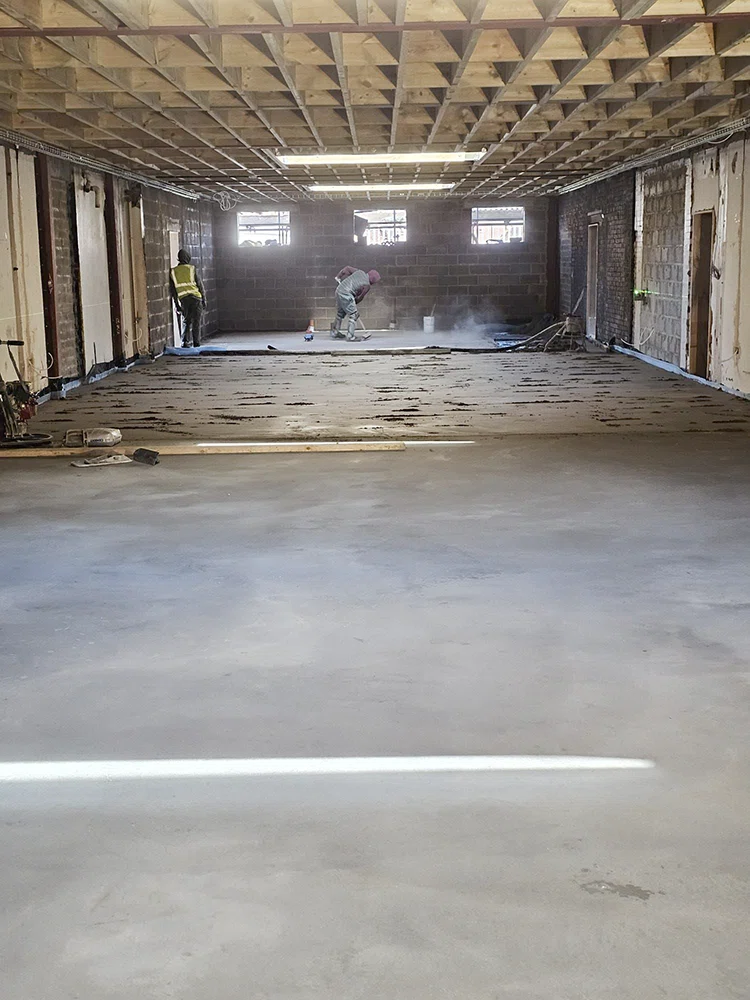
K & B Screeding’s own team, led by director Donatas Bardisevicius. Founded 2019, company 12298780.
See what customers say in our Google reviews and on our testimonials page.
Anhydrite & Flow Screed from Slough to Wokingham
Wokingham is about 11.7 miles south-west of our Slough base as the crow flies, with postcodes including RG40 and RG41. The nearest towns to it are Crowthorne (3.3 miles), Bracknell (3.5 miles), Woodley (4.4 miles) and Sandhurst (4.6 miles).
More on anhydrite screed, part of our screeding services.
