
Choosing an anhydrite grade for a Sandhurst house
Flats are only 10% of Sandhurst's homes, so the typical calcium sulphate floor here is a house floor. That changes the grade conversation. Grades are set by a European standard covering screed materials: the number after C is crushing strength and the number after F is bending strength, both given in N/mm2. A lightly used room in a house can manage on CA-C20-F4, most homes, apartments and offices go with CA-C25-F5, and harder use calls for CA-C30-F6.
For a heated open-plan kitchen and extension, CA-C25-F5 is the natural starting point, but the designer or the specification has the final say, and we pour exactly what is specified.
Alpha hemihydrate products come in where depth is tight or drying time is short. In a knock-through where the old floor leaves limited room above the slab, a thinner section can make heating possible. How thin they can go and how fast they dry varies by product, so we work to the figures each maker publishes.
Low shrinkage means the whole kitchen, dining and extension area can often go down as one bay. Joints are still placed where they are needed, such as between heating zones or across door thresholds, and we set that layout before the pour. In the purpose-built blocks that hold 9% of homes, CA-C25-F5 is the usual grade for apartment floors. For more detail, read anhydrite screed explained.
Before flooring goes down on Sandhurst anhydrite
A calcium sulphate floor is not ready when it looks dry. Three steps come between the pour and the flooring, and each one prevents a common failure.
The laitance comes off first. As the floor dries, a fragile crust gathers on top, and adhesive spread over it cannot be relied on to stay put. Once dry enough, the floor is sanded back to sound screed and cleaned.
The moisture test comes next. Flooring makers often allow calcium sulphate less moisture than cement, so the reading must sit under the figure your chosen floor's maker gives. We take it with a hygrometer. In a heated Sandhurst extension, the system can normally begin force drying around day 7 and cut the wait.
Priming is last. The primer must be one made for calcium sulphate, since the adhesive or levelling compound that follows relies on it.
Water and anhydrite do not mix, so a shower room, or a utility where a washing machine might leak, belongs on cement: either a flowing cement based screed or traditional sand and cement for Sandhurst homes. The same material and specification work applies to anhydrite screed in Bracknell.
Anhydrite & Flow Screed prices in Sandhurst
Liquid flowing screed (which includes anhydrite): £24 to £31 per m² supplied and laid (MyJobQuote, August 2026), so £960 to £1,240 for 40 m². MyJobQuote does not say whether these figures include VAT. See our floor screeding cost guide or screed calculator.
Who lays your anhydrite and flow screed in Sandhurst
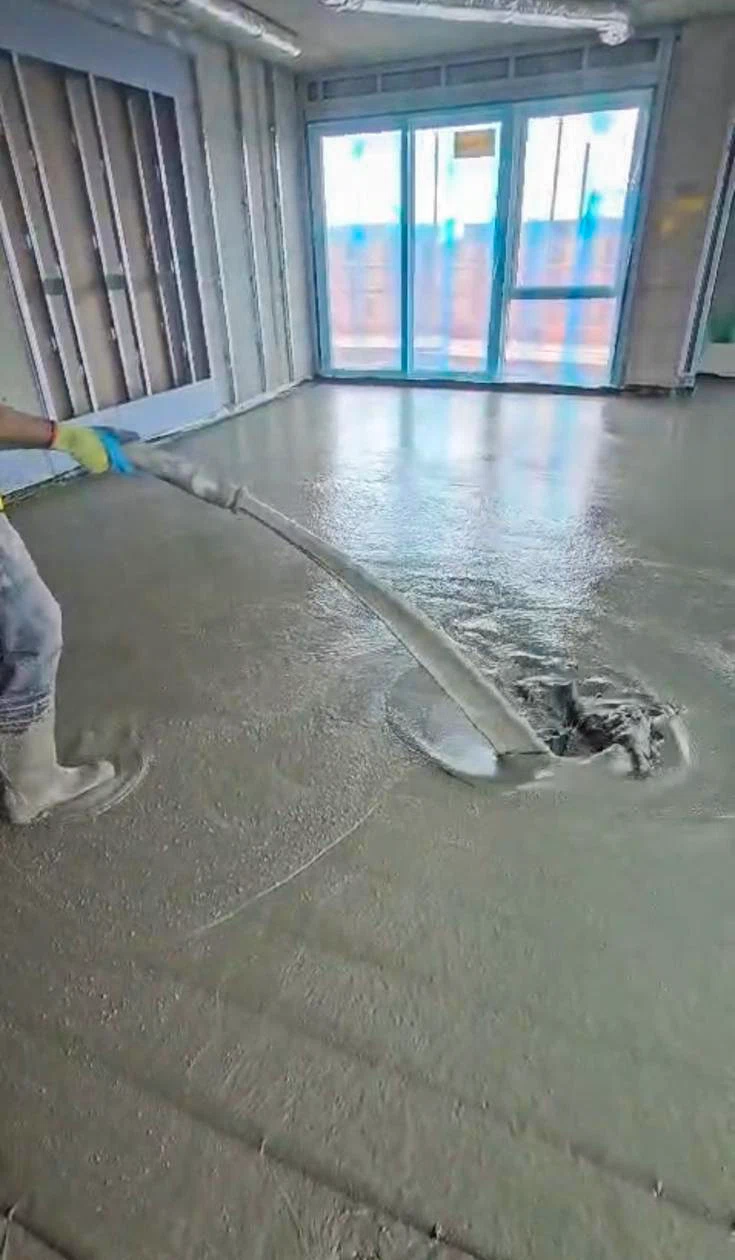
K & B Screeding’s own team, led by director Donatas Bardisevicius. Founded 2019, company 12298780.
See what customers say in our Google reviews and on our testimonials page.
Anhydrite & Flow Screed from Slough to Sandhurst
Sandhurst is about 14.5 miles south-south-west of our Slough base as the crow flies, with postcodes including GU47. The nearest towns to it are Yateley (0.8 miles), Crowthorne (1.6 miles), Camberley (2.6 miles) and Frimley (3.5 miles).
More on anhydrite screed, part of our screeding services.