
Meeting the existing floor in a Sandhurst extension
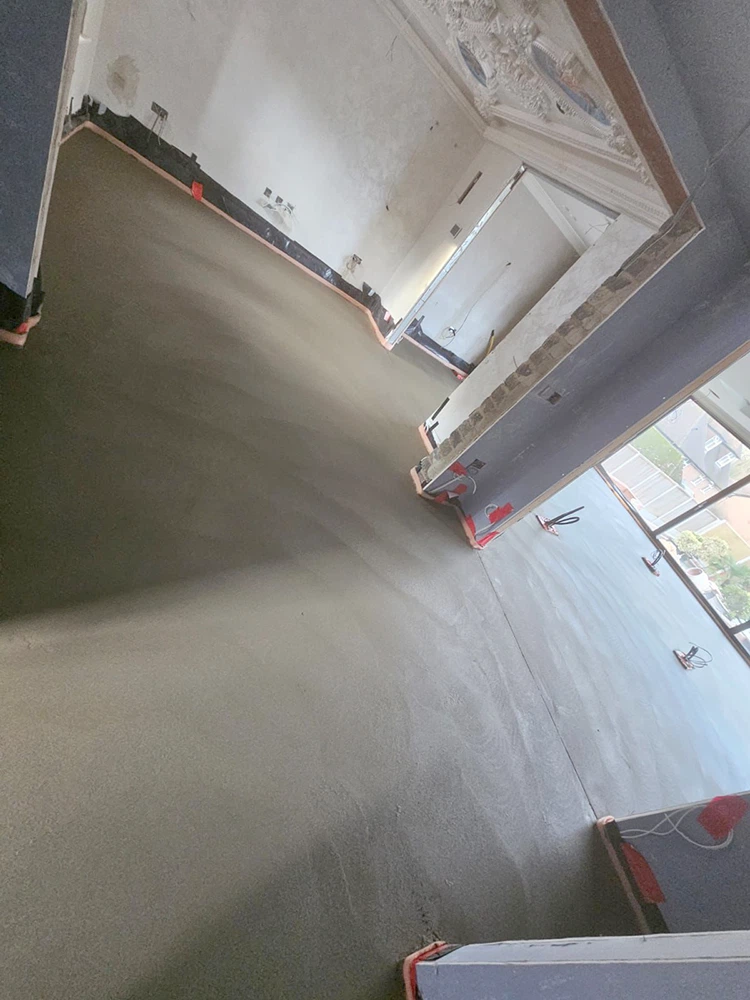
The hardest part of an extension floor is the line where it meets the house. If the new floor finishes a few millimetres high or low, the doorway shows it for ever. A hand-laid sand and cement screed lets the level be taken from the existing floor, with rails or datum points run through from the house, and the screed compacted and ruled off to exactly that height.
The build-up is planned backwards from the finished floor. Flooring thickness comes off first, then the screed depth, then insulation and membrane down to the slab. For a floating domestic floor the sand and cement screed is usually 65mm, and commercial floors take 75mm. Where the slab is too high for insulation and a floating screed, a bonded screed of 25 to 40mm can go directly onto the concrete, and our bonded screed service covers that method.
Sandhurst has few very old houses. Only 6% of its homes were built before 1919 and 4% between the wars, so digging out an old floor with no membrane is a smaller part of the picture here than extension work. Where one of those older houses does need its ground floor rebuilt, sand and cement is still the usual finish, laid over a new membrane and insulation. For the usual depth in each of these situations, see how thick a screed should be.
Wet rooms and garage conversions in Sandhurst homes
Two jobs in any house call for a cement screed. First on the list is the wet room or walk-in shower. Calcium sulphate screed is weakened by water, so the base must be cement, and the falls towards the drain are formed in the screed itself. That gives the tiler a consistent slope rather than asking the adhesive to create one.
Second comes the garage, and Sandhurst's detached and semi-detached houses have plenty of them. Converting one normally means bringing its floor up to match the house, with a membrane and insulation going in under the screed. Our garage conversion guide walks through the build-up.
Sand and cement can also be adapted to the job. Mixing in fibres costs an extra £1 to £3 per m² and keeps cracking in check, while a rapid drying additive brings the flooring date forward.
The trade-off is drying. The first 40mm takes about a day for each millimetre and the remainder longer, so a 65mm extension floor is weeks away from its tiles or wood. Next door, the same work is available as sand and cement screed in Yateley.
Sand and Cement Screed prices in Sandhurst
Sand and cement screed: £18 to £25 per m² supplied and laid (MyJobQuote, August 2026), so £450 to £630 for 25 m². MyJobQuote does not say whether these figures include VAT. See our floor screeding cost guide or screed calculator.
Who lays your sand and cement screed in Sandhurst
K & B Screeding’s own team, led by director Donatas Bardisevicius. Founded 2019, company 12298780.
See what customers say in our Google reviews and on our testimonials page.
Sand and Cement Screed from Slough to Sandhurst
Sandhurst is about 14.5 miles south-south-west of our Slough base as the crow flies, with postcodes including GU47. The nearest towns to it are Yateley (0.8 miles), Crowthorne (1.6 miles), Camberley (2.6 miles) and Frimley (3.5 miles).
More on sand & cement screed, part of our screeding services.
