
Replacing old slabs in Farnborough semis and terraces
Terraces make up 23% of Farnborough's homes, and alongside the semis they carry the bulk of the town's post-war floor work. The pattern is steady: an old slab has cracked, dipped or lost its damp protection, so it is broken out, the ground is dug to the right depth, and a membrane, insulation and new screed are laid in its place.
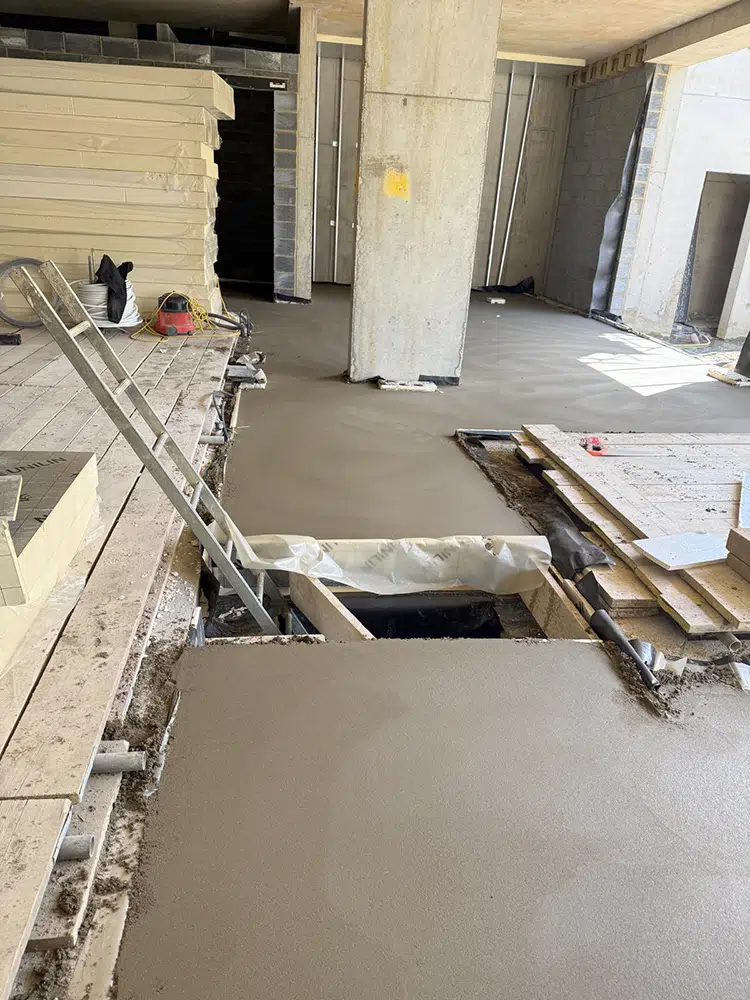
Sand and cement is a practical screed for that job for three reasons. It is mixed in small batches, so a hallway, a back room and a kitchen can be done in stages while the rest of the house stays in use. It is compacted by hand and power floated, so it reaches into corners, under door frames and round awkward shapes. And it leaves a cement surface that tiles and most adhesives take without extra preparation.
Depth is the part to plan early. In a Farnborough house the screed floats on the insulation at 65mm thick. Add the insulation thickness and the membrane, and the dig depth is set by the finished floor level at the existing doors.
Older property is a smaller share: 9% of Farnborough's homes were built before 1919. Floors in houses of that age have often been altered several times, and a failed section is usually easiest to rebuild by hand. If the rest of the floor is sound, repairing the damaged screed may avoid a full replacement. Our screed thickness guide gives the figure for every build-up.
Wet rooms, garages and faster mixes in Farnborough
Water decides the screed in some rooms. A wet room floor has to slope to its drain, which is easy to form by hand in sand and cement. Calcium sulphate should be kept away from floors that may get wet, so bathrooms, utility rooms and shower areas in Farnborough houses normally go in cement.
Garages are similar. Turning a garage into a room means lifting its floor to the level of the house with insulation and screed, and the depth needed is seldom a tidy figure. Laying by hand copes with an awkward depth, and where the slab is sound a 25 to 40mm bonded screed can go directly on top. Screeding a garage conversion runs through the choices.
The main drawback is drying. Most coverings must wait several weeks on a 65mm screed, since it dries at roughly a millimetre a day up to 40mm and slower past that point. Short of time? A quick drying mix costs £20 to £28 per m², a step up from £18 to £25 for the standard one. Fibres, at £1 to £3 per m², reduce the risk of shrinkage cracks. Where a floor needs early strength or will take heavy use, see our higher strength screed option.
Sand and Cement Screed prices in Farnborough
Sand and cement screed: £18 to £25 per m² supplied and laid (MyJobQuote, August 2026), so £450 to £630 for 25 m². MyJobQuote does not say whether these figures include VAT. See our floor screeding cost guide or screed calculator.
Who lays your sand and cement screed in Farnborough
K & B Screeding’s own team, led by director Donatas Bardisevicius. Founded 2019, company 12298780.
See what customers say in our Google reviews and on our testimonials page.
Sand and Cement Screed from Slough to Farnborough
Farnborough is about 17.4 miles south-south-west of our Slough base as the crow flies, with postcodes including GU14 and GU11. The nearest towns to it are Frimley (1.8 miles), Aldershot (2.8 miles), Camberley (3.4 miles) and Fleet (3.9 miles).
More on sand & cement screed, part of our screeding services.