
Traditional screed where Frimley's old and new floors meet
Sand and cement is mixed on site, so the mix and depth can change from one area to the next. That flexibility helps on a Frimley extension, where the new floor may change depth to meet an older slab, run through a knock-through and still finish flush with the existing hallway.
Over insulation, a domestic screed of this kind goes down about 65mm thick, one bay at a time, tamped firm by hand and trowelled flat. Floors from the 1950s to the 1990s often have little or no insulation, so when part of the old ground floor is dug out, adding insulation boards and a membrane under the new screed is sensible.
Where the existing slab is sound and height is tight, a screed bonded straight to it can be 25 to 40mm, saving the depth a floating screed would take. It needs a clean, keyed surface, which our floor preparation service provides by shot blasting.
A cracked or hollow screed found under old tiles is another reason to reach for sand and cement. Loose areas are cut out and relaid, and the patch is finished to meet the sound floor around it; our screed repairs service describes the method.
What it costs you is time. Drying runs at around one day for each millimetre of the first 40mm and slows after that, so a 65mm floor is weeks away from taking its finish; how thick screed should be shows how the depth sets that wait.
Frimley garages, utilities and wet rooms
Garage conversions suit a traditional screed. Garage concrete is normally a step below the house, so the converted room is built up with insulation, a membrane and screed until it lines up with the hall. Each layer is explained in screeding a garage floor.
A wet room, or a shower you walk straight into without a tray, needs its floor sloping down to the drain. A hand-laid mix can be shaped to that slope, and unlike calcium sulphate it copes with getting wet. Tanking goes on once it is dry.
Utilities and workshops often need a floor that takes weight early. Fibres, adding £1 to £3 per m², improve crack resistance, and a fibre reinforced screed is useful where a floor will carry appliances or a workbench.
On cost, published 2026 figures put sand and cement at £18 to £25 per m², and small rooms usually cost more per metre than big ones because setting up takes the same effort. A small job is still cost effective with sand and cement, since there is no pump to bring.
Sand and Cement Screed prices in Frimley
Sand and cement screed: £18 to £25 per m² supplied and laid (MyJobQuote, August 2026), so £450 to £630 for 25 m². MyJobQuote does not say whether these figures include VAT. See our floor screeding cost guide or screed calculator.
Who lays your sand and cement screed in Frimley
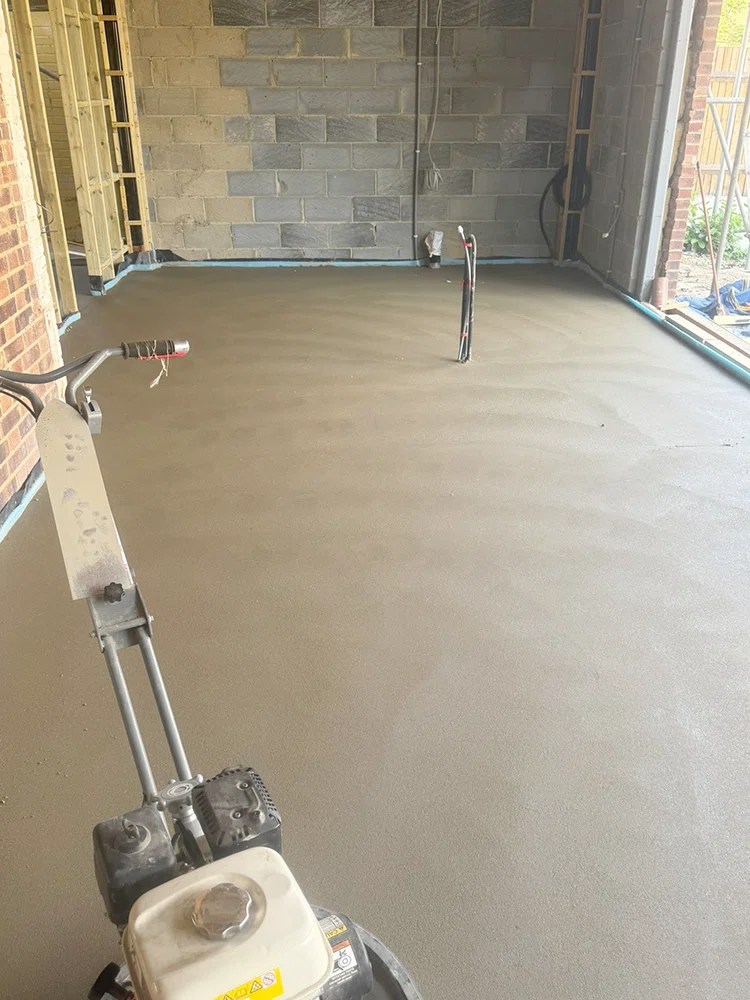
K & B Screeding’s own team, led by director Donatas Bardisevicius. Founded 2019, company 12298780.
See what customers say in our Google reviews and on our testimonials page.
Sand and Cement Screed from Slough to Frimley
As the crow flies, our yard in Slough is about 15.6 miles from Frimley, which lies to the south-south-west. Postcodes here include GU16, and Camberley (1.7 miles), Farnborough (1.8 miles), Sandhurst (3.5 miles) and Yateley (3.8 miles) are close by.
More on sand & cement screed, part of our screeding services.
