
Rebuilding tired solid floors in Camberley houses
Only 8% of Camberley homes were built before 1919, so a floor rebuild here usually means a post-war or later floor rather than a Victorian one. Whatever the age of a house, the signs of a failing solid floor are the same: cracks that keep opening, a hollow sound underfoot, damp at the edges, or a floor that has dropped away from the skirting.
Breaking it out and rebuilding is what lasts. A new build-up normally goes in as a damp proof membrane, insulation and then the screed. On insulation, a house floor needs 65mm of sand and cement, and a commercial one 75mm. If the concrete underneath is sound, bonding the screed straight to it means 25 to 40mm may do, which is handy when a door threshold leaves little height.
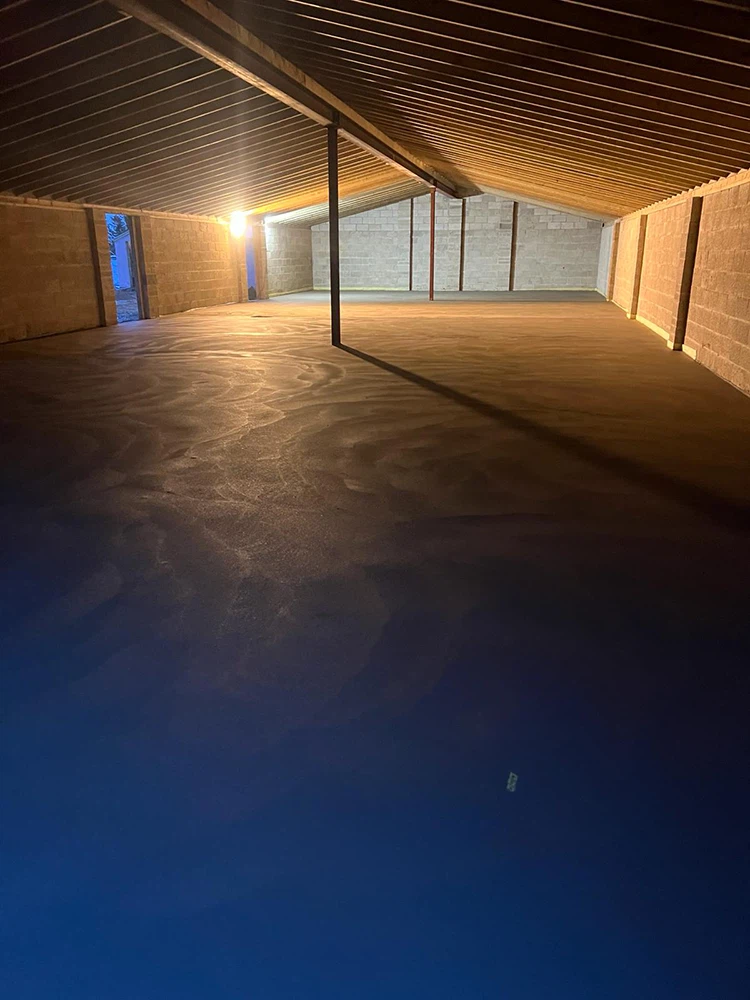
Because it is mixed on site, each batch suits the room it goes into. We tamp it down by hand, then float it until the surface is dense and level. That makes it practical where a pump would be excessive: a hallway, a downstairs toilet, a utility or a single kitchen. It also gives a cement substrate, which some tile and stone adhesives call for, and it can take load early.
It does dry slowly. Count on about a day for each of the first 40 millimetres and more for the rest, which puts a 65mm floor several weeks away from moisture sensitive flooring. There is more on this in how long screed takes to dry.
Garages, wet rooms and small rooms in Camberley
Garage conversions are among the usual projects on Camberley houses built from the 1950s onwards. The garage slab nearly always sits below the house, so the floor is raised with insulation and then screeded to meet the hallway without a step. Sand and cement works well here, because its depth can vary across the room and the surface can be matched to the floor next door. Read screeding a garage conversion for the layers that go into that floor.
Wet rooms and walk-in showers are another job for it. Water must run to the drain, so the screed is trowelled to a slope, something a self-levelling pour will not hold. A cement mix also copes with a wet room, where calcium sulphate would not.
For larger or more demanding floors, fibre reinforced screed adds fibres to the mix for about £1 to £3 per m² more, helping to control cracking. If the kitchen fitter is booked soon, a fast drying sand and cement mix brings the flooring date forward.
If the room in question is a big, open extension rather than a small or awkward space, compare the speed and cost of liquid screed in Camberley before deciding. For compact rooms, hand-laid screed usually wins.
Sand and Cement Screed prices in Camberley
Sand and cement screed: £18 to £25 per m² supplied and laid (MyJobQuote, August 2026), so £450 to £630 for 25 m². MyJobQuote does not say whether these figures include VAT. See our floor screeding cost guide or screed calculator.
Who lays your sand and cement screed in Camberley
K & B Screeding’s own team, led by director Donatas Bardisevicius. Founded 2019, company 12298780.
See what customers say in our Google reviews and on our testimonials page.
Sand and Cement Screed from Slough to Camberley
Camberley is about 14 miles south-south-west of our Slough base as the crow flies, with postcodes including GU15. The nearest towns to it are Frimley (1.7 miles), Sandhurst (2.6 miles), Crowthorne (3 miles) and Yateley (3.2 miles).
More on sand & cement screed, part of our screeding services.
