
Replacing failed original screeds in Yateley remodels
Carpet hides a lot. An original screed can fail underneath it for years without anyone knowing, until the carpet comes up during a remodel. Tap the floor then: if it sounds hollow, the screed has lost its bond with the base or was never properly compacted. Crumbling edges, cracks and dust are further clues. Put tiles or LVT over a floor like that and they could crack or lift.
Putting it right means breaking out the failed screed, cleaning back to the slab, checking the damp proof membrane and laying fresh screed. With the floor open anyway, this is the time to add insulation, which alters the build-up and the depth. With insulation under it as a floating floor, sand and cement is laid about 65mm thick for a house; bonded directly onto sound concrete, it drops to about 25 to 40mm.
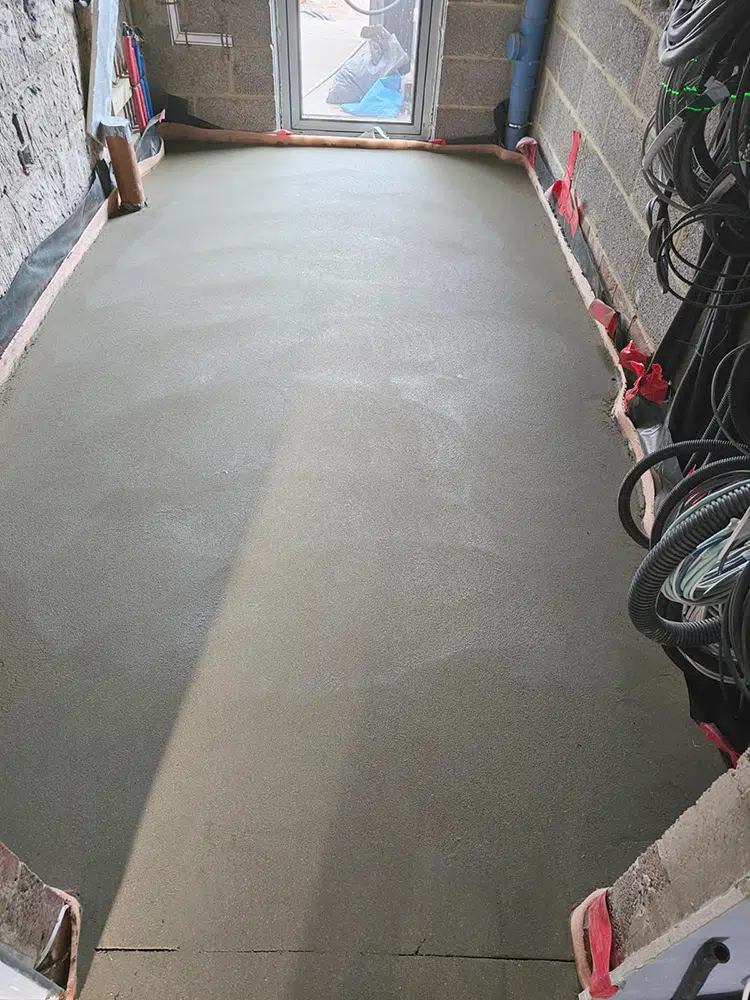
Laying by hand fits this kind of job. Old screed rarely fails evenly, so one room may need more depth than the next, and a hand-laid floor can be adjusted area by area. It also works well in rooms that still connect to the rest of the house, where doorways and thresholds fix the finished height.
The section is often thinner at the line where new floor meets old, and sand and cement with added fibres helps limit cracking there, at about £1 to £3 per m² extra.
The depths for each kind of floor are set out in our screed thickness guide.
Garages, utility rooms and terraces around Yateley
Terraces make up 24% of Yateley's homes, and in a narrow house without side access, setting up a pump can be a nuisance. Wheeling barrows through and mixing the right amount for each room is often the simpler way.
Remodels also throw up small jobs that suit sand and cement: a utility room, a downstairs shower room, a garage turning into a living space. None of them is worth setting up a pump for. In a shower area we can lay the cement screed with a fall to the drain, something a calcium sulphate screed cannot be used for.
Garage conversions bring their own problem, a low, uninsulated slab that must be raised to meet the house floor and satisfy Building Regulations. Sand and cement is also the better pick where a floor has to carry weight early or the finish needs a cement base.
The cost is time. A hand-laid cement floor takes longer to give up its water than a pumped liquid one, about a day per millimetre up to 40mm and slower after, so plan the flooring date around it. Hand-laid screed in Crowthorne is priced on the same basis.
Sand and Cement Screed prices in Yateley
Sand and cement screed: £18 to £25 per m² supplied and laid (MyJobQuote, August 2026), so £450 to £630 for 25 m². MyJobQuote does not say whether these figures include VAT. See our floor screeding cost guide or screed calculator.
Who lays your sand and cement screed in Yateley
K & B Screeding’s own team, led by director Donatas Bardisevicius. Founded 2019, company 12298780.
See what customers say in our Google reviews and on our testimonials page.
Sand and Cement Screed from Slough to Yateley
As the crow flies, our yard in Slough is about 15.2 miles from Yateley, which lies to the south-south-west. Postcodes here include GU46 and GU17, and Sandhurst (0.8 miles), Crowthorne (2.3 miles), Camberley (3.2 miles) and Frimley (3.8 miles) are close by.
More on sand & cement screed, part of our screeding services.