
Rebuilding older floors near Fleet Pond and the Blue Triangle
Fleet has little old housing: 5% of its homes were built before 1919. Even so, older homes near Fleet Pond and in the Blue Triangle can need more preparation before a new floor goes down: an old solid floor taken up, the ground dug to the right depth, and a membrane and insulation laid before any screed.
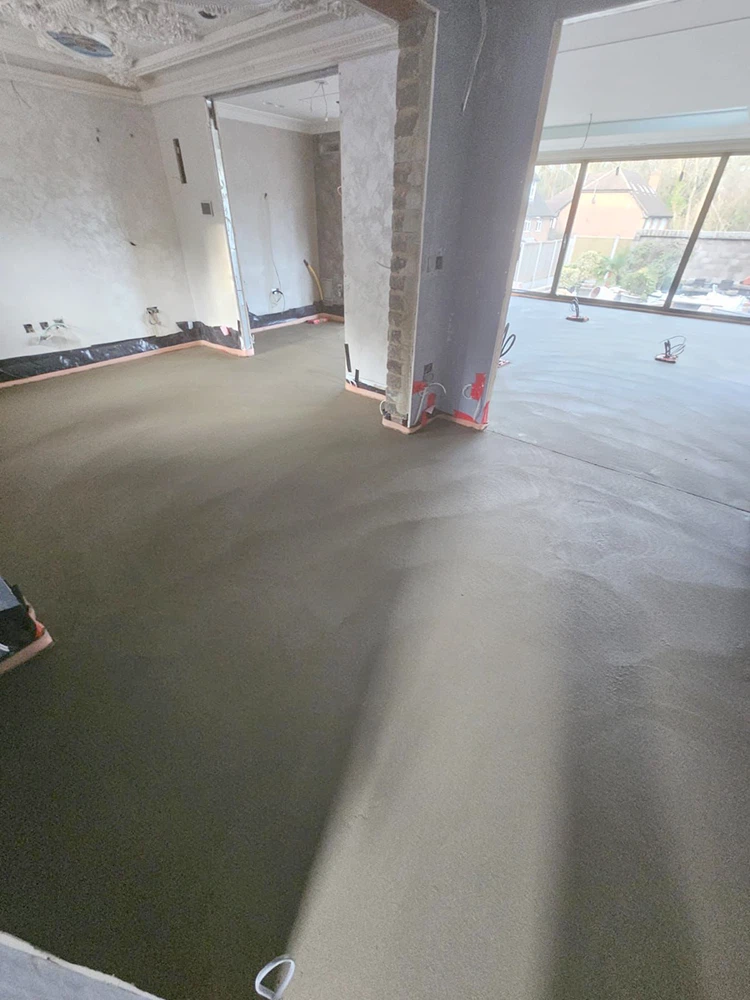
This is the kind of rebuild sand and cement handles well. We mix it in small batches on site, which lets you have one room done at a time. It is compacted by hand and power floated, so it gets into corners and around irregular walls. And it gives a cement surface that suits tiles and wet areas without the extra preparation calcium sulphate needs.
In a house it is floated over insulation at 65mm, and commercial floors take 75mm. That is thicker than a liquid screed, so the dig depth must allow for it and still meet the existing thresholds. If the old floor near Fleet Pond is sound and needs only a thin topping, a bonded screed of 25 to 40mm fixed directly to the slab could do instead.
The post-war decades matter too: 33% of Fleet's homes were built between 1945 and 1972. Houses of that age commonly have original floors with little or no insulation, and any refit that takes the floor up is a chance to add it. Our guide to screed thickness adds up the layers for you.
Wet rooms, garages and drying times in Fleet
Certain rooms in a Fleet house call for cement, whatever screed goes down elsewhere. A wet room floor must slope down to its drain, and the slope is hand-shaped in sand and cement. Calcium sulphate screed is not the choice for areas that may get wet, so a detached house with a liquid screed across the kitchen may still have sand and cement in the shower room and utility.
Converted garages are another place it is often used. Most garage slabs sit lower than the house floor, and insulation plus screed fill the difference. Hand-laid screed can make up an awkward depth where a pump would be more than one room needs. The layers are set out in how to screed a garage floor.
Drying time is the cost of all this. A 65mm floor needs weeks before tiles or wood go down, as the first 40mm alone takes about 40 days and the rest is slower; underfloor heating stays off for 21 days at the least. A quick drying mix costs £20 to £28 per m², set against £18 to £25 for standard, and cuts the wait. If the timetable matters more than the method, compare with liquid screed in Fleet.
Sand and cement on Crookham Park and Edenbrook plots
New build at Hartland Village, Edenbrook and Crookham Park, on the former Queen Elizabeth Barracks, brings apartments and houses where acoustic and heated screeds are commonly part of the specification. Much of that floor area may be poured, but hand-laid sand and cement still has a place on a new plot.
Small areas are the first. A cloakroom, a stair landing, a patch around a service riser or a strip left where a doorway was changed late can all fall outside the main pour. Mixing a small batch on site is more practical than bringing a lorry and pump back for a few square metres.
Acoustic floors are the second. On upper floors in apartment blocks, the designer sets the separating layer and the screed depth, and the screed is laid floating to that detail. The edge strip and the layer turned up at the walls matter as much as the screed itself, because a screed that touches a wall or a pipe at any point can carry sound past the acoustic layer to the flat below. We check that isolation before laying.
Repairs are the third. Where new screed has been damaged by other trades before handover, or cut out for a late service run, a hand-laid patch can be worked into the surrounding floor once the original screed type is known. A calcium sulphate floor is patched with a product suited to it, and our screed repairs page covers both.
Sand and cement screed prices in Fleet
Sand and cement screed: £18 to £25 per m² supplied and laid (MyJobQuote, August 2026), so £450 to £630 for 25 m². MyJobQuote does not say whether these figures include VAT. See our screed cost per m³ and per tonne guide or screed calculator.
Who lays your sand and cement screed in Fleet
K & B Screeding’s own team, led by director Donatas Bardisevicius. Founded 2019, company 12298780.
See what customers say in our Google reviews and on our testimonials page.
Sand and cement screed from Slough to Fleet
As the crow flies, our base in Slough is about 19.4 miles from Fleet, which lies to the south-south-west. Postcodes here include GU51 and GU52, and Farnborough (3.9 miles), Aldershot (4.1 miles), Yateley (4.3 miles) and Sandhurst (4.9 miles) are close by.
Your quote will say whether the screed pump needs road space in Fleet. If it does, a suspension or dispensation can be requested from Hampshire County Council (parking dispensations). An extension floor usually needs building regulations approval (Part L sets the insulation standard in England); the council building control service for Fleet is the Hart and Rushmoor Building Control Partnership.
More on sand & cement screed, part of our screeding services. For every screed we lay locally, see floor screeding in Fleet.
Further reading: screed thickness guide and sand and cement screed mix ratio.