
Underfloor heating in Fleet's larger detached houses
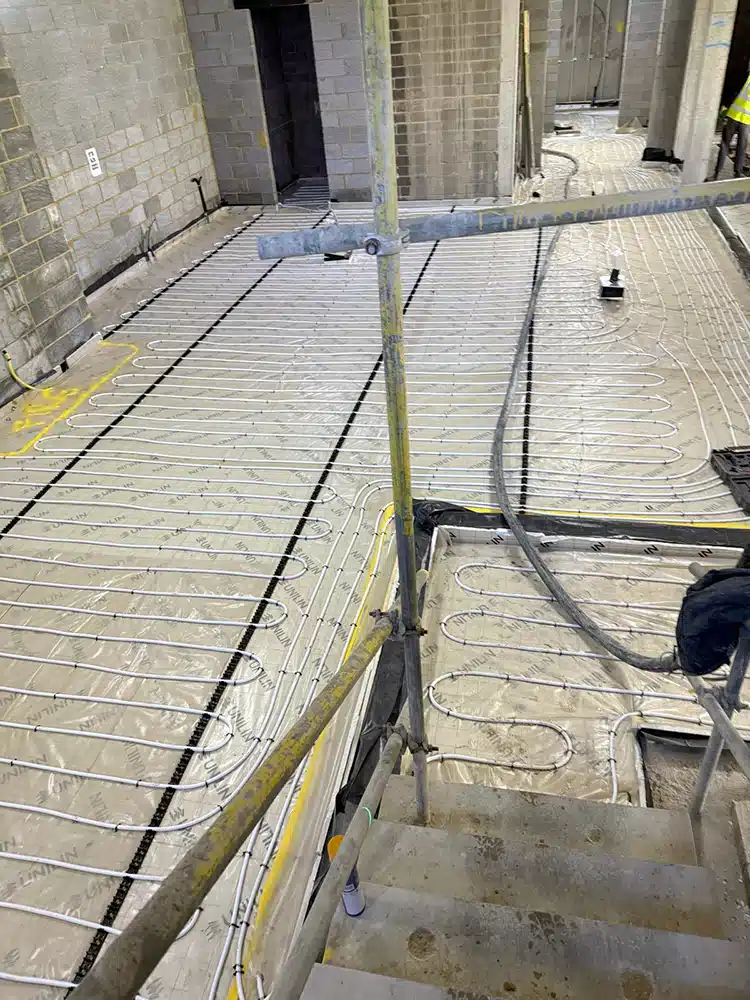
Whole ground floor refits with underfloor heating are a typical Fleet project. The old floor finishes come up, and often the old screed too, so that insulation can go down with the pipes clipped or tracked on top. The new screed then carries the heat into the room above.
Liquid screed is the usual pairing on work like this. Liquid closes round each pipe without trapping air and needs 25mm or more on top, which usually puts the full depth at 45 to 50mm. A thinner screed heats up faster and uses less of the floor height. Sand and cement will also do the job, but with roughly 45mm over the pipes the floor ends up thicker and slower to react.
Height is the constraint in older rooms. The heated floor has to finish level with doorways and any rooms that are not being done, and in a house of the 1970s or 1980s that usually means taking out the existing screed and some of what lies under it. If heating is going into part of the floor only, check the levels before ordering insulation.
Extensions are simpler because the floor is designed from scratch. A heated garden room or kitchen extension can be given the right insulation depth, pipe layout and screed from the start. Our liquid screed page for Fleet covers the pumped floor itself, and the thickness guide gives the figures for each build-up.
Heated screeds at Hartland Village, Edenbrook and Crookham Park
New build is changing the mix. 13% of Fleet's homes were built since 2015, and at Hartland Village, Edenbrook and Crookham Park, apartments and houses commonly include acoustic and heated screeds in the specification. For an apartment, that can mean an acoustic layer, insulation, heating pipes and a floating screed, each laid to the drawings.
Whether new build or refit, commissioning follows the same order. Your installer pressure tests the pipes before we screed and ideally leaves them under pressure throughout, so any damage shows at once. The heating then stays off while the screed gains strength. Gentle heat is usually fine in calcium sulphate once it is about 7 days old, while sand and cement is not ready until 21 days at the earliest. Begin with a low setting and raise it over several days, in the steps the screed maker gives.
Flooring comes after a moisture test, not after a set number of days. Tiles, LVT and engineered wood all need a dry, flat base, and heated floors are less forgiving of shortcuts. Where a Fleet new build specification gives a calcium sulphate grade, the laitance and testing steps are explained on our page about anhydrite flow screed.
Underfloor Heating Screed prices in Fleet
Liquid screed over underfloor heating: £20 to £35 per m² supplied and laid (trade2base, June 2026), so £700 to £1,230 for 35 m². trade2base gives these figures excluding VAT. See our floor screeding cost guide or screed calculator.
Who lays your underfloor heating screed in Fleet
K & B Screeding’s own team, led by director Donatas Bardisevicius. Founded 2019, company 12298780.
See what customers say in our Google reviews and on our testimonials page.
Underfloor Heating Screed from Slough to Fleet
As the crow flies, our yard in Slough is about 19.4 miles from Fleet, which lies to the south-south-west. Postcodes here include GU51 and GU52, and Farnborough (3.9 miles), Aldershot (4.1 miles), Yateley (4.3 miles) and Sandhurst (4.9 miles) are close by.
More on underfloor heating screed, part of our screeding services.