Pipe cover and floor height in Basingstoke extensions
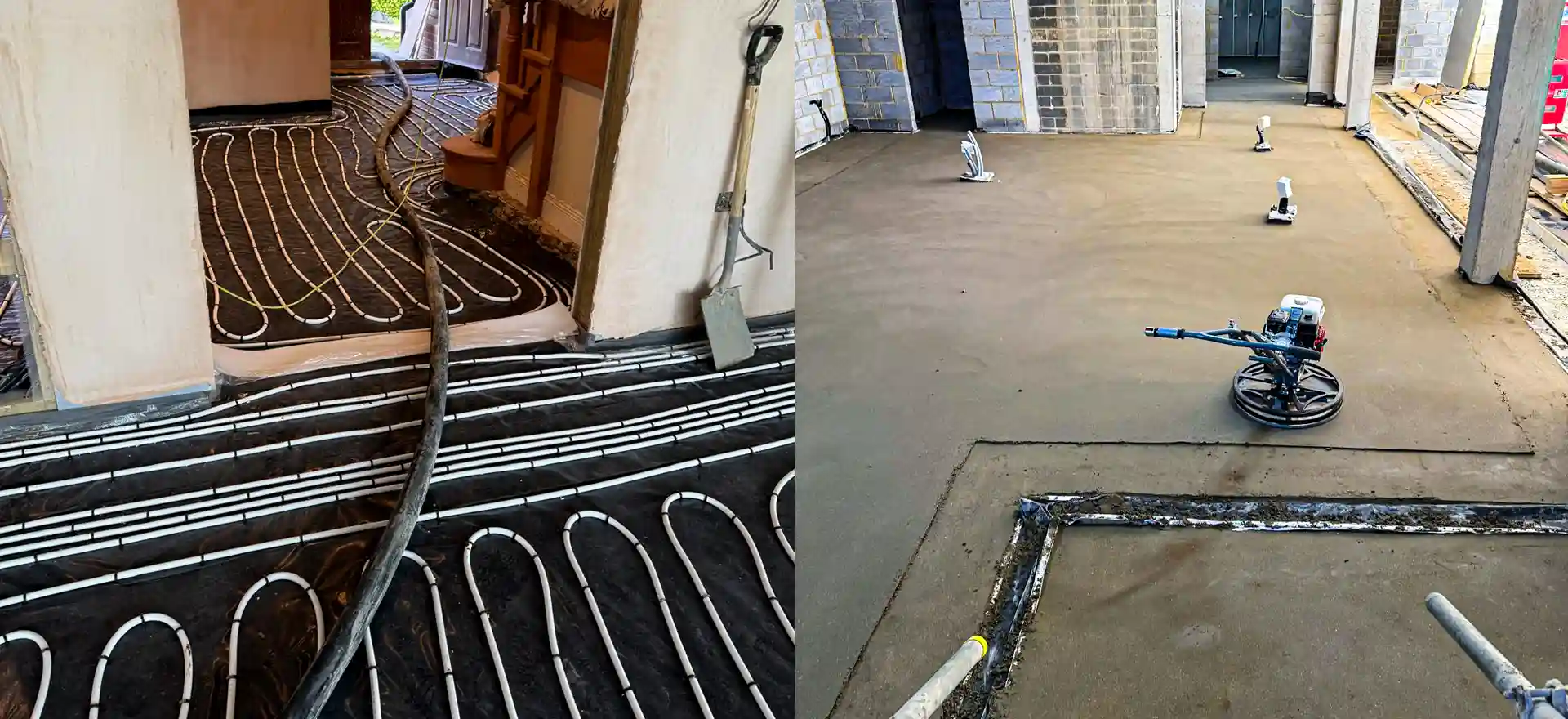
Screed is what turns a mat of plastic pipes into a warm floor. It surrounds the pipes, spreads the heat and gives the flooring a firm base. Too little cover and the floor cracks over the pipe runs; too much and it takes an age to warm up.
Pumped over the pipes, liquid screed must bury them by 25mm or more, so the layer usually finishes 45 to 50mm deep. A hand-laid cement screed needs about 45mm above them, giving a thicker and heavier slab. A liquid pour also flows fully round the pipes with no air pockets, which helps the floor respond faster. For the pumped option, see liquid screed for Basingstoke extensions.
In an extension, height is usually the limiting factor. The insulation, the pipes and the screed together have to finish flush with the existing kitchen or hallway. On a retrofit, where heating is going into an older room and the ceiling or door heads cannot move, every millimetre counts, and the thinner liquid build-up can make the difference.
Before we pour, we check that the insulation is laid tight, the edge strip runs round every wall and the membrane is sealed. If the build-up underneath is not in place yet, our insulation and membranes service can supply it. Of Basingstoke's homes, 18% were built between 2000 and 2014, and their owners are adding heated extensions as well.
Switching the heating on in a Basingstoke home
The heating is part of the drying plan, but it cannot be rushed. With calcium sulphate, gentle warmth is usually allowed from around day 7. A cement screed gets no heat at all until at least 21 days have passed.
The first warm-up should be gradual. The system starts low and is raised a little each day until it reaches working temperature, then held there before it is brought back down. Your heating engineer sets the schedule for the system, and we hand over written guidance on the screed side so both match. Heating a young screed hard on the first day is one of the usual causes of cracking.
Detached houses make up 21% of the town's homes, and their larger extensions and garden rooms often run heating across the whole floor. On those bigger areas a liquid screed keeps joints to a minimum. Where the room includes a shower or utility area, a cement based screed is used there, and our sand and cement screed service in Basingstoke covers that side.
As a budget figure, a liquid screed laid over heating pipes costs between £20 and £35 a square metre on 2026's published UK prices. If you are comparing quotes across north Hampshire, see underfloor heating screed in Fleet.
Heating a new ground floor in Popley or Winklebury
Basingstoke's 1960s expansion was organised as near self-contained districts such as Popley, Brighton Hill, Oakridge, Winklebury and South Ham, and estate terraces from the 1960s and 1970s are the backbone of the town's housing. Their concrete ground floors can now be cracked, uneven or poorly insulated, and replacing one is a natural moment to add underfloor heating.
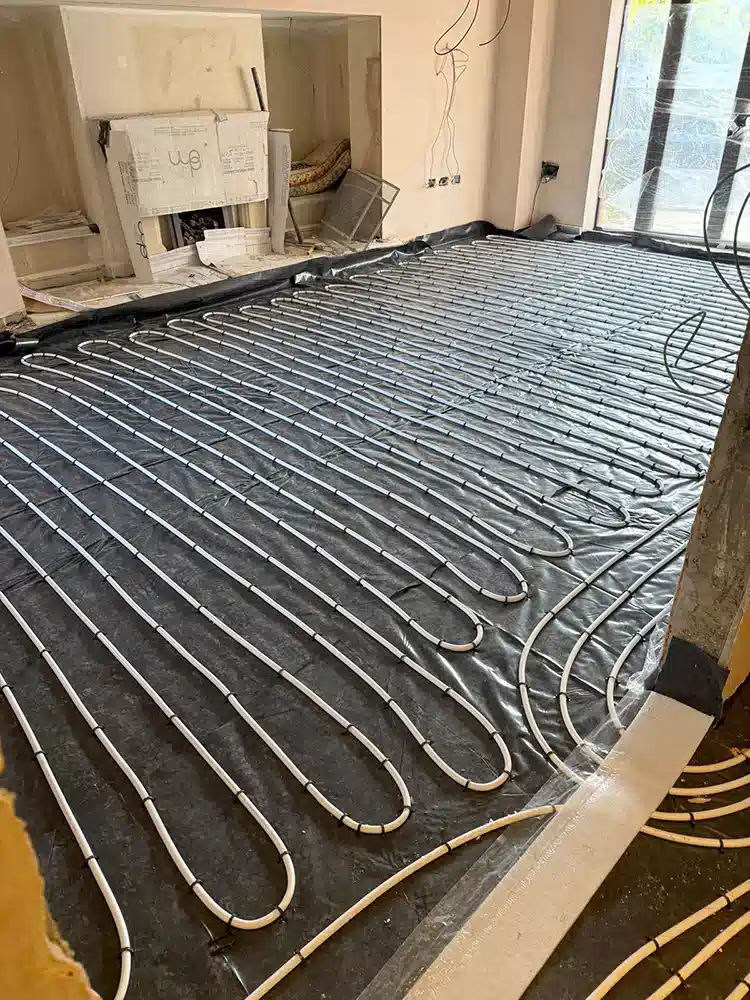
Planning is mostly about sequence. The old slab is broken out and the ground prepared, then insulation goes down, followed by the membrane and edge strip. Your heating engineer lays and pressure tests the pipes, and the screed goes on last. Because the floor is new from the ground up, there is room to choose the insulation depth and screed type rather than squeezing them under an old level.
The screed can differ between rooms. An open kitchen and living area suits a pumped liquid screed, while a cloakroom or shower room is better in a cement screed. The two meet with a joint at the doorway.
Terraces are the most common house type in Basingstoke, at 33% of homes, and a mid terrace has no side access. That shapes the job. A pump can run its hose through the front door and down the hall, but the old concrete has to leave the same way, so the breaking out, the skip and the pour all need planning around one route and one parking space.
Underfloor heating screed prices in Basingstoke
Liquid screed over underfloor heating: £20 to £35 per m² supplied and laid (trade2base, June 2026), so £700 to £1,230 for 35 m². trade2base gives these figures excluding VAT. See our liquid screed cost per m² guide, the floor screeding cost guide or the screed calculator.
Who lays your underfloor heating screed in Basingstoke
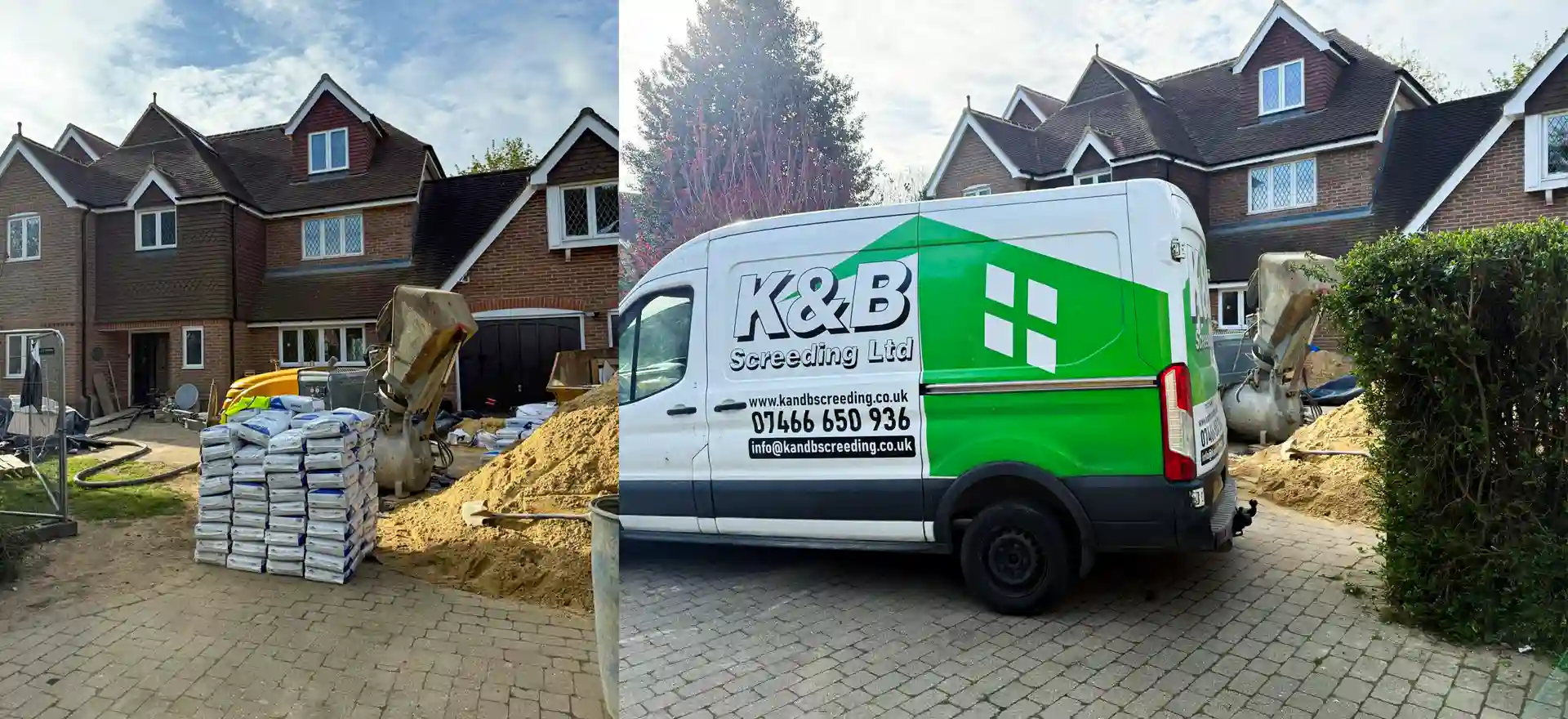
K & B Screeding’s own team, led by director Donatas Bardisevicius. Founded 2019, company 12298780.
See what customers say in our Google reviews and on our testimonials page.
Underfloor heating screed from Slough to Basingstoke
On the map, Basingstoke sits south-west of Slough, about 26.5 miles from our base in a straight line (postcodes including RG21, RG22, RG24 and RG23), next to Tadley (6.7 miles), Alton (9.6 miles), Fleet (10.7 miles) and Thatcham (11.9 miles).
On Basingstoke streets where the screed lorry cannot park off the road, a suspension or dispensation comes from Hampshire County Council (parking dispensations). We confirm on the quote whether it is needed. An extension floor usually needs building regulations approval (Part L sets the insulation standard in England); the council building control service for Basingstoke is Basingstoke and Deane Borough Council Building Control.
More on underfloor heating screed, part of our screeding services. For every screed we lay locally, see floor screeding in Basingstoke.
Further reading: screed thickness guide and underfloor heating on a concrete floor.