
Heating retrofits in Farnham's post-war and later homes
Farnham has a large stock of houses from the second half of the 20th century: 24% of its homes were built between 1945 and 1972, and 21% between 1973 and 1999. Houses of those ages are good candidates for a single storey extension with underfloor heating, and for retrofitting heating into the existing ground floor when it is dug up.
How deep the screed goes depends on the pipework. Pumped liquid has to clear the pipes by 25mm or more, normally giving 45 to 50mm overall, while a hand-laid mix wants about 45mm over the pipes and ends up deeper. On a retrofit where the existing floor level has to be kept, that difference can decide which screed is used.
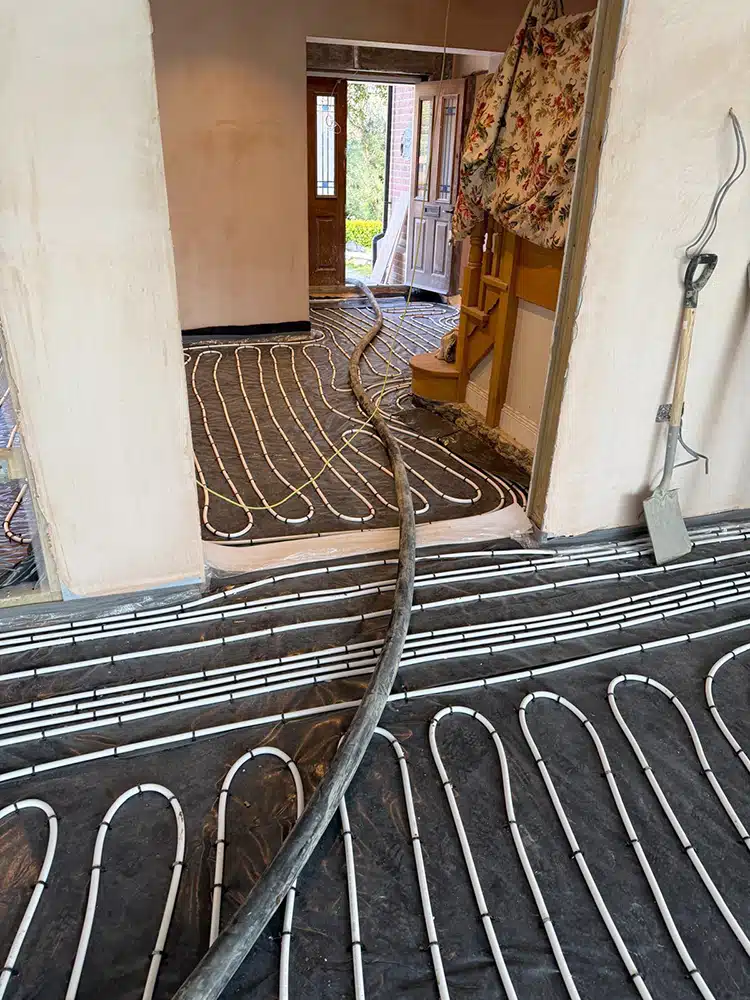
Just as important is that the pipes are fully surrounded. The screed must wrap every pipe with no air pockets, or heat will not spread evenly and the floor above a void can crack. Liquid flows round them of its own accord, whereas a semi-dry mix needs packing in by hand along every run.
Where an extension joins the original house, the heated floor must finish flush with the rooms it opens onto, so we take our levels from the existing floor and avoid a lip at the join. Our liquid screed page for Farnham covers the pumped option, and the screed thickness guide gives typical depths.
Commissioning heated floors in Farnham homes
After the pour, the floor mostly needs leaving alone. On calcium sulphate the heating can normally come on from around day 7, and on sand and cement it stays off for 21 days at the very least.
How the system is commissioned is down to your heating engineer. The heat is raised gradually, a little each day, held at working temperature, then let down slowly. Jumping straight to full heat risks cracking the screed and spoiling whatever floor sits on it.
The heat also helps drying, and a moisture test before flooring confirms the screed is ready.
Before the pour, the build-up is checked: insulation boards tight together, membrane lapped at the edges, edge strip round every wall, and pipes filled and pressure tested. If your builder has not supplied the insulation and membrane, we can, through our insulation and membranes service.
Pipe laying is not part of our work; your heating engineer fixes and tests the circuit, and we pour once that is done. In the larger detached houses, where an open plan kitchen replaces several rooms, a heated floor can run across the whole space, and published 2026 figures put underfloor heating liquid screed at £20 to £35 per m².
Underfloor Heating Screed prices in Farnham
Liquid screed over underfloor heating: £20 to £35 per m² supplied and laid (trade2base, June 2026), so £700 to £1,230 for 35 m². trade2base gives these figures excluding VAT. See our floor screeding cost guide or screed calculator.
Who lays your underfloor heating screed in Farnham
K & B Screeding’s own team, led by director Donatas Bardisevicius. Founded 2019, company 12298780.
See what customers say in our Google reviews and on our testimonials page.
Underfloor Heating Screed from Slough to Farnham
On the map, Farnham sits south-south-west of Slough, about 22.9 miles from our base in a straight line (postcodes including GU9 and GU10), next to Aldershot (2.9 miles), Fleet (4.9 miles), Farnborough (5.6 miles) and Frimley (7.4 miles).
More on underfloor heating screed, part of our screeding services.
