
Calcium sulphate grades on Farnham new builds and flats
A calcium sulphate screed specification is written as a strength code. The number after C tells you the compressive strength, and the number after F the bending (flexural) strength, both in N/mm2. Light domestic floors can take CA-C20-F4, ordinary houses, flats and offices normally take CA-C25-F5, and CA-C30-F6 is there for harder wear. We pour to the grade on the drawings and can advise where none is given.
Purpose-built blocks hold 18% of Farnham's homes, and apartment floors are a typical place for a CA-C25-F5 specification over insulation or acoustic layers. On new build plots the screed usually goes over insulation and heating pipes on a floor designed around it.
Alpha hemihydrate products sit within the same family. Specifiers turn to them when a floor must dry sooner or be poured thinner, and every one is laid to its own data sheet.
Low shrinkage lets calcium sulphate go down in large bays with few joints. Even so, we draw up where the bays and joints will go before pouring, paying most attention to doorways, the edges of heating zones and any line where the screed meets a different base.
It must stay dry in use. Showers, wet rooms and other floors that could get wet get a flowing screed with a cement binder from us instead. The anhydrite screed guide explains the material in more detail, and liquid screed vs sand and cement compares the wider choice.
Finishing an anhydrite floor for Farnham fitters
Calcium sulphate forms laitance, a weak, powdery skin, on its surface as it cures. It must be removed, normally by sanding once the screed is dry enough, and the dust cleared. Adhesives, primers and compounds laid over laitance can fail.
Moisture is tested next. Plenty of flooring makers allow less moisture in calcium sulphate than in cement screed, so a figure that would pass on a sand and cement floor can still fail here. A hygrometer test gives the figure, and the flooring maker's limit decides.
Force drying can help. If there are heating pipes in the floor, they can normally be run from about day 7 to drive the moisture out, in line with the commissioning schedule.
Priming comes last. The primer has to be compatible with calcium sulphate, because some products made for cement do not suit it. If a smoother surface is needed for LVT or vinyl, a compound goes on after priming, as described on our floor levelling page.
At handover you get our drying and laitance notes in writing, which tell your floor layer exactly what has been done. The same specification work applies to anhydrite flow screed in Farnborough.
Anhydrite & Flow Screed prices in Farnham
Liquid flowing screed (which includes anhydrite): £24 to £31 per m² supplied and laid (MyJobQuote, August 2026), so £960 to £1,240 for 40 m². MyJobQuote does not say whether these figures include VAT. See our floor screeding cost guide or screed calculator.
Who lays your anhydrite and flow screed in Farnham
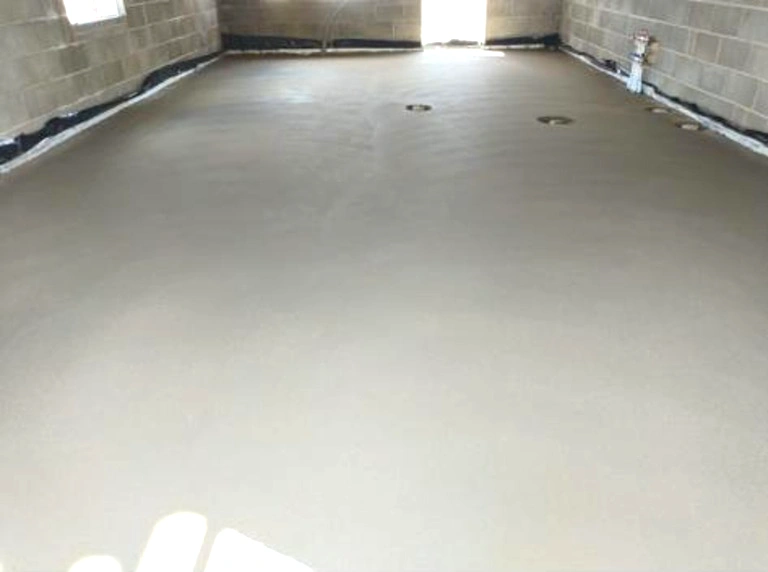
K & B Screeding’s own team, led by director Donatas Bardisevicius. Founded 2019, company 12298780.
See what customers say in our Google reviews and on our testimonials page.
Anhydrite & Flow Screed from Slough to Farnham
On the map, Farnham sits south-south-west of Slough, about 22.9 miles from our base in a straight line (postcodes including GU9 and GU10), next to Aldershot (2.9 miles), Fleet (4.9 miles), Farnborough (5.6 miles) and Frimley (7.4 miles).
More on anhydrite screed, part of our screeding services.
