
Reading an anhydrite specification for a Haslemere project
Look on the drawings for a code beginning CA. Under the European screed standard, its C figure is compressive strength and its F figure flexural strength, both in N/mm2. Light domestic traffic needs no more than CA-C20-F4. Most houses, flats and offices are specified at CA-C25-F5. A floor with heavier use gets CA-C30-F6.
The engineer chooses the grade for a Haslemere block of flats or new plot, and that grade is what we pour. Sometimes an alpha hemihydrate product appears instead, because it dries faster or can be laid at a reduced depth. Its product sheet then sets the thickness and drying, and we work to it.
The reason designers pick calcium sulphate is its behaviour. Very low shrinkage while it sets lets big bays go down with few joints, ideal for an open apartment floor. Doorways and the boundaries between heating zones may still need a joint, and we draw up the bay layout ahead of the pour.
Homes built from 2000 to 2014 make up 9% of Haslemere, and buildings of that sort are more likely to come with a calcium sulphate grade already specified. Older buildings being converted can use it too, once the base is sound, which may call for floor preparation first.
One rule never changes. Prolonged wetting weakens calcium sulphate, so we never use it on a floor that may get wet, and a flowing cement based screed takes its place. Our anhydrite screed guide goes deeper into the material.
Laitance, primers and moisture in Haslemere flats
Hardening is not the same as being ready for flooring. A thin, weak surface skin, the laitance, appears as the screed dries. Adhesive has nothing reliable to hold on to there, so when the floor is dry we sand the laitance away and prime with a product made for calcium sulphate. A cement primer is not a safe substitute. Miss either step and tiles or LVT can come loose months down the line.
Moisture testing comes next. Flooring makers commonly want calcium sulphate drier than they would a cement screed, so the reading has to be taken, not assumed. Where a flat has underfloor heating, switching it on from about 7 days normally helps force dry the screed. It is raised gently and held rather than turned straight to full, and the test still decides the flooring date.
Every floor is handed over with our drying and laitance advice in writing. Where a thin sheet finish needs SR1 flatness, a levelling coat before vinyl or LVT can follow once the screed is sanded, primed and dry.
Anhydrite & Flow Screed prices in Haslemere
Liquid flowing screed (which includes anhydrite): £24 to £31 per m² supplied and laid (MyJobQuote, August 2026), so £960 to £1,240 for 40 m². MyJobQuote does not say whether these figures include VAT. See our floor screeding cost guide or screed calculator.
Who lays your anhydrite and flow screed in Haslemere
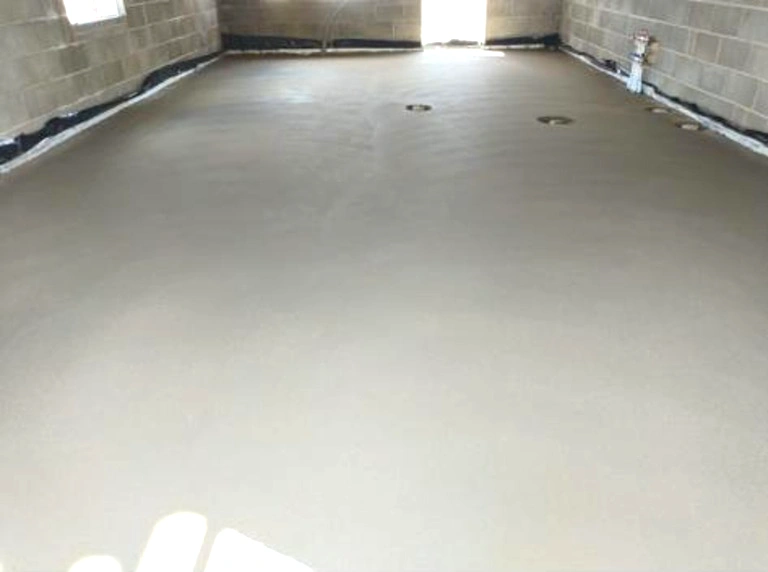
K & B Screeding’s own team, led by director Donatas Bardisevicius. Founded 2019, company 12298780.
See what customers say in our Google reviews and on our testimonials page.
Anhydrite & Flow Screed from Slough to Haslemere
Haslemere is about 30.8 miles south of our Slough base as the crow flies, with postcodes including GU27. The nearest towns to it are Godalming (7.9 miles), Farnham (9.6 miles), Aldershot (11.4 miles) and Petersfield (11.5 miles).
More on anhydrite screed, part of our screeding services.