
What a CA grade means on an Alton specification
What a specification names is the screed's strength. Read CA-C25-F5 as two strengths measured in N/mm2: compressive after the C, flexural after the F. Most specifications use one of three grades. Where a home's floor sees little wear, CA-C20-F4 does the job. The middle grade, CA-C25-F5, suits houses, flats and offices, including the new homes and apartments on the brewery site. Floors that take real punishment are given CA-C30-F6.
Care homes and extra care buildings, like those in the brewery scheme, have corridors that take trolleys, wheelchairs and equipment, so a designer may call for a higher grade than a private house would need. We supply what is specified and raise a query if something looks out of step with the use.
Next to those grades are the alpha hemihydrate products. Specifiers turn to them to dry sooner or lay thinner, and every product has its own sheet for depth and heating.
Where calcium sulphate scores is how little it shrinks. Big bays with few joints are possible, handy in long apartment corridors and open-plan plots, though we still set out bay sizes and joints before pouring, doorways in particular.
Purpose-built flats account for 22% of Alton's homes, and floors in blocks like these suit the material well. For a plain comparison of pumped options, see the Alton liquid screed page; for the background, read anhydrite screed explained.
Sanding, testing and priming anhydrite floors in Alton
Three steps after the pour decide whether the flooring stays put.
First, laitance. Curing leaves a thin, weak crust across the top. When the floor has dried, that crust is sanded away and the dust cleared; skip it and tile adhesive or primer grips the crust and not the screed.
Second, moisture. Flooring makers often allow less moisture in calcium sulphate than in cement based screed, so the floor gets a hygrometer test instead of a guess. Air moving through the room helps, and around day 7 the heating can normally be brought in, slowly, to force dry it.
Third, primer. It has to be one made for calcium sulphate, and cement based adhesives in particular should not go straight onto an unprimed floor.
Where water is expected, such as a wet room, a plant room or a kitchen that is washed down, calcium sulphate is not the right material. A cement based flowing screed offers the same pumped speed without that weakness. If a finished floor still falls short of the flatness the covering needs, floor levelling brings it within SR1 or SR2.
Anhydrite & Flow Screed prices in Alton
Liquid flowing screed (which includes anhydrite): £24 to £31 per m² supplied and laid (MyJobQuote, August 2026), so £960 to £1,240 for 40 m². MyJobQuote does not say whether these figures include VAT. See our floor screeding cost guide or screed calculator.
Who lays your anhydrite and flow screed in Alton
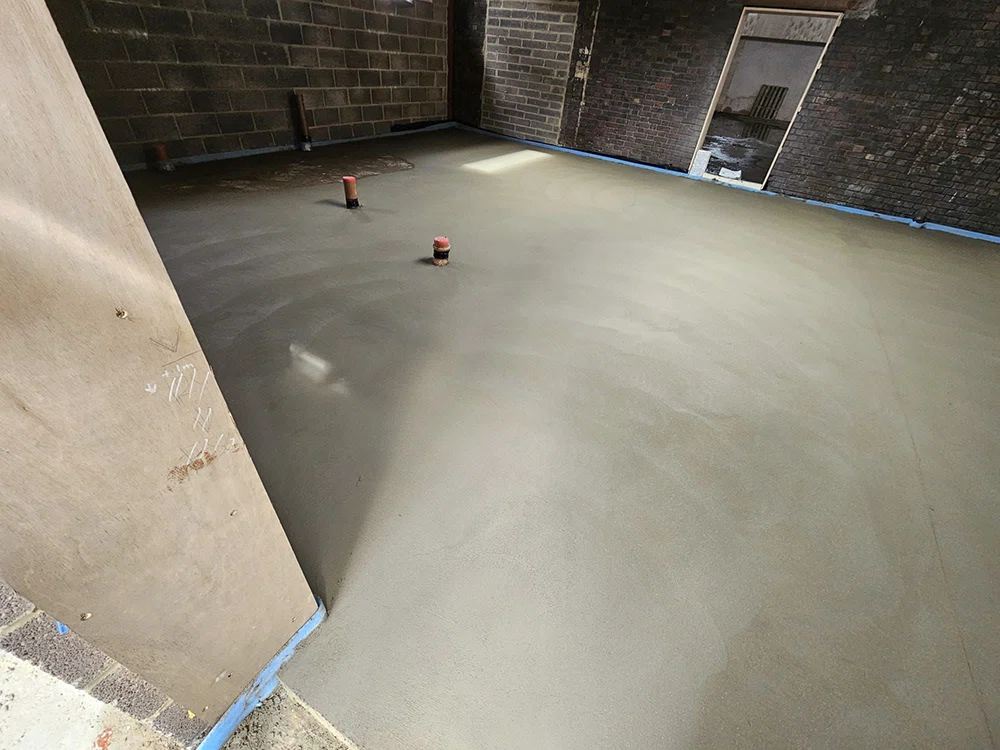
K & B Screeding’s own team, led by director Donatas Bardisevicius. Founded 2019, company 12298780.
See what customers say in our Google reviews and on our testimonials page.
Anhydrite & Flow Screed from Slough to Alton
Alton is about 30.1 miles south-south-west of our Slough base as the crow flies, with postcodes including GU34. The nearest towns to it are Farnham (8.9 miles), Basingstoke (9.6 miles), Petersfield (10.1 miles) and Fleet (10.8 miles).
More on anhydrite screed, part of our screeding services.