
Grades and products for Basingstoke apartment and plot floors
Every anhydrite screed is specified by a grade code from the BS EN standard that covers screed materials. The C number is the compressive strength and the F number the flexural strength, both in N/mm2. Three grades cover most buildings. CA-C20-F4 is for domestic floors with light traffic. CA-C25-F5 suits most homes, apartments and offices. CA-C30-F6 is kept for heavier use.
On a new plot, the grade comes from the engineer or the developer's specification, and we pour what is written. Some specifications name an alpha hemihydrate product instead. Those are chosen where faster drying or a thinner section matters, and they follow their own product sheet for depth and drying, so we work from that sheet rather than general rules.
The material's big advantage is low shrinkage. Calcium sulphate barely moves as it sets, so large bays can be poured with few joints. That is handy wherever a floor runs a long way unbroken, such as an open-plan ground floor or a corridor through a block of flats. If a doorway or a change of heating zone calls for a joint, its line is fixed on the layout before pumping starts.
Only 9% of Basingstoke's homes were built from 2015 onwards, but new building is picking up again, and anhydrite is often the default on heated plots. For how the material behaves over heating pipes, see our underfloor heating screed page for Basingstoke. For background on calcium sulphate itself, read anhydrite screed explained.
Laitance, moisture and primers on Basingstoke anhydrite floors
As an anhydrite screed dries, a thin, weak skin called laitance forms on top. Adhesives and levelling compounds will not hold properly on it, so it must be removed. When the readings allow, we sand it back to firm screed and prime with a product that is compatible with calcium sulphate.
The moisture test is where many programmes slip. A lot of flooring manufacturers allow calcium sulphate less moisture than a cement screed, which is why a surface that looks dry can still fail. We test with a hygrometer and give you the result. If heating is installed, calcium sulphate can usually be force dried with it from about 7 days, which helps on a tight handover.
There is one clear limit. Prolonged moisture weakens calcium sulphate, which rules it out for a wet room, a walk-in shower or a utility floor at risk from leaks. Those areas take a cement based flowing screed, which can go in on the same day.
When the screed is dry, sanded and primed, thin sheet finishes may still need an extra skim for SR1 flatness. Our floor levelling service covers that last step. For flow screed on the Berkshire side, see anhydrite screed in Newbury.
Anhydrite & Flow Screed prices in Basingstoke
Liquid flowing screed (which includes anhydrite): £24 to £31 per m² supplied and laid (MyJobQuote, August 2026), so £960 to £1,240 for 40 m². MyJobQuote does not say whether these figures include VAT. See our floor screeding cost guide or screed calculator.
Who lays your anhydrite and flow screed in Basingstoke
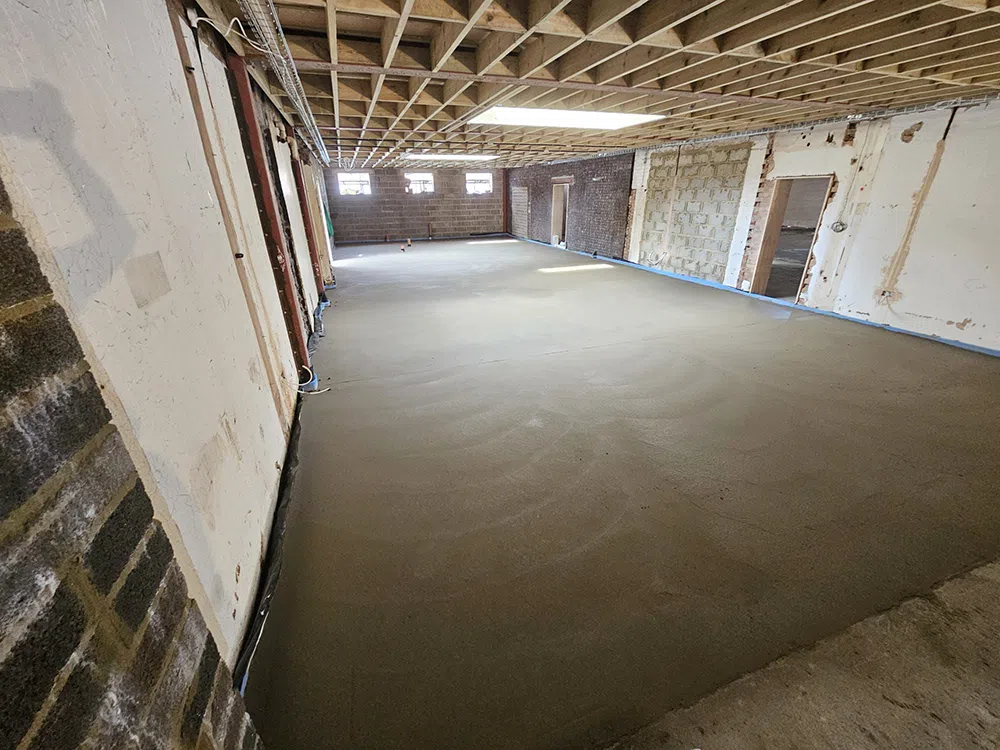
K & B Screeding’s own team, led by director Donatas Bardisevicius. Founded 2019, company 12298780.
See what customers say in our Google reviews and on our testimonials page.
Anhydrite & Flow Screed from Slough to Basingstoke
On the map, Basingstoke sits south-west of Slough, about 26.5 miles from our base in a straight line (postcodes including RG21, RG22, RG24 and RG23), next to Tadley (6.7 miles), Alton (9.6 miles), Fleet (10.7 miles) and Thatcham (11.9 miles).
More on anhydrite screed, part of our screeding services.
