
Reading a calcium sulphate specification for a Tadley build
The grade printed on the drawing is a code set out in the European screed standard. Read it left to right: CA for calcium sulphate, then C, the compressive strength, then F, the flexural strength, both in N/mm2. Lightly used floors in a house are normally CA-C20-F4. The middle grade, CA-C25-F5, fits most homes, flats and offices. Floors that will take heavier wear get CA-C30-F6.
On a Tadley self-build or new plot, the architect or engineer picks the grade, and that is what we pour. Some drawings skip the standard grades altogether in favour of an alpha hemihydrate product. Those go in where the floor must dry quicker or be thinner, and each has its own product sheet for depth, drying and heating, which we follow instead of general figures.
It hardly shrinks while it cures. So the bays can be big and the joints few, which works well across a large open-plan ground floor. Door thresholds and the edges of heating zones still get joints, and we agree the bay and joint plan with you before pour day.
Our own team builds up the layers first and checks everything under the screed, from insulation to membrane to edge strip, so nothing is poured onto an unready base. If calcium sulphate does not suit, we can pump a flowing screed that is cement based instead. For background reading on calcium sulphate as a material, see our anhydrite explainer.
Laitance, primer and moisture before Tadley floors go down
Calcium sulphate needs aftercare that cement screeds do not. While it dries, laitance, a thin weak skin, builds up on the surface. Unless that skin is sanded away before adhesive or compound goes on, the finish sticks to it and can fail. Once it is dry enough, the surface gets sanded back and primed with a calcium sulphate compatible product.
Moisture testing comes next, and it matters more here than with cement. Calcium sulphate often has to be drier than cement before flooring, as many manufacturers set a lower limit for it, so the hygrometer decides, not the calendar. If heating is fitted, running it from about 7 days will usually force dry the screed, using the warm-up on our Tadley heated floor screed page.
The exception is anywhere water could get at it, such as showers you walk into, wet rooms or a utility that might spring a leak, because water can weaken calcium sulphate. Those need a cement based screed; see sand and cement screed in Tadley. The same anhydrite service runs in Reading.
Anhydrite & Flow Screed prices in Tadley
Liquid flowing screed (which includes anhydrite): £24 to £31 per m² supplied and laid (MyJobQuote, August 2026), so £960 to £1,240 for 40 m². MyJobQuote does not say whether these figures include VAT. See our floor screeding cost guide or screed calculator.
Who lays your anhydrite and flow screed in Tadley
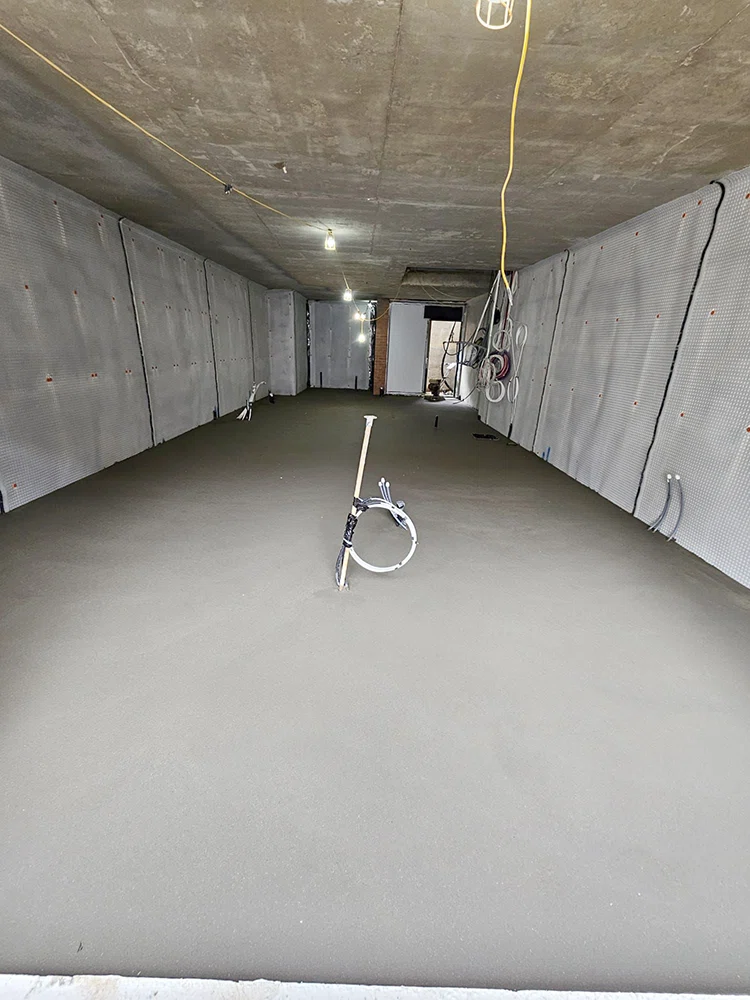
K & B Screeding’s own team, led by director Donatas Bardisevicius. Founded 2019, company 12298780.
See what customers say in our Google reviews and on our testimonials page.
Anhydrite & Flow Screed from Slough to Tadley
On the map, Tadley sits west-south-west of Slough, about 24.9 miles from our base in a straight line (postcodes including RG26), next to Thatcham (5.7 miles), Basingstoke (6.7 miles), Newbury (8.1 miles) and Reading (10.1 miles).
More on anhydrite screed, part of our screeding services.
