
Anhydrite grades for Kennet Island and Green Park Village
Purpose-built flats account for 24% of Reading's homes, and recent growth has come through brownfield villages such as Kennet Island and Green Park Village. Apartment floors of this kind are a common setting for a calcium sulphate specification.
On the drawings, the grade appears as a code from the European screed materials standard. Read the figure after C as compressive strength and the one after F as flexural strength, each in N/mm2. Lightly trodden domestic rooms need only CA-C20-F4, while most houses, flats and offices take CA-C25-F5. CA-C30-F6 is for heavier use, which in a block might mean corridors or communal areas. We pour to the grade the engineer sets.
Alpha hemihydrate products are another option on a specification. Specifiers pick them when drying time or a shallower depth is the priority, such as a converted Reading house with little headroom, and the maker's own data sheet governs them rather than any rule of thumb.
The practical strength of the material is its low shrinkage. A whole apartment floor can go down as one large bay, with joints only where they are needed at door lines or between heating zones, and we plan those before the day. Sound insulation between flats goes in below the screed, as part of our acoustic and thermal insulation work. For background reading, see what anhydrite screed is.
Sanding and testing anhydrite before Reading flats are floored
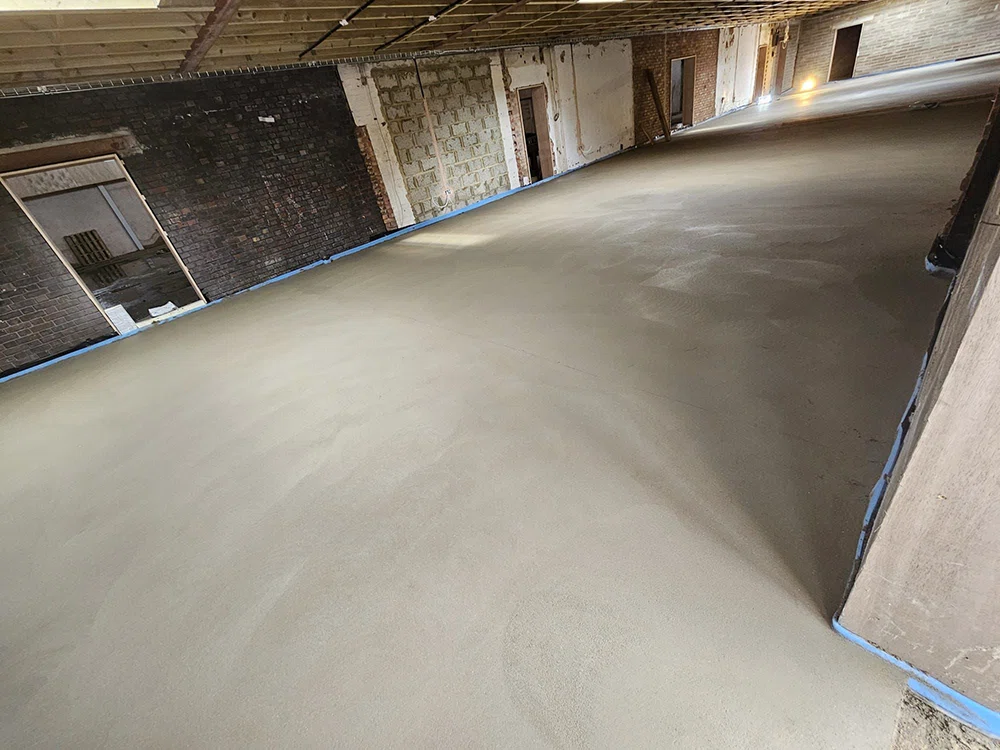
Calcium sulphate needs two steps after the pour that cement screeds do not. Drying throws a soft, crumbly film to the surface, known as laitance. Once the floor is dry enough, that layer is sanded off and the dust removed, because adhesive laid on it can pull away with it.
Then comes the moisture check. Flooring makers frequently allow calcium sulphate less moisture than cement, so our hygrometer reading is judged against the limit for whichever covering you have chosen. Where an apartment floor has heating pipes, the system can normally start force drying from roughly 7 days, which helps when handover is close. The final step is priming, using a product designed for calcium sulphate.
Converted flats, which are 5% of Reading's homes, raise a different question. The existing floor structure has to be assessed before a wet screed goes onto it, and a thinner product may be the answer.
Wet areas are off limits for this material. Bathrooms, shower rooms and plant rooms where water may sit need a cement based flowing screed or sand and cement in Reading. For a project outside the town, see anhydrite screed in Henley-on-Thames.
Anhydrite & Flow Screed prices in Reading
Liquid flowing screed (which includes anhydrite): £24 to £31 per m² supplied and laid (MyJobQuote, August 2026), so £960 to £1,240 for 40 m². MyJobQuote does not say whether these figures include VAT. See our floor screeding cost guide or screed calculator.
Who lays your anhydrite and flow screed in Reading
K & B Screeding’s own team, led by director Donatas Bardisevicius. Founded 2019, company 12298780.
See what customers say in our Google reviews and on our testimonials page.
Anhydrite & Flow Screed from Slough to Reading
As the crow flies, our yard in Slough is about 15.2 miles from Reading, which lies to the west-south-west. Postcodes here include RG1, RG31, RG4 and RG30, and Woodley (2.9 miles), Henley-on-Thames (6.5 miles), Wokingham (6.8 miles) and Crowthorne (9.8 miles) are close by.
More on anhydrite screed, part of our screeding services.
