
Tight tolerances for Green Park and Thames Valley Park refits
Reading's business parks house technology firms such as Microsoft and Oracle, and office refurbishments there set exacting targets for the floor. A raised floor, carpet tile or sheet finish needs a base that is flat to a stated class, and an old slab that has been through several fit-outs rarely is.
BS 8204 sets the test: a 2m straightedge laid across the slab. For SR1 the biggest gap beneath it is 3mm, for SR2 it is 5mm, and SR3 tolerates 10mm. Thin sheet coverings in an office refit usually need the floor at SR1 before they can be laid. We survey the floor, mark the high and low areas, and decide whether compound alone will bring it into class.
Retail is similar but faster. A shop fit-out near The Oracle may have days, not weeks, between strip-out and flooring. Fast drying compounds keep that programme intact, and we plan the work in zones where part of the space has to stay open.
Preparation decides the result. Paint, old glue and anything loose is stripped away first. Primer depends on what lies beneath: concrete takes one kind, and sand and cement, calcium sulphate or an old tiled surface each take their own. Laid from about 2mm to around 10mm, the compound then flows to a smooth finish. Where a slab is breaking up, concrete floor grinding or screed repairs come before any levelling.
Levelling older and newer floors in Reading homes
Reading built about 23% of its present housing in the years 1945 to 1972. Floors that old have settled and been patched, and when a new extension is added, the two floors rarely meet cleanly. A feathered layer of compound across the join removes the lip at the doorway, so one floor finish can run from the old kitchen into the new room.
Newer houses can need work too. Homes built since 2000 make up 20% of the total, and even a sound modern floor may not be smooth enough for a new LVT or large tile. A skim of compound over a primed surface closes the gap without disturbing the screed below.
There is a point where compound is the wrong answer. Pile compound on thick to disguise a floor that really wants a new screed and it is liable to crack and come loose. A floor that sounds hollow, shows damp, or has dips beyond roughly 10mm spread across large areas needs new screed instead, and replacing a floor in sand and cement covers how that works. If you only need a few millimetres on a solid base, latex screeding is worth a look too.
How we price floor levelling in Reading
A fixed written price within 24 hours, once we know the area and the base. See our floor screeding cost guide.
Who levels your floor in Reading
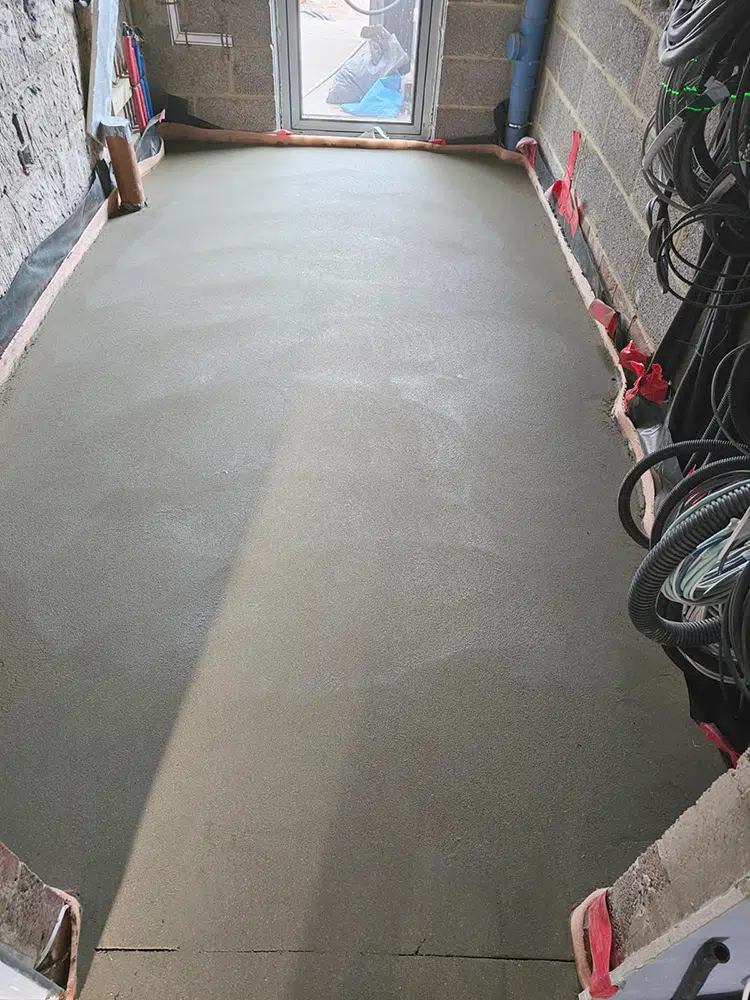
K & B Screeding’s own team, led by director Donatas Bardisevicius. Founded 2019, company 12298780.
See what customers say in our Google reviews and on our testimonials page.
Floor Levelling from Slough to Reading
As the crow flies, our yard in Slough is about 15.2 miles from Reading, which lies to the west-south-west. Postcodes here include RG1, RG31, RG4 and RG30, and Woodley (2.9 miles), Henley-on-Thames (6.5 miles), Wokingham (6.8 miles) and Crowthorne (9.8 miles) are close by.
More on floor levelling, part of our screeding services. Not sure whether you need a thin compound or a full flowing screed? See self levelling screed explained.
