
Levelling old and new floors across Henley-on-Thames
Thin flooring shows every dip. LVT, sheet vinyl and large tiles want a flat base underneath, and plenty of thin sheet products ask for SR1: a 2m straightedge laid on the floor may show 3mm of gap at most. SR2 allows 5mm and SR3 allows 10mm, which is fine under carpet but too rough for most hard finishes. Measuring the floor against those classes is the first thing we do.
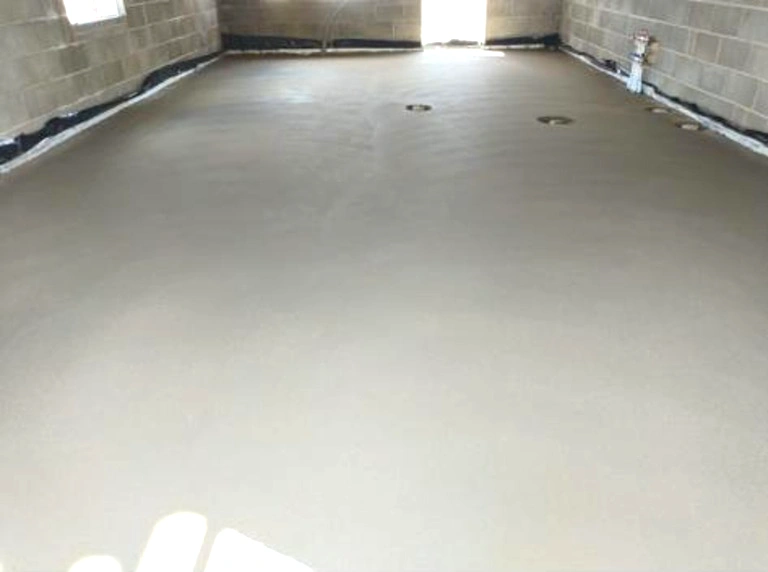
Levelling compound is poured and spread to fill the low spots and leave a smooth surface. Typical depths run from 2mm or so to about 10mm, though certain products can be built up thicker. It dries far faster than a screed, so flooring can often follow within days.
Homes of every era in the town end up needing it. 22% of Henley-on-Thames homes are semi-detached and 19% were built between 1973 and 1999, and houses like these tend to gain a kitchen extension whose new floor meets an older concrete slab at the doorway. The compound can feather out the step and carry one level surface across both.
The oldest solid floors are a different case. Around Market Place and Friday Street many floors were laid without a membrane, and levelling over a damp or crumbling floor only hides the problem. Where the base is failing, a new screed is the honest answer; see sand and cement screed for Henley period homes.
When a Henley-on-Thames floor needs more than compound
A floor that is way off level will not be put right by compound. Pouring it thick to dodge a proper screed tends to end in cracking and the compound coming away from the base. If a straightedge shows dips well beyond the compound's range, or the floor is loose, hollow or crumbling, we will say so and price the right fix instead.
Priming is where many levelling jobs go wrong. The primer has to suit the base: dense concrete, an older sand and cement screed, a calcium sulphate screed with its laitance removed, or an existing tiled floor each needs a different approach. Anything loose, old glue and any contamination must be cleared beforehand, and grinding or cleaning of that kind is part of our preparation work on floors.
For a solid base that needs just a few millimetres, latex levelling screed also does the job. For the cost side of levelling and screeding, the floor screeding cost guide sets out published figures. This service is not wood floor sanding, and we do not give advice on DIY products.
How we price floor levelling in Henley-on-Thames
A fixed written price within 24 hours, once we know the area and the base. See our floor screeding cost guide.
Who levels your floor in Henley-on-Thames
K & B Screeding’s own team, led by director Donatas Bardisevicius. Founded 2019, company 12298780.
See what customers say in our Google reviews and on our testimonials page.
Floor Levelling from Slough to Henley-on-Thames
On the map, Henley-on-Thames sits west of Slough, about 11.2 miles from our base in a straight line (postcodes including RG9), next to Woodley (5.8 miles), Marlow (6 miles), Reading (6.5 miles) and Maidenhead (8 miles).
More on floor levelling, part of our screeding services. Not sure whether you need a thin compound or a full flowing screed? See self levelling screed explained.
