
Rebuilding old solid floors near Henley's Market Place
29% of homes in Henley-on-Thames are terraced, and older terraces and cottages stand in the streets around Market Place, Bell Street and Friday Street. When a solid floor in one of those houses cracks, sinks or turns damp, patching it seldom lasts. The usual answer is to break it out, dig down to the right level, and rebuild the floor in layers: hardcore where needed, a damp proof membrane, insulation, then a floating screed on top.
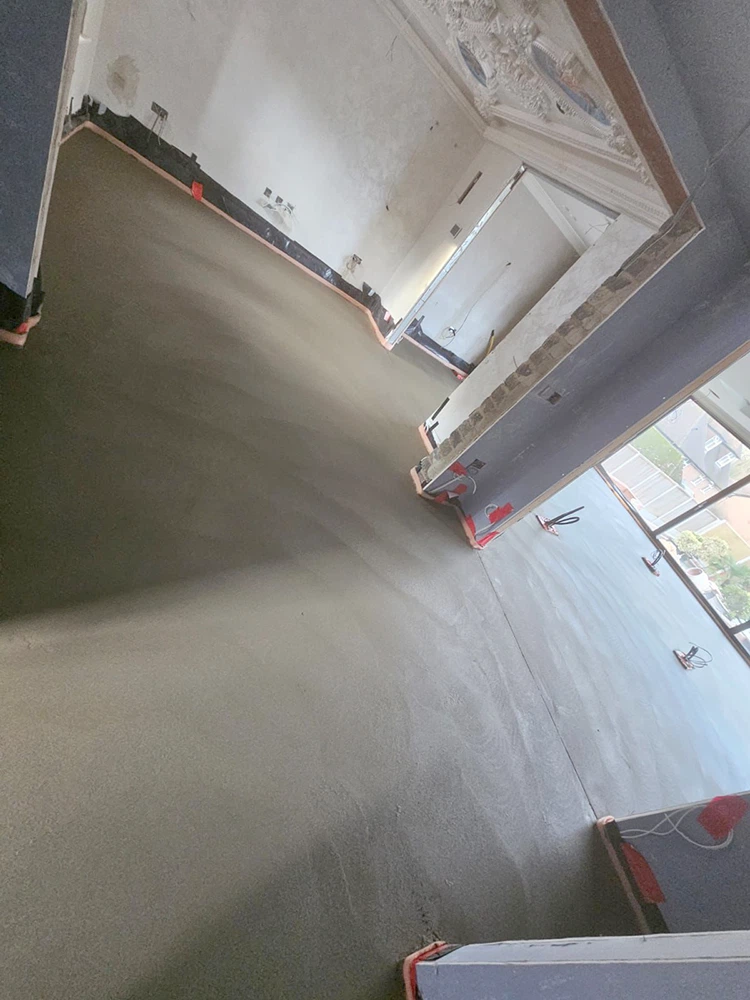
In a house, that floating screed is laid at about 65mm; commercial floors take about 75mm. The depth is worked backwards from the finished floor height, so the new surface meets the thresholds, hearths and staircase that are already there. Stone flags and solid timber boards both need a firm, flat base, and a well compacted sand and cement screed provides it.
Sand and cement is the practical choice for this work because it is mixed to suit each area and depth, and it is placed by hand into small rooms, alcoves and corridors where a pump brings little benefit. It also works in bathrooms and wet rooms, where it can be laid to a fall towards the drain. Calcium sulphate screeds are not suited to areas that stay wet.
If the old floor is sound but uneven, a full rebuild may not be needed, and levelling the existing floor can be enough. Where a cracked concrete slab underneath can be saved, our concrete floor repair service deals with it first.
Garages, wet rooms and bonded screeds in Henley-on-Thames
Plenty of Henley sand and cement work has nothing to do with old cottages. A garage conversion needs the floor raised to meet the house, usually with insulation and a membrane under a new floating screed, while a garage that stays a garage may only need a harder wearing topping. Our garage floor screed guide covers the height and insulation questions.
The difference between bonded and floating matters. A bonded screed is fixed directly to a prepared concrete base at about 25 to 40mm, and suits a sound slab that just needs a new surface. A floating screed sits on insulation or a membrane and has to be thicker, at about 65mm in a house, because it carries loads on its own.
Drying is the slow part. Count on about one day for every millimetre of the first 40mm and longer for each one after, which is why a 65mm floor keeps the timber or vinyl waiting for weeks, not days. Plan the floor fitter with that in mind. If the fitter is booked and time is short, a quick drying screed with rapid drying additives in the mix cuts the wait, and fibres go in when a floor needs to resist cracking better. Only a hygrometer reading shows for certain that it is ready.
Sand and Cement Screed prices in Henley-on-Thames
Sand and cement screed: £18 to £25 per m² supplied and laid (MyJobQuote, August 2026), so £450 to £630 for 25 m². MyJobQuote does not say whether these figures include VAT. See our floor screeding cost guide or screed calculator.
Who lays your sand and cement screed in Henley-on-Thames
K & B Screeding’s own team, led by director Donatas Bardisevicius. Founded 2019, company 12298780.
See what customers say in our Google reviews and on our testimonials page.
Sand and Cement Screed from Slough to Henley-on-Thames
On the map, Henley-on-Thames sits west of Slough, about 11.2 miles from our base in a straight line (postcodes including RG9), next to Woodley (5.8 miles), Marlow (6 miles), Reading (6.5 miles) and Maidenhead (8 miles).
More on sand & cement screed, part of our screeding services.
