
Rebuilding floors in Didcot's older houses
The older part of Didcot, with its inter-war and post-war houses, has floors that have been down for many decades. Homes of that age often have a solid ground floor with an original screed that has worn, cracked or lost its bond, and sometimes no effective damp proof membrane beneath it.
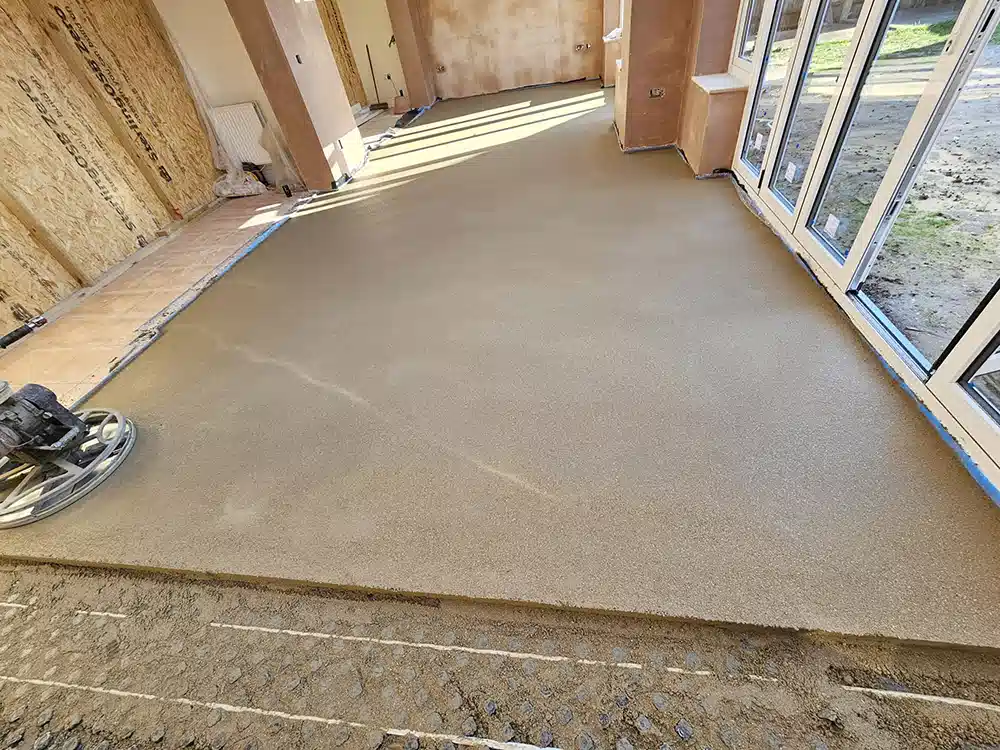
When a floor like that is taken up, the rebuild follows a pattern. The old screed and any failed slab are broken out. New hardcore, a membrane and insulation go in where the height allows. A sand and cement screed then goes on top, compacted and finished flat by hand.
Depth is the key decision. Floating on insulation, the screed goes down 65mm thick in a house, or 75mm in a commercial building. If height is tight, bonding it straight onto solid concrete lets it be as thin as 25 to 40mm.
Pre-1919 houses are rare here, at 2% of the stock, but where they exist the same rebuild applies.
Hand-laid screed has other advantages in these homes. Small rooms and hallways with several doors are easier to lay by hand than to dam for a pour. A wet room floor has to slope to its drain, and cement can be laid to that slope. It also suits a floor that has to carry weight soon, a garage conversion being the obvious case.
If you want the floor dry sooner, quick drying screed uses the same method with additives that shorten the wait.
Great Western Park repairs and Southmead workshop floors
Newer floors can fail too. At Great Western Park, repairs to screed that has cracked or come loose are a common reason to call a screeder. Sometimes the problem is local, around a doorway or over a service run, and a section can be cut out and relaid. Sometimes the screed has lost its bond across a wider area and sounds hollow when tapped, and more of it needs replacing. Our screed repairs service covers both.
If the repair is in a heated room, the new section has to cover the pipes properly. A cement repair needs roughly 45mm above the pipes, and the system then stays off for 21 days or more. Read more on heated floors in Didcot.
Southmead Industrial Estate has hosted motorsport firms. Workshop units used for that kind of work take vehicle loads, jacks and heavy equipment. A dense sand and cement screed, sometimes a higher strength mix, is the usual base for that kind of use.
Drying needs planning. Expect around a day per mm through the first 40mm and slower drying after, which puts a 65mm floor several weeks away from taking finishes that dislike moisture.
The 2026 published UK range for this screed is £18 to £25 per m². The floor screeding cost guide explains what affects the final figure.
Sand and Cement Screed prices in Didcot
Sand and cement screed: £18 to £25 per m² supplied and laid (MyJobQuote, August 2026), so £450 to £630 for 25 m². MyJobQuote does not say whether these figures include VAT. See our floor screeding cost guide or screed calculator.
Who lays your sand and cement screed in Didcot
K & B Screeding’s own team, led by director Donatas Bardisevicius. Founded 2019, company 12298780.
See what customers say in our Google reviews and on our testimonials page.
Sand and Cement Screed from Slough to Didcot
On the map, Didcot sits west of Slough, about 26.2 miles from our base in a straight line (postcodes including OX11), next to Abingdon-on-Thames (4.7 miles), Wantage (8 miles), Oxford (10.1 miles) and Thatcham (14.1 miles).
More on sand & cement screed, part of our screeding services.
