
Where pumped liquid screed suits Didcot homes
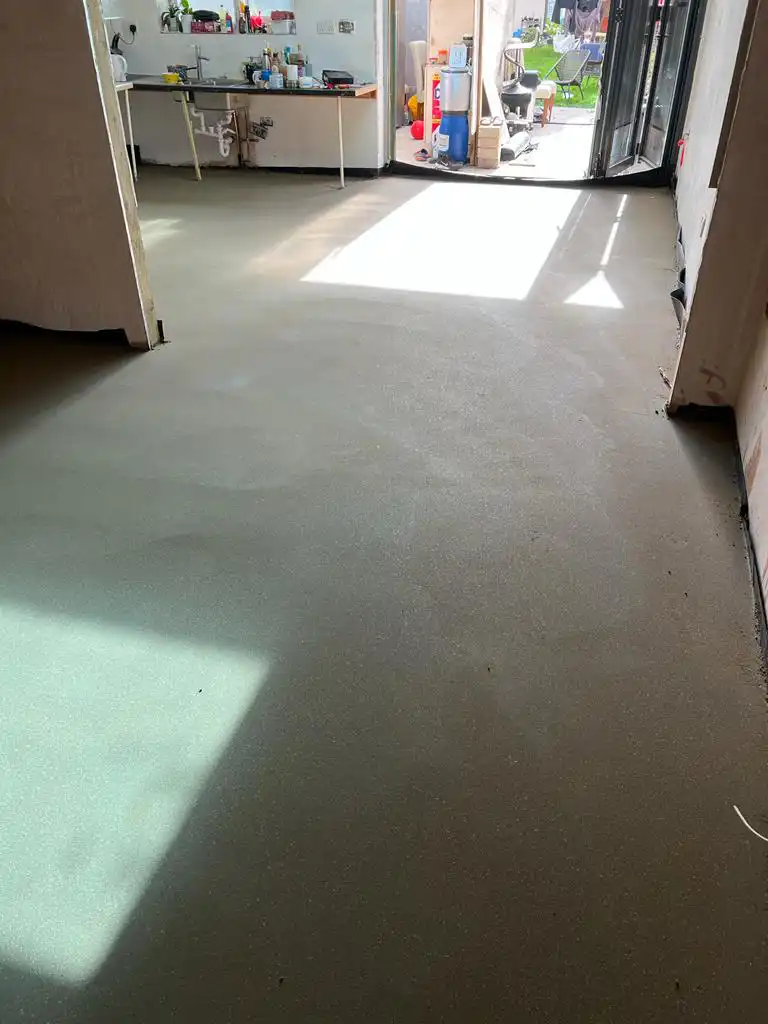
The case for liquid screed is strongest when the floor is big, open and needs to be flat. Replacing a conservatory in Ladygrove with a solid extension, and knocking the kitchen through into it, creates exactly that kind of floor. A pumped screed flows across the whole space, around corners and into recesses, and settles to a level surface that readily meets SR1 or SR2.
That flatness matters for what comes next. Large format tiles, LVT and engineered wood all need a regular surface beneath them, and a screed that arrives flat saves time and compound later.
It barely shrinks, so a wide kitchen-diner gets by with a lot fewer joints than hand-laid screed. Where joints are needed, such as across a doorway between the old house and the extension, they are planned before the pour.
Flats make up 14% of Didcot's homes. An upper floor is a good candidate for liquid screed, because the hose carries the material up and the floor weighs less than a thick traditional one.
Liquid screeds come in two broad types: calcium sulphate, which suits dry rooms and heating, and cement based flowing screeds for areas that may get wet. Drawings quoting a calcium sulphate grade are explained, along with sanding and testing, on our page about anhydrite grades for Didcot floors.
Liquid screed does not suit everything. Wet rooms with falls and very small rooms are usually quicker and better done by hand.
Pumping into Didcot terraces, flats and back gardens
Every pour depends on getting the hose from the pump to the room. We park the pump on your drive or by the kerb, then feed the hose through the hallway, across a side gate or up the stairs. A semi-detached house with off-road parking makes that straightforward. For a terraced house with no side access, or a flat several floors up, we check the route before the day. The kit and how it is set up are described under pumping screed to the room.
Inside, the room is prepared first: insulation laid flat, an edge strip fixed around every wall, a membrane taped at the joins, and doorways dammed. The depth is marked across the floor, and the screed is pumped to that level.
Over the next couple of days, keep the door closed and stop draughts or heaters playing on the new surface. Standing on it is fine from 24 to 48 hours, though it will still be holding moisture. Reckon on roughly a day per mm over the first 40mm, slowing beyond that, and test the moisture before any flooring goes on.
As for cost, published UK rates in 2026 run from £24 to £31 per m². Nearby, we also offer liquid screed in Abingdon-on-Thames.
Liquid Screed prices in Didcot
Liquid screed: £24 to £31 per m² supplied and laid (MyJobQuote, August 2026), so £960 to £1,240 for 40 m². MyJobQuote does not say whether these figures include VAT. See our floor screeding cost guide or screed calculator.
Who lays your liquid screed in Didcot
K & B Screeding’s own team, led by director Donatas Bardisevicius. Founded 2019, company 12298780.
See what customers say in our Google reviews and on our testimonials page.
Liquid Screed from Slough to Didcot
On the map, Didcot sits west of Slough, about 26.2 miles from our base in a straight line (postcodes including OX11), next to Abingdon-on-Thames (4.7 miles), Wantage (8 miles), Oxford (10.1 miles) and Thatcham (14.1 miles).
More on liquid screed, part of our screeding services.