
Matching new floors to newer Carterton houses
A house built in the last decade or two usually has a finished floor level that the builder set precisely, with a known build-up of insulation, screed and flooring. When an extension is added, the new floor has to arrive at the same height so the two rooms join without a step or a ramp. Liquid screed makes that easier than most options. It is poured to a set depth using level markers, then flows out flat, so the final height is controlled across the whole floor rather than trowelled in by eye.
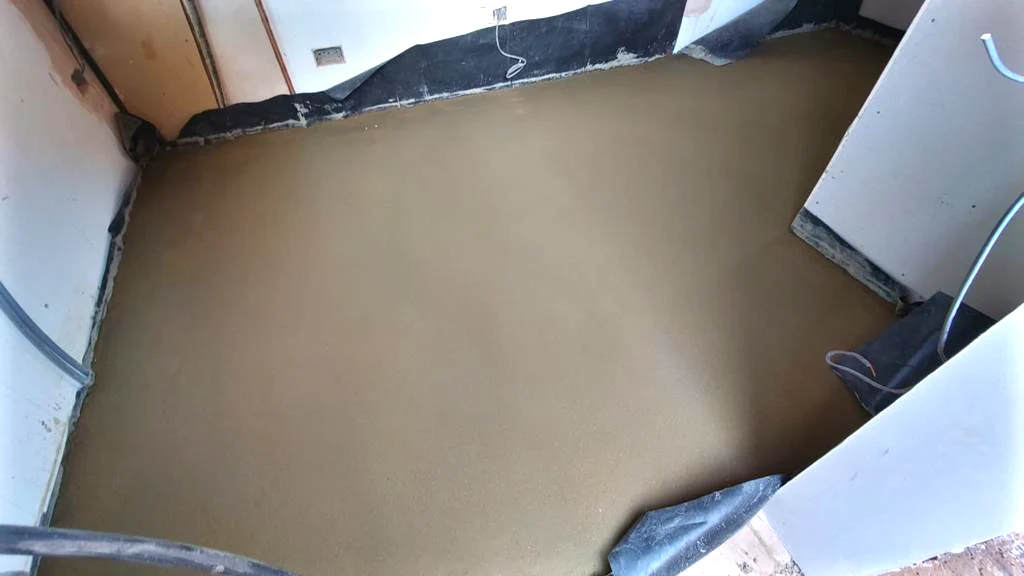
The floor that results is dense and even. SR1 or SR2 surface regularity is readily achievable, which suits the LVT, large tiles and engineered boards common in open-plan kitchens. Shrinkage is low too, which means a big kitchen-diner can be poured with a lot fewer joints than hand-laid screed would need.
Laid floating in a home, liquid screed can be as shallow as about 35mm. That shallow depth helps where an extension must match an existing floor with limited room for insulation. For a fuller picture of the depths involved, the screed thickness guide sets them out.
Two broad types exist. Calcium sulphate liquid screeds suit dry, heated rooms; cement based flowing screeds go where a floor may get wet. Either goes in through the same hose.
If heating pipes are going into the extension, read our page on screed over underfloor heating in Carterton as well, because the depth over the pipes changes.
Pump access and drying on a Carterton pour
Liquid screed is delivered ready to pump, and the pump works from outside. It needs a spot near the house and a hose route to the room, through a door, a window or across a garden. Most drives make this easy. Where parking is on the road or the extension is at the end of a long garden, we plan the route in advance and tell you what we need on the day.
Flats are part of the picture too, at 11% of Carterton's homes. An upper floor is reachable by hose where there is a route up, which is far easier than carrying bags of sand and cement upstairs.
The room must be closed up before the pour. We dam each doorway, fix edge strip along the foot of every wall and tape the membrane wherever sheets meet. Then, for a day or two, leave the windows closed and any heaters off so the top does not dry out too fast.
You can walk on the new floor once 24 to 48 hours have passed. Laying flooring is another matter. Expect around a day per mm through the first 40mm and slower progress after that, and have the floor tested before any finish that dislikes moisture goes down. Owners about 5 miles away can compare liquid screed in Witney, and our liquid versus sand and cement comparison explains the choice in full.
Liquid Screed prices in Carterton
Liquid screed: £24 to £31 per m² supplied and laid (MyJobQuote, August 2026), so £960 to £1,240 for 40 m². MyJobQuote does not say whether these figures include VAT. See our floor screeding cost guide or screed calculator.
Who lays your liquid screed in Carterton
K & B Screeding’s own team, led by director Donatas Bardisevicius. Founded 2019, company 12298780.
See what customers say in our Google reviews and on our testimonials page.
Liquid Screed from Slough to Carterton
Carterton is about 43.7 miles west-north-west of our Slough base as the crow flies, with postcodes including OX18. The nearest towns to it are Witney (5.1 miles), Kidlington (13.8 miles), Wantage (13.9 miles) and Oxford (14.5 miles).
More on liquid screed, part of our screeding services.
