
Heated extensions on Carterton's newer houses
An extension with underfloor heating has three jobs to get right at once: the height of the finished floor, the cover over the pipes, and the way the screed transfers heat. In a Carterton house built after 2000, the existing floor level is usually known, so the build-up of insulation, pipes and screed is worked back from it.
A liquid screed over heating pipes gives more room to manoeuvre. Allow 25mm or more above the pipes and the full depth tends to land at 45 to 50mm. Because it flows, it wraps each pipe completely with no air pockets, and the floor warms up faster and spreads heat more evenly as a result.
Traditional screed wants roughly 45mm over the same pipes, giving a thicker, heavier floor. It still has a place: where a room may get wet, or where a builder prefers a cement base.
In Carterton, 28% of homes are detached. Where one gains a large, open heated extension, a flowing screed suits the bigger floor area.
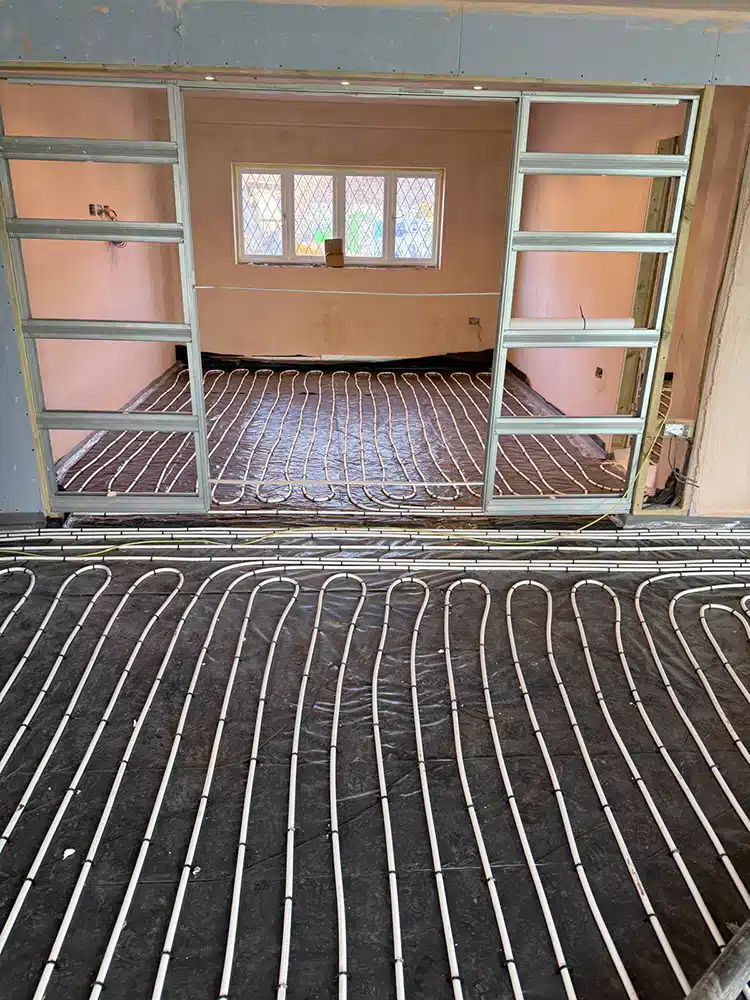
Before the pour, the heating engineer must fix the pipes firmly, fill them and pressure test them. Loose pipes can float up as the screed flows. Underneath, we look over the insulation boards, the perimeter edge strip and the membrane before starting.
Drawings that quote a calcium sulphate grade are decoded on our page about Carterton anhydrite grades.
Bringing a Carterton heated floor up to temperature
Owners are often tempted to rush the first heat-up, and rushing it can damage a new floor.
Heating under a calcium sulphate liquid floor can normally run from around 7 days after pouring. A sand and cement floor needs 21 days or more first. Then commission gradually. Run cool water through the loops to begin with and lift it bit by bit over several days, in line with the screed manufacturer's schedule and what your heating engineer advises. A sudden jump in temperature can crack the screed or cause it to curl at the edges.
Used carefully, the system speeds drying as well. From around 7 days, a calcium sulphate floor can normally be force dried this way, so the flooring can go down sooner. The screed drying guide explains how moisture leaves a floor and how it is measured.
On a bungalow renovation, where the old floor is lifted and insulation is added, heating may go in at the same time. Height is then the limiting factor, and a liquid screed's shallower build-up can make it possible.
Liquid screed laid over heating pipes is published at £20 to £35 per m² in 2026 UK figures. For the same service further east, see underfloor heating screed in Oxford.
Underfloor Heating Screed prices in Carterton
Liquid screed over underfloor heating: £20 to £35 per m² supplied and laid (trade2base, June 2026), so £700 to £1,230 for 35 m². trade2base gives these figures excluding VAT. See our floor screeding cost guide or screed calculator.
Who lays your underfloor heating screed in Carterton
K & B Screeding’s own team, led by director Donatas Bardisevicius. Founded 2019, company 12298780.
See what customers say in our Google reviews and on our testimonials page.
Underfloor Heating Screed from Slough to Carterton
Carterton is about 43.7 miles west-north-west of our Slough base as the crow flies, with postcodes including OX18. The nearest towns to it are Witney (5.1 miles), Kidlington (13.8 miles), Wantage (13.9 miles) and Oxford (14.5 miles).
More on underfloor heating screed, part of our screeding services.
