
Thin heated screeds for Montpellier and Pittville houses
In a period house, the floor level is fixed by things that cannot move: stone thresholds, original doors, staircases and skirting. A heated floor has to fit insulation, pipes and screed beneath that line, and in Montpellier and Pittville houses the old floor may have been suspended timber rather than concrete.
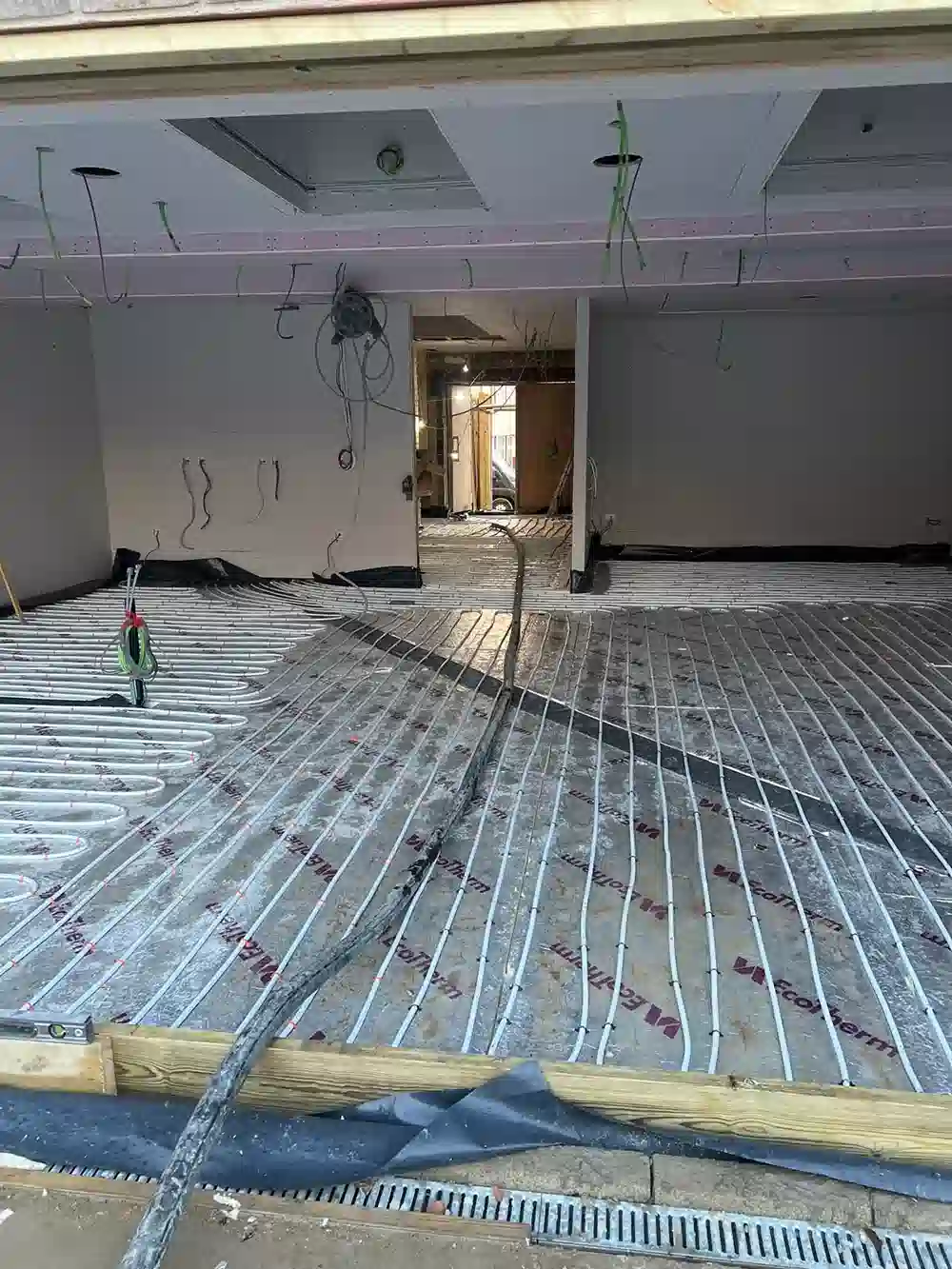
Pumped screed normally solves it. Over the pipes it wants 25mm or more, so the floor comes to roughly 45 to 50mm, whereas hand-laid wants about 45mm on top of them and finishes thicker. Where depth is extremely tight, an alpha hemihydrate product may be specified for a thinner section, following its own product sheet.
Material choice also has to suit the building, not just the heating design. Calcium sulphate screed is weakened by prolonged damp, so over an old basement or a floor at risk of rising moisture, a cement based screed or a proper membrane is needed. Lime-built walls must be allowed to breathe at the floor edges, so the membrane and edge detail are planned with them in mind before any pipes are clipped down.
Flowing screed also surrounds every pipe with no air pockets, which lets the heat reach the surface quickly and evenly. How the pour itself runs is set out under pumped screed in Cheltenham, and example heated build-ups are in our guide to how deep screed should be.
Heated extensions on Cheltenham's post-war semis
The post-war semis are far simpler. 29% of Cheltenham's homes were built between 1945 and 1972, and extensions and kitchen refits on houses of that age are an easy place to add underfloor heating, because the new floor can be designed from scratch. A garden room at the end of a Hatherley or Charlton Kings plot is the same job, only smaller.
After the pour, leave the thermostat alone for a while. Calcium sulphate can normally take warmth from around day 7, and a hand-laid floor after 21 days or more. First firing begins with cool water, turned up a notch at a time across several days, never straight to full. You get the plan on paper, and your engineer follows it.
Only 5% of homes were built since 2015, and Golden Valley will be a large new build programme. Where new homes are designed with heated floors from the outset, the screed is poured plot by plot to the developer's programme.
Budget £20 to £35 per m² for a pumped heated screed, based on 2026 UK prices. For more on budgets, see how much floor screeding costs.
Underfloor Heating Screed prices in Cheltenham
Liquid screed over underfloor heating: £20 to £35 per m² supplied and laid (trade2base, June 2026), so £700 to £1,230 for 35 m². trade2base gives these figures excluding VAT. See our floor screeding cost guide or screed calculator.
Who lays your underfloor heating screed in Cheltenham
K & B Screeding’s own team, led by director Donatas Bardisevicius. Founded 2019, company 12298780.
See what customers say in our Google reviews and on our testimonials page.
Underfloor Heating Screed from Slough to Cheltenham
On the map, Cheltenham sits west-north-west of Slough, about 66.5 miles from our base in a straight line (postcodes including GL50, GL51, GL53 and GL52), next to Tewkesbury (7.2 miles), Gloucester (7.7 miles), Stroud (12.3 miles) and Cirencester (13.5 miles).
More on underfloor heating screed, part of our screeding services.