
Golden Valley plots and specifying anhydrite in Cheltenham
Each anhydrite mix on a drawing carries a short code. Take CA-C25-F5: CA says calcium sulphate, C25 is how hard it can be squeezed before failing and F5 how much bending it takes, both measured in N/mm2. CA-C20-F4 is aimed at houses with light foot traffic. CA-C25-F5 is the usual choice for houses, flats and offices, with CA-C30-F6 held back for heavier wear.
For a Golden Valley plot, the engineer fixes the grade and our pump delivers precisely that. Now and again the drawings swap in an alpha hemihydrate mix, chosen because the floor must dry sooner or be shallower. The maker's own sheet then rules how deep it goes and how long it takes to dry.
Developers like the way the material behaves. Shrinkage while curing is slight, so wide bays need hardly any joints, and the mix closes in tight around heating pipes. If the floor does need a joint, for example at a threshold or between two heating zones, its position is fixed on the plan before the pump arrives.
Apartments are a strong fit, because an apartment floor can usually be poured in one visit over its acoustic layer, which must be continuous and turned up at the walls. Newer houses count too: 11% of Cheltenham's homes were built between 2000 and 2014, and where one of those has a calcium sulphate floor that is being refinished, the same rules apply. More on the material is in our plain guide to anhydrite.
Drying, sanding and testing Cheltenham anhydrite floors
The work does not end when the pour does. As it dries, the top of the floor forms a weak crust called laitance. It must be sanded off before flooring, or the adhesive bonds to the crust instead of the screed. After sanding we seal it with a primer made to suit calcium sulphate.
Next comes the moisture check. Flooring makers often allow less moisture in anhydrite than in cement, so a figure that would pass on a cement floor could still fail on this one. Our hygrometer gives the answer. If pipes run through the floor, switching the heating on from about 7 days usually helps it dry.
The material has a firm limit. It should not be used where a floor may stay wet, and in Cheltenham that includes damp basements in older houses as well as wet rooms. For those rooms we change to a cement based flowing mix, or to sand and cement laid by hand in Cheltenham. If the finished surface needs a final skim for thin flooring, floor levelling follows.
Anhydrite & Flow Screed prices in Cheltenham
Liquid flowing screed (which includes anhydrite): £24 to £31 per m² supplied and laid (MyJobQuote, August 2026), so £960 to £1,240 for 40 m². MyJobQuote does not say whether these figures include VAT. See our floor screeding cost guide or screed calculator.
Who lays your anhydrite and flow screed in Cheltenham
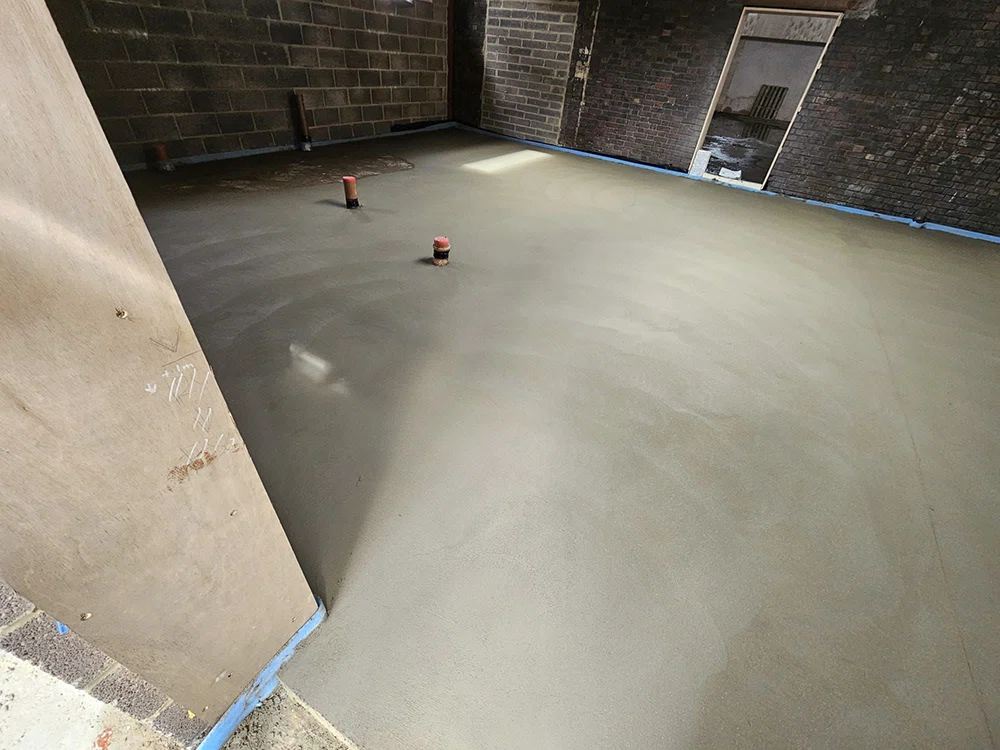
K & B Screeding’s own team, led by director Donatas Bardisevicius. Founded 2019, company 12298780.
See what customers say in our Google reviews and on our testimonials page.
Anhydrite & Flow Screed from Slough to Cheltenham
On the map, Cheltenham sits west-north-west of Slough, about 66.5 miles from our base in a straight line (postcodes including GL50, GL51, GL53 and GL52), next to Tewkesbury (7.2 miles), Gloucester (7.7 miles), Stroud (12.3 miles) and Cirencester (13.5 miles).
More on anhydrite screed, part of our screeding services.