
Grades and thin sections for Gloucester Docks apartments
Open the specification for a dock conversion and the screed will be listed by a grade code. That code is defined by the European standard for screeds: C stands for compressive strength and F for flexural strength, and each figure is in N/mm2. In practice that means CA-C20-F4 where a home sees light wear, CA-C25-F5 across the general run of houses, flats and offices, and CA-C30-F6 once loads get heavier. Whichever the engineer writes down is what goes in.
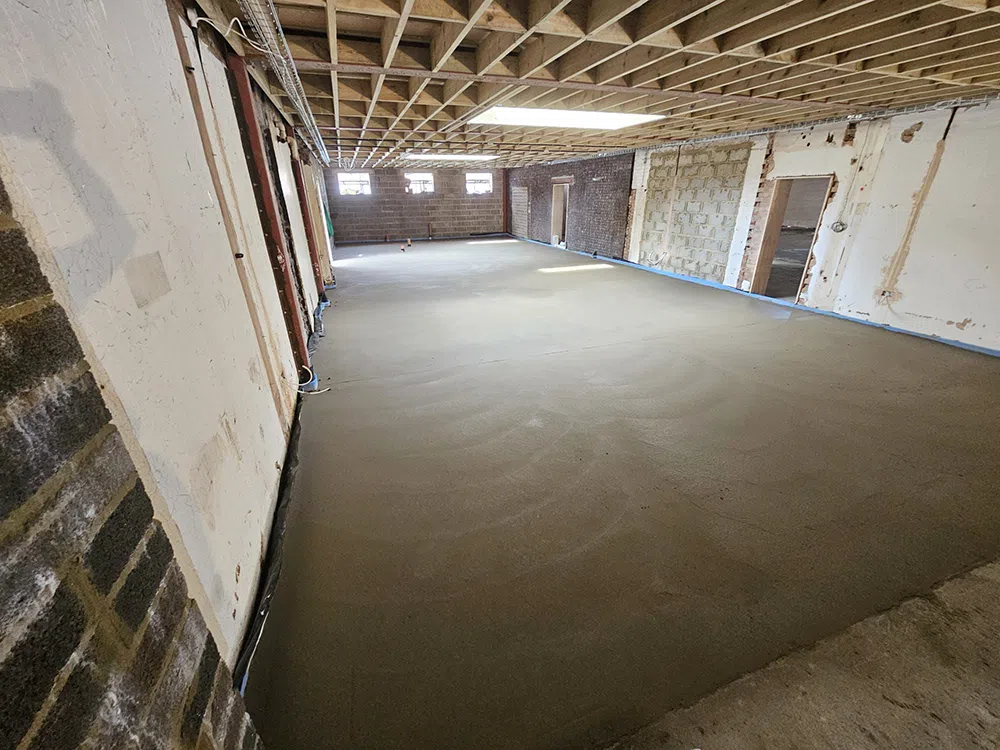
Apartment floors bring their own constraints. In a converted warehouse at Gloucester Docks, or a new block at King's Quarter, the floor build-up is limited by ceiling heights and door heads, and each flat needs an acoustic layer to stop sound travelling to the one below. That makes the screed thin and the base soft, which is where material choice matters. Alpha hemihydrate products are used where a reduced depth or faster drying is required, and they follow their own product sheet for minimum thickness.
The material also shrinks very little, so a whole apartment can often be poured in one bay with joints only where the plan needs them, such as at doorways or between heating zones. We agree that layout before the pour.
Purpose-built flats make up 16% of Gloucester's homes, and converted flats make up another 3%. Both are candidates for this kind of floor. What anhydrite actually is gets covered in our anhydrite screed guide.
Sanding, priming and testing at King's Quarter
Calcium sulphate needs finishing after the pour. Drying leaves a soft, flaky skin on top, known as laitance, and flooring glue will not grip it. When the floor has dried enough we sand that skin off and seal the surface with a calcium sulphate primer, so the finish sticks to firm screed underneath.
The moisture test is stricter than for cement. Flooring makers frequently allow calcium sulphate less moisture, so a hygrometer figure that would clear a cement screed can still count as damp on anhydrite. We test before handing over. In a heated apartment, switching the system on from about day 7 can usually force dry the floor and keep the block's programme moving.
Keep it away from water. Water is its weak point: left wet, calcium sulphate loses strength. So the shower rooms and wet rooms in a block are poured in a cement based flowing screed or laid in traditional sand and cement. Where an old concrete base must be cleaned or ground first, see concrete floor grinding. For the same specification work about 15.7 miles away, see anhydrite flow screed in Cirencester.
Anhydrite & Flow Screed prices in Gloucester
Liquid flowing screed (which includes anhydrite): £24 to £31 per m² supplied and laid (MyJobQuote, August 2026), so £960 to £1,240 for 40 m². MyJobQuote does not say whether these figures include VAT. See our floor screeding cost guide or screed calculator.
Who lays your anhydrite and flow screed in Gloucester
K & B Screeding’s own team, led by director Donatas Bardisevicius. Founded 2019, company 12298780.
See what customers say in our Google reviews and on our testimonials page.
Anhydrite & Flow Screed from Slough to Gloucester
On the map, Gloucester sits west-north-west of Slough, about 72.5 miles from our base in a straight line (postcodes including GL1, GL4, GL2 and GL3), next to Cheltenham (7.7 miles), Stroud (8.3 miles), Tewkesbury (9.6 miles) and Cirencester (15.7 miles).
More on anhydrite screed, part of our screeding services.
