
Levelling for office refits at The Forum and Waterwells
Commercial floors are judged by flatness class. BS 8204 has a simple test: rest a 2m straightedge on the slab, then find and measure the worst gap under it. The permitted gap is 3mm at SR1, 5mm at SR2 and 10mm at SR3. SR1 is the class many thin sheet finishes demand, so a floor that coped with carpet tiles can fail when vinyl sheet or LVT is specified.
At The Forum, where King's Quarter is being rebuilt with new offices, and at Waterwells Business Park near junction 12 of the M5, whose occupiers include Gloucestershire Police and Kohler Mira, fit-outs and tenant changes are the moments a floor gets tested. Levelling compound is the usual answer: laid thin, typically from about 2mm up to around 10mm, and quick enough to keep the flooring contractor on programme. Raised floor systems need a sound, flat base too.
The base comes first. We clean it, strip out anything loose, and choose a primer for what is there, as concrete, sand and cement, calcium sulphate and old adhesive each need their own. The wrong primer is the most common reason compound lets go, so it is a step that cannot be skipped on a refit.
Where a slab is worn, contaminated or damaged, it needs more than a skim. Our commercial screeding and concrete floor repair services deal with the base before the levelling layer goes on, so the compound has something sound to bond to.
Joining old and new floors in Gloucester homes
Semi-detached houses are 40% of Gloucester's homes, and post-war semis make up much of the extension and open-plan kitchen work in the city. The new floor is flat. The old one next to it has often settled or was laid slightly out, leaving a ridge or slope where they meet. A self levelling compound brings the two to one plane so LVT or tiles run through without a lip at the opening. Each base is primed to suit before the compound goes down.
Compound only goes so far. It finishes a floor rather than rebuilding one, and pouring it deep over a floor that should really be replaced tends to end in cracks and debonding. A hollow or crumbling floor, or one out by more than about 10mm over a big area, needs a fresh screed instead, as described under Gloucester sand and cement screeding. If a sound floor needs just a few millimetres, a latex screed could be enough.
For levelling work about 7.7 miles away, see floor levelling in Cheltenham.
How we price floor levelling in Gloucester
A fixed written price within 24 hours, once we know the area and the base. See our floor screeding cost guide.
Who levels your floor in Gloucester
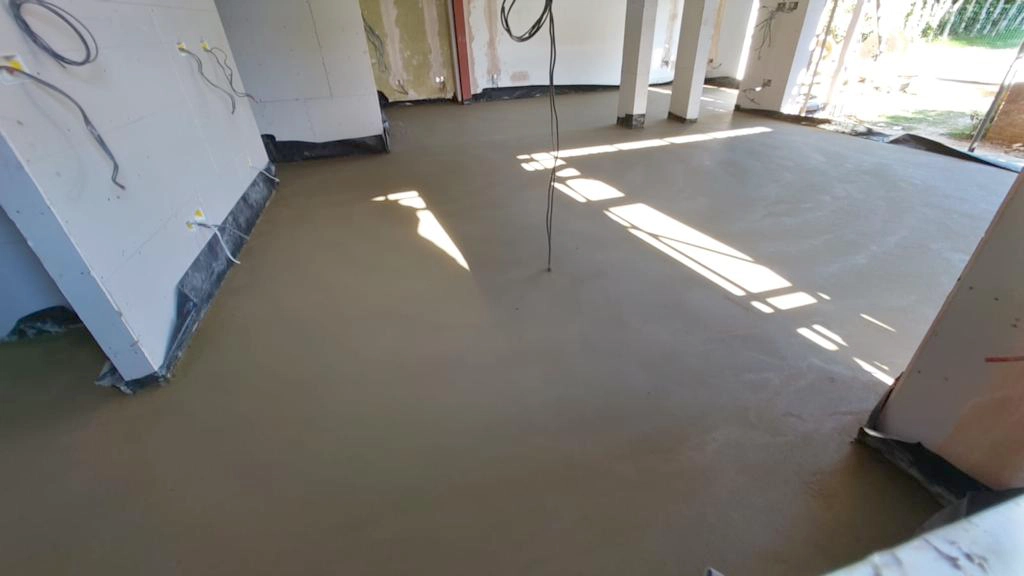
K & B Screeding’s own team, led by director Donatas Bardisevicius. Founded 2019, company 12298780.
See what customers say in our Google reviews and on our testimonials page.
Floor Levelling from Slough to Gloucester
On the map, Gloucester sits west-north-west of Slough, about 72.5 miles from our base in a straight line (postcodes including GL1, GL4, GL2 and GL3), next to Cheltenham (7.7 miles), Stroud (8.3 miles), Tewkesbury (9.6 miles) and Cirencester (15.7 miles).
More on floor levelling, part of our screeding services. Not sure whether you need a thin compound or a full flowing screed? See self levelling screed explained.