
Rescreeding solid floors in older Gloucester terraces
The typical failure in an older terrace is easy to recognise: a ground floor that is cracked, damp at the edges or sinking in places, with no membrane under it. Patching rarely lasts. The repair that holds up is to break the whole floor out and start again, laying new insulation, then a damp proof membrane over it and fresh screed on top.
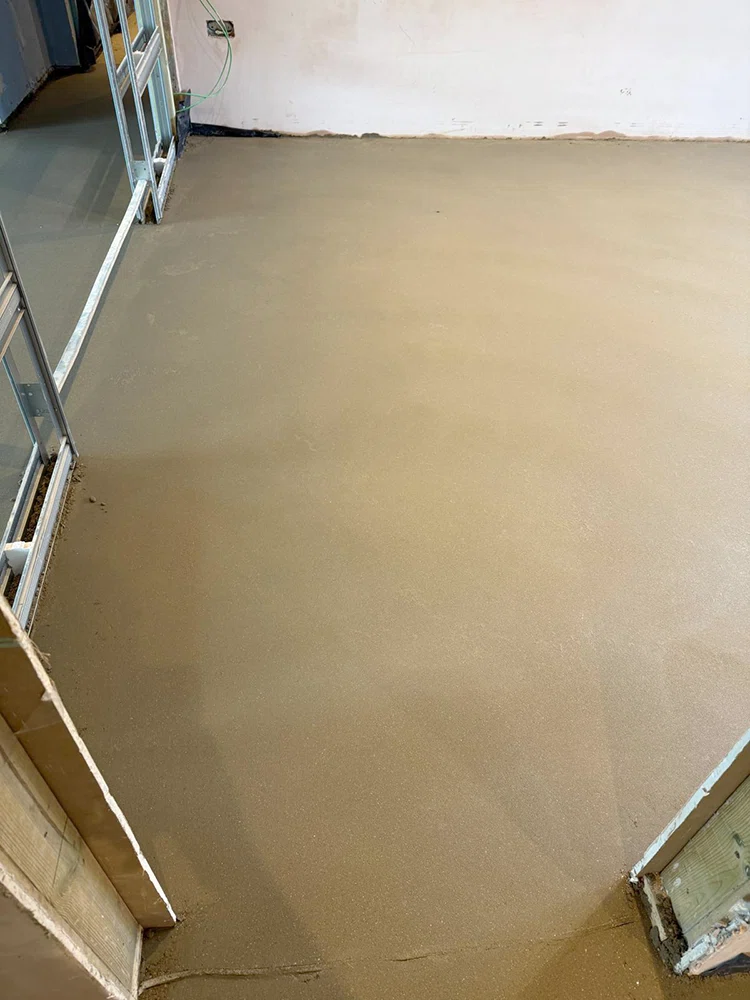
That rebuild is exactly where a hand-laid mix fits. It is mixed on site to the depth each area needs, so a floor that steps between rooms or runs out of square can still be laid properly. Each bay is tamped and ruled off by hand, leaving a hard, level floor that tiles, LVT or timber can go straight onto.
How thick it goes depends on what sits beneath. Floated over insulation, a house floor is 65mm and a commercial one 75mm. Bonded directly to a sound slab, 25 to 40mm can be enough, handy in a pre-1919 terrace where an old front door or threshold fixes the finished height. When bonding is the right call is set out under bonded screed.
Whatever the age of the house, the method is the same: find out what is underneath, then build the new floor up in the right sequence. If the slab below needs work first, see concrete floor repair. Breaking out and rebuilding is also a chance to raise the floor's insulation to modern standards.
Wet rooms, garages and drying times in Gloucester
Traditional screed is the dependable choice anywhere water is expected. In a wet room, the floor must tip gently towards the drain, and we shape that slope with the trowel while the screed is still fresh. Calcium sulphate screed must not be used in those rooms, so sand and cement gives a cement substrate that tanking and tiles can go on safely.
Converting a garage into living space suits it as well. The slab is often lower than the house floor and may have no insulation, so the new build-up lifts the level while adding insulation and a membrane. Our garage floor screeding guide walks through those layers in order.
The drawback is time. Allow around a day for every mm of the first 40mm, and longer for each mm after, which leaves a 65mm terrace floor several weeks short of most finishes. An additive for rapid drying can cut that wait, and mixing in fibres to limit cracking adds roughly £1 to £3 per m² on published pricing.
Before extras, the hand-laid floor is £18 to £25 per m², based on UK prices published in 2026. Up the road, our Cheltenham sand and cement page covers that town.
Sand and Cement Screed prices in Gloucester
Sand and cement screed: £18 to £25 per m² supplied and laid (MyJobQuote, August 2026), so £450 to £630 for 25 m². MyJobQuote does not say whether these figures include VAT. See our floor screeding cost guide or screed calculator.
Who lays your sand and cement screed in Gloucester
K & B Screeding’s own team, led by director Donatas Bardisevicius. Founded 2019, company 12298780.
See what customers say in our Google reviews and on our testimonials page.
Sand and Cement Screed from Slough to Gloucester
On the map, Gloucester sits west-north-west of Slough, about 72.5 miles from our base in a straight line (postcodes including GL1, GL4, GL2 and GL3), next to Cheltenham (7.7 miles), Stroud (8.3 miles), Tewkesbury (9.6 miles) and Cirencester (15.7 miles).
More on sand & cement screed, part of our screeding services.
