
Rebuilding floors in Stroud's stone terraces
Terraced houses are 20% of Stroud's homes. Up on the hillsides, many stone terraces and weavers' cottages stand on solid floors that are out of level and were laid without a damp proof membrane.
Those floors need thought before any work. A solid floor without a membrane lets moisture evaporate from its surface. Seal it under a dense screed and the moisture finds another way out, usually up the walls. So the first decision is whether the floor can stay, with only a thin levelling layer, or whether it has to come out and be rebuilt with breathable detailing, insulation and a planned membrane.
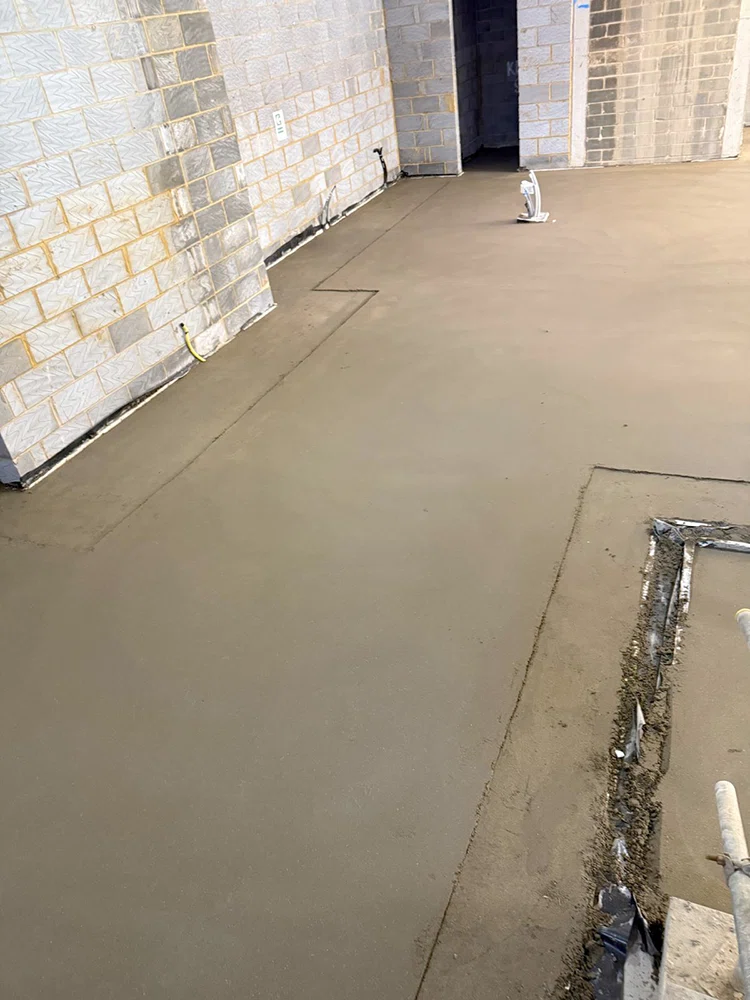
When it is rebuilt, sand and cement has clear advantages. It is mixed on site to the depth each area needs, copes with small rooms and out-of-square walls, and can be laid by hand in a house where the only access is a flight of steps. Laid as a floating floor over new insulation, a cottage needs 65mm of it, while a commercial building needs 75mm. Stuck straight to a sound base instead, 25 to 40mm will do, and when that suits is explained under bonded screeding.
Hand laying also means the screed can be set room by room to the heights of existing thresholds and stairs, which matters in an old house where few walls or floors are quite square. If the old base in a weavers' cottage needs work before any of this, that comes under preparing the floor first.
Wet rooms, garages and drying in Stroud homes
Traditional screed is the one to choose where water is expected. In a walk-in shower or wet room the floor tilts gently to the drain, and that tilt is shaped by trowel while the screed is still soft. Calcium sulphate screed cannot be used in those areas, so sand and cement gives the cement base that tanking and tiles need.
It also handles early load and awkward bases well. A garage being turned into a room usually has a slab lower than the house, often without insulation, and the new floor has to lift it while adding both. How those layers stack up, from slab to finished level, is shown in the garage screed walkthrough.
Drying is the trade-off. Each of the first 40 millimetres takes roughly a day to dry and the rest take longer, which puts a 65mm cottage floor several weeks away from most finishes. A rapid drying additive can shorten the wait, and fibres added to reduce cracking cost about £1 to £3 per m² on published figures. The base price for sand and cement, on published 2026 UK figures, is £18 to £25 per m².
Cirencester is about 10.9 miles off, and our Cirencester sand and cement page covers the same work there.
Sand and Cement Screed prices in Stroud
Sand and cement screed: £18 to £25 per m² supplied and laid (MyJobQuote, August 2026), so £450 to £630 for 25 m². MyJobQuote does not say whether these figures include VAT. See our floor screeding cost guide or screed calculator.
Who lays your sand and cement screed in Stroud
K & B Screeding’s own team, led by director Donatas Bardisevicius. Founded 2019, company 12298780.
See what customers say in our Google reviews and on our testimonials page.
Sand and Cement Screed from Slough to Stroud
On the map, Stroud sits west-north-west of Slough, about 69.2 miles from our base in a straight line (postcodes including GL5, GL10 and GL6), next to Gloucester (8.3 miles), Cirencester (10.9 miles), Cheltenham (12.3 miles) and Yate (16.6 miles).
More on sand & cement screed, part of our screeding services.
