
Specifying anhydrite for Brimscombe Port and Stroud flats
Engineers' drawings label calcium sulphate screed using a grade code set by the European standard for screed. Its C value tells you compressive strength and its F value flexural strength, each in N/mm2. A home floor with little wear can be CA-C20-F4. A typical house, flat or office is poured at CA-C25-F5, and only floors under heavier use go up to CA-C30-F6.
On a new development such as the St Modwen scheme at Brimscombe Port, the grade is normally set on the engineer's drawings, and we pour exactly what is named. Where the drawings name an alpha hemihydrate product instead, the reason is normally quicker drying or a slimmer section, and its maker's data sheet then governs depth and drying for us.
Because it hardly shrinks, anhydrite pays off on larger floors. A big bay needs only a handful of joints, handy across an open-plan ground floor or an entire flat. Any joints that are required, say at a doorway or where heating zones meet, are mapped out with the bays ahead of pour day.
Purpose-built flats are 13% of Stroud's homes, and another 4% are flats in converted buildings. In a conversion, the floor build-up is often limited by existing heights, which is one of the places a thin alpha hemihydrate section earns its keep. How the material behaves, and where it parts company with cement, is set out in our anhydrite screed guide.
Finishing and moisture testing Stroud anhydrite floors
A dry anhydrite floor still has one more job to go through before flooring. A weak, dusty skin called laitance forms on its surface, and adhesives and compounds will not hold to it. So once the floor is dry enough, the crust is abraded off with a sander and a primer designed for calcium sulphate goes on.
Moisture is judged against a lower bar. Flooring makers often hold calcium sulphate to a tighter moisture figure than cement, so a hygrometer reading, not the number of days gone, decides when flooring can start. In a heated home, running the system from about day 7 can usually force dry the floor.
The firm rule is to keep it dry in use. Left damp, calcium sulphate weakens, so for wet rooms, showers and any floor where a leak is likely we switch to a flowing screed with a cement binder or to hand-ruled sand and cement. Where an existing base needs cleaning or repair first, see screed repairs. Cheltenham, about 12.3 miles away, has its own anhydrite page.
Anhydrite & Flow Screed prices in Stroud
Liquid flowing screed (which includes anhydrite): £24 to £31 per m² supplied and laid (MyJobQuote, August 2026), so £960 to £1,240 for 40 m². MyJobQuote does not say whether these figures include VAT. See our floor screeding cost guide or screed calculator.
Who lays your anhydrite and flow screed in Stroud
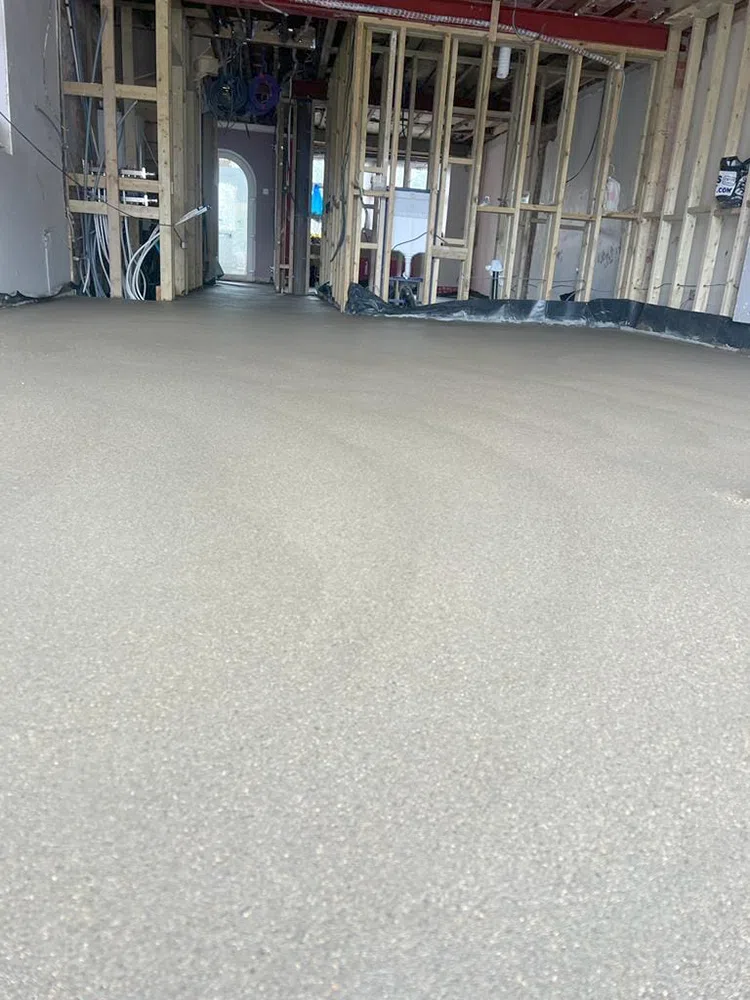
K & B Screeding’s own team, led by director Donatas Bardisevicius. Founded 2019, company 12298780.
See what customers say in our Google reviews and on our testimonials page.
Anhydrite & Flow Screed from Slough to Stroud
On the map, Stroud sits west-north-west of Slough, about 69.2 miles from our base in a straight line (postcodes including GL5, GL10 and GL6), next to Gloucester (8.3 miles), Cirencester (10.9 miles), Cheltenham (12.3 miles) and Yate (16.6 miles).
More on anhydrite screed, part of our screeding services.
