
Reading an anhydrite specification in Royal Wootton Bassett
Calcium sulphate screeds are labelled using a designation from the European screed standard. Its C number gives compressive strength; its F number, flexural strength, both in N/mm2. Light domestic floors suit CA-C20-F4. For most dwellings and offices, flats included, the everyday grade is CA-C25-F5. CA-C30-F6 is kept for heavier use.
On a new-build plot the developer's engineer picks the grade and we lay exactly that. Houses from 2015 onwards are 6% of the town's stock, and on plots like those the drawings normally state a grade. If the wording is unclear, we take it up with the engineer before pouring, because once the screed is down its grade is fixed.
Where quicker drying or a thinner floor is wanted, an alpha hemihydrate product is sometimes named. Each comes with its own data sheet covering how deep to lay it, how it dries and how it is first heated, and that sheet overrides general advice.
Purpose-built flats account for 12% of homes here, and calcium sulphate suits apartment floors well. It barely shrinks while setting, which lets a big bay go down in one pour with few joints, over insulation and often over heating too. Joints are still put in where they are needed, for instance at doorways or where heating zones meet, and the layout is settled before pouring.
There is more on the material in our anhydrite guide.
Sanding and testing before flooring in Royal Wootton Bassett
Pouring the floor does not finish a calcium sulphate job. Drying leaves a thin, weak skin on top called laitance. It has to be sanded off before any adhesive, compound or primer goes on, or the flooring ends up bonded to a crust that can let go later. After sanding, the floor gets a primer that is compatible with calcium sulphate.
Moisture is checked too, with a hygrometer. Flooring manufacturers often set a tighter moisture limit for calcium sulphate than for cement, so a floor that looks dry may still not be ready for wood or vinyl. If underfloor heating is in, it can generally help force dry the screed from about 7 days.
Keep anhydrite out of rooms where water is a risk: wet rooms, utility rooms where leaks could happen, anywhere water might sit. There, a flowing screed made with cement takes its place. For wet rooms and showers, take a look at the sand and cement option. We carry out the same specification work for calcium sulphate floors in Chippenham.
Anhydrite & Flow Screed prices in Royal Wootton Bassett
Liquid flowing screed (which includes anhydrite): £24 to £31 per m² supplied and laid (MyJobQuote, August 2026), so £960 to £1,240 for 40 m². MyJobQuote does not say whether these figures include VAT. See our floor screeding cost guide or screed calculator.
Who lays your anhydrite and flow screed in Royal Wootton Bassett
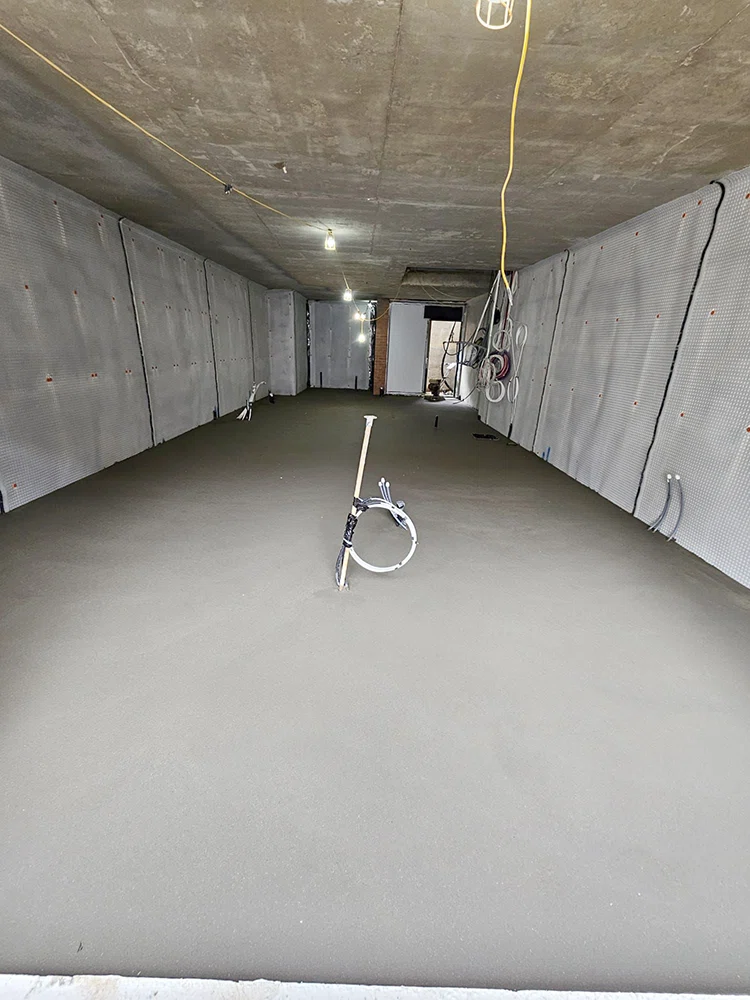
K & B Screeding’s own team, led by director Donatas Bardisevicius. Founded 2019, company 12298780.
See what customers say in our Google reviews and on our testimonials page.
Anhydrite & Flow Screed from Slough to Royal Wootton Bassett
As the crow flies, our yard in Slough is about 54.3 miles from Royal Wootton Bassett, which lies to the west. Postcodes here include SN4, and Swindon (5.3 miles), Calne (8.4 miles), Chippenham (10.7 miles) and Cirencester (12.4 miles) are close by.
More on anhydrite screed, part of our screeding services.