
Calcium sulphate grades on Hunter's Meadow plots
Anhydrite is described by a designation from the European standard for screed materials. C is the compressive strength and F the flexural strength, each given in N/mm2. Most housing is covered by three of them: CA-C20-F4 for domestic floors with light use, CA-C25-F5 for the majority of homes, apartments and offices, and CA-C30-F6 where use is heavier.
On a new-build site the developer's engineer chooses the grade, and we pour to that. Only 5% of Melksham's homes date from 2015 or later, and the houses still going up at Hunter's Meadow are exactly where these designations show up on plot drawings. If speed or a thin floor is the priority, the specification may call for an alpha hemihydrate product instead. Those have their own data sheet for depth and drying, and the pour follows that sheet rather than general rules.
Calcium sulphate hardly shrinks while it cures. Open-plan ground floors and whole apartment levels can therefore go down in large bays with hardly any joints. Some joints are still needed, at doorways and where one heating zone meets another for example, so the bay and joint plan is agreed before pouring.
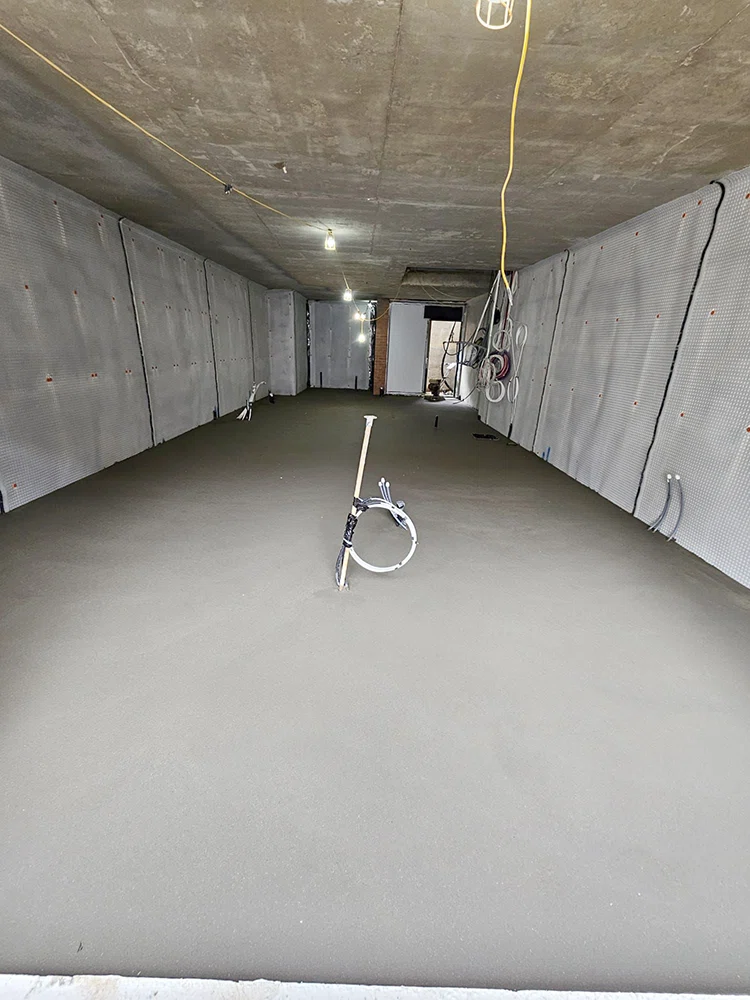
Purpose-built flats make up 10% of homes in Melksham. In a block, an entire floor can go down in one visit, over insulation and often over heating, with very little cracking thanks to that low shrinkage. To see how it compares with cement based screeds, read what anhydrite screed is.
Laitance and moisture tests before Melksham flooring
Pouring calcium sulphate is half the work. While it dries, a thin and weak top skin known as laitance forms. That skin must be sanded away before adhesive or compound touches the floor, otherwise the new finish is bonded to a crust and not to the screed. Once the floor has dried, we sand it and apply a primer that is compatible with calcium sulphate.
Then the floor is tested for moisture with a hygrometer. Plenty of flooring manufacturers give calcium sulphate a lower moisture limit than cement, so a reading that would be fine on sand and cement can still mean the floor is too damp for vinyl or wood. If the floor is heated, the heating can usually be used from about 7 days to drive the moisture out, on a gradual schedule.
Keep anhydrite away from anywhere that may get wet, such as wet rooms, utility rooms where leaks are possible, or places water could pool. For those, use a flowing screed with a cement base, or a traditional sand and cement floor. We do the same specification work for anhydrite floors in Devizes, roughly six miles off.
Anhydrite & Flow Screed prices in Melksham
Liquid flowing screed (which includes anhydrite): £24 to £31 per m² supplied and laid (MyJobQuote, August 2026), so £960 to £1,240 for 40 m². MyJobQuote does not say whether these figures include VAT. See our floor screeding cost guide or screed calculator.
Who lays your anhydrite and flow screed in Melksham
K & B Screeding’s own team, led by director Donatas Bardisevicius. Founded 2019, company 12298780.
See what customers say in our Google reviews and on our testimonials page.
Anhydrite & Flow Screed from Slough to Melksham
As the crow flies, our yard in Slough is about 65.4 miles from Melksham, which lies to the west. Postcodes here include SN12, and Corsham (4.7 miles), Trowbridge (4.7 miles), Chippenham (6 miles) and Devizes (6.3 miles) are close by.
More on anhydrite screed, part of our screeding services.
