
Calcium sulphate grades for new Bath floors
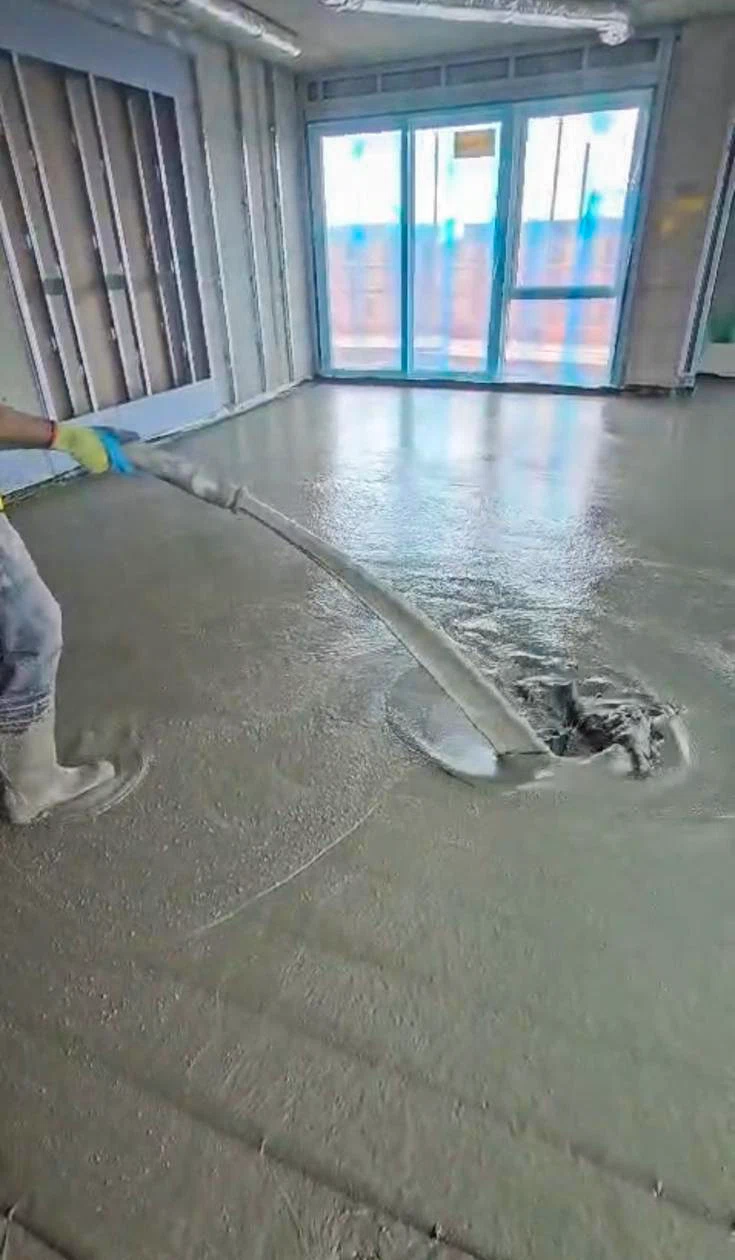
Anhydrite screed is based on calcium sulphate, not cement. Low drying shrinkage lets it go down in wide bays with few joints, and heat passes through it well from underfloor pipes. That makes it a common specification for apartment buildings and groups of new homes.
The grade is written as a class under the screed standard. Light domestic traffic calls for CA-C20-F4. The general run of homes, apartments and offices takes CA-C25-F5, and floors that work harder take CA-C30-F6. C stands for compressive strength and F for flexural, each given in N/mm2. On a development such as Bath Riverside, built on the former Stothert & Pitt works, the grade normally comes from the developer's engineer, and we pour to it.
When a floor has to dry sooner or be thinner, the specifier may choose an alpha hemihydrate product. Its own data sheet governs depth and heating, so please attach it when you send the enquiry.
Homes built from 2000 to 2014 make up 6% of Bath's stock. When a flat of that age is refitted, the existing screed may well be calcium sulphate, which changes how the new floor finish is prepared. The anhydrite screed guide explains why.
We plan bay and joint positions before the pour so they follow doorways and heating zones, and our own team prepares the full build-up beneath.
Moisture testing and laitance at Mulberry Park
At Mulberry Park in Foxhill, homes built on former Ministry of Defence land usually have modern floor build-ups. Any calcium sulphate floor, there or elsewhere, forms a laitance on its surface as it dries. That thin, weak layer must be sanded off and vacuumed before primer, compound or adhesive, or the finish can fail. It is an easy step to miss when a programme is tight.
Moisture testing needs care. Flooring makers are often stricter about moisture in calcium sulphate than in cement, so the only safe check is a hygrometer reading compared with their figure. From about 7 days the floor heating can usually be run, on a gradual schedule, to force the drying.
Primers must be made for calcium sulphate, and the primer goes on after sanding, before anything else. For a thin compound over the dried screed, see levelling before new flooring.
Calcium sulphate is not for rooms that may get wet. In a shower room, utility or wet room, a cement based flowing screed is used instead, because persistent moisture weakens the calcium sulphate material.
Anhydrite & Flow Screed prices in Bath
Liquid flowing screed (which includes anhydrite): £24 to £31 per m² supplied and laid (MyJobQuote, August 2026), so £960 to £1,240 for 40 m². MyJobQuote does not say whether these figures include VAT. See our floor screeding cost guide or screed calculator.
Who lays your anhydrite and flow screed in Bath
K & B Screeding’s own team, led by director Donatas Bardisevicius. Founded 2019, company 12298780.
See what customers say in our Google reviews and on our testimonials page.
Anhydrite & Flow Screed from Slough to Bath
As the crow flies, our yard in Slough is about 74.7 miles from Bath, which lies to the west. Postcodes here include BA2 and BA1, and Trowbridge (7.9 miles), Corsham (8.3 miles), Melksham (9.6 miles) and Frome (10.6 miles) are close by.
More on anhydrite screed, part of our screeding services.