
Liquid screed in Twerton, Weston and Combe Down
Liquid screed is most useful on floors that are large, open and fairly simple in shape. It is pumped from the mixer, spreads under its own weight, leaving a dense surface that reaches SR1 or SR2 without heavy finishing. That flatness suits tiles, LVT and engineered boards once the floor has dried. You can normally cross it on foot within 24 to 48 hours.
The post-war housing in Twerton, Weston and Combe Down, much of it council-built between 1945 and 1972, suits conventional extension screeds. When the back of one of these houses is opened into a kitchen and family room, a single liquid pour avoids the joints that come with laying several sections by hand, and nothing has to be barrowed through the house.
Homes built since 2015 make up 9% of Bath's total. At Mulberry Park and Bath Riverside, an alteration will normally need to match a modern floor build-up, and liquid screed can be poured to the exact depth needed to meet the existing level.
Floated on insulation in a house, liquid screed begins at about 35mm thick. Heating pipes need 25mm or more of it above them, so a heated floor ends up near 45 to 50mm. Our guide to how deep screed goes gives the reasons.
For very small rooms, or floors that need falls to a drain, hand-laid screed is usually the better choice.
Pumping to upper floors and flats in Bath
Purpose-built flats make up 19% of Bath's homes, and liquid screed is well suited to them. The hose can be run up a stairwell or through a window to reach an upper floor, which is often easier than carrying dozens of bags of sand and cement up several flights.
Planning the hose route is part of the job. The pump needs to stand close to the building, and on a steep or narrow street that may mean a parking suspension or an early start. Tell us about the stair, the lift, the parking and any shared areas when you ask for a price.
Get the floor build-up finished before pour day. Insulation should be laid tight, the membrane taped and turned up at the walls, and the edge strip fixed, so the screed cannot leak into the floor below. We check this on the day.
A 40mm depth needs around 40 days to dry, and every extra millimetre takes longer. For a comparison of drying, cost and use, see liquid screed against sand and cement. If only the pumping is needed, our screed pumping page explains that service.
Liquid Screed prices in Bath
Liquid screed: £24 to £31 per m² supplied and laid (MyJobQuote, August 2026), so £960 to £1,240 for 40 m². MyJobQuote does not say whether these figures include VAT. See our floor screeding cost guide or screed calculator.
Who lays your liquid screed in Bath
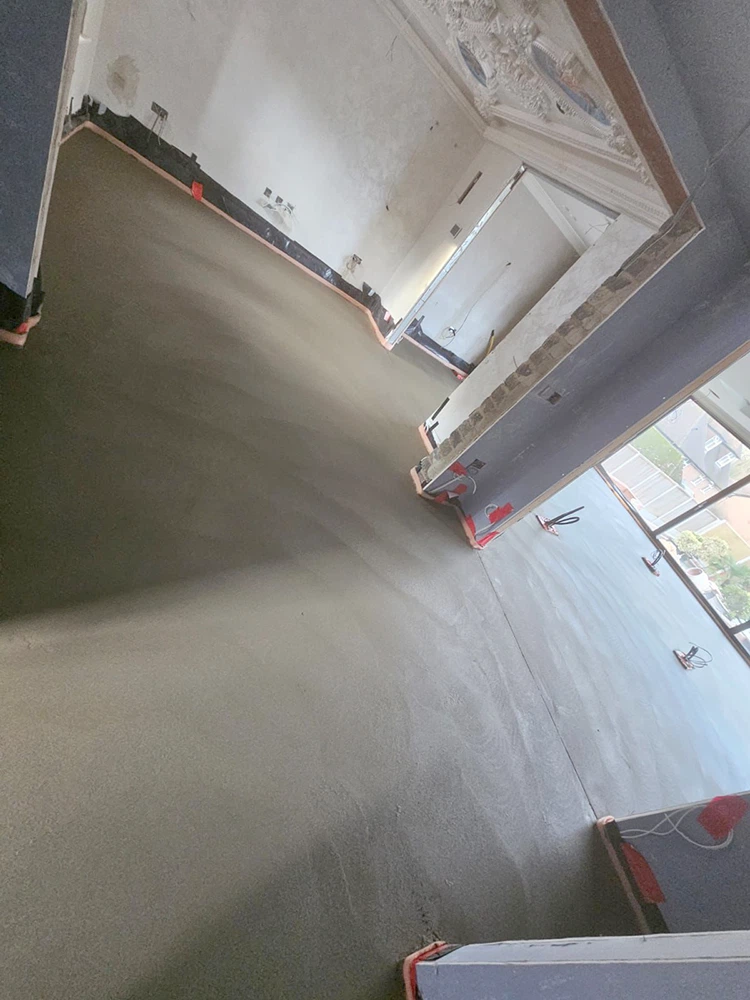
K & B Screeding’s own team, led by director Donatas Bardisevicius. Founded 2019, company 12298780.
See what customers say in our Google reviews and on our testimonials page.
Liquid Screed from Slough to Bath
As the crow flies, our yard in Slough is about 74.7 miles from Bath, which lies to the west. Postcodes here include BA2 and BA1, and Trowbridge (7.9 miles), Corsham (8.3 miles), Melksham (9.6 miles) and Frome (10.6 miles) are close by.
More on liquid screed, part of our screeding services.
