
Heated extensions on Bath's post-war estates
The years 1945 to 1972 produced 25% of Bath's homes, with Combe Down, Twerton and Weston all brought into the city for new housing then. Post-war houses there suit conventional extension screeds, and a rear kitchen, dining and living space added to one is often heated from the floor.
Without the right screed over the pipes, the heating will not perform properly. A liquid pour needs a minimum 25mm above the pipes, which normally lands the floor at 45 to 50mm, and it surrounds each pipe without leaving air pockets. Hand-laid sand and cement wants around 45mm on top of the pipes, so that floor is thicker. See our liquid screed page for Bath for pumping and access.
Semis are 24% of Bath's homes, and when one has a heated extension added, the new floor must line up with the old one, so insulation, pipes and screed are measured downward from the existing finished level. Settling this before the pipes go down avoids a step at the doorway.
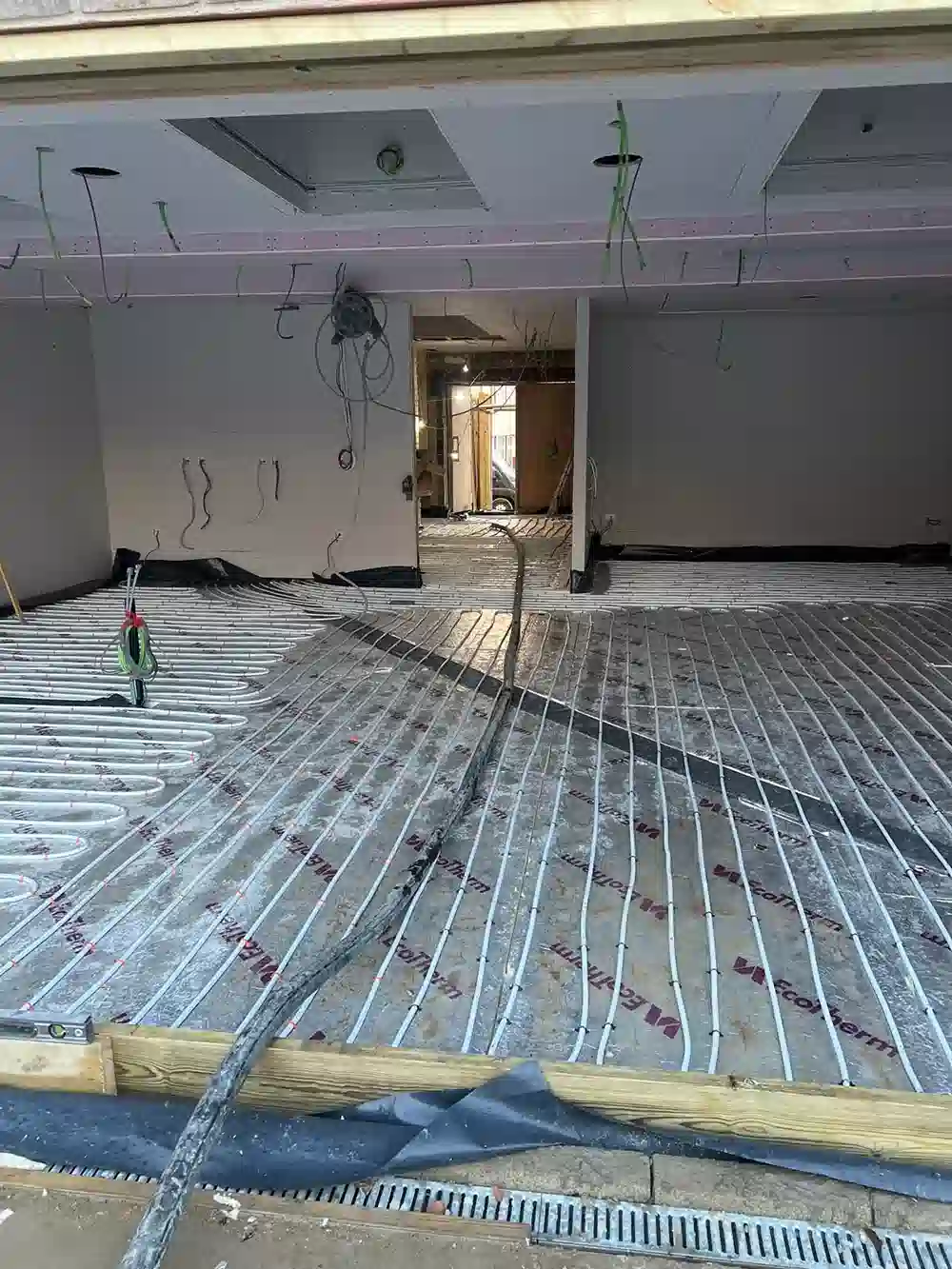
By the time we turn up, the pipes need clipping and pressure testing, with tight-fitting insulation below and edge strip around every wall. We check each of these and can supply membrane and edge strip. Fitting the pipework is your heating engineer's job, as it is not a service K & B provides.
Retrofitting heated floors in older Bath houses
Georgian and Victorian houses rarely have spare depth under the ground floor. Adding heating means taking up the old floor, and in a listed house that step may need consent before anything else happens. Original floors in these houses were often laid without a damp proof membrane, so the new build-up has to include one, along with insulation beneath the pipes to stop heat being lost into the ground.
Where a new floor is allowed, the thinnest practical build-up usually wins. A liquid screed at the lower end of its range keeps depth down. Where the room is a bathroom or may get wet, cement screed laid by hand goes over the pipes instead.
Commissioning must be gradual. Calcium sulphate will normally take heat from around 7 days, with the thermostat set low and brought up in small steps. Sand and cement should be left 21 days or more before any heating runs. Rushing either can crack the screed or the tiles above it.
On flats in converted buildings, depth and sound insulation both matter, and the screed depth guide helps when comparing options with a heating designer.
Underfloor Heating Screed prices in Bath
Liquid screed over underfloor heating: £20 to £35 per m² supplied and laid (trade2base, June 2026), so £700 to £1,230 for 35 m². trade2base gives these figures excluding VAT. See our floor screeding cost guide or screed calculator.
Who lays your underfloor heating screed in Bath
K & B Screeding’s own team, led by director Donatas Bardisevicius. Founded 2019, company 12298780.
See what customers say in our Google reviews and on our testimonials page.
Underfloor Heating Screed from Slough to Bath
As the crow flies, our yard in Slough is about 74.7 miles from Bath, which lies to the west. Postcodes here include BA2 and BA1, and Trowbridge (7.9 miles), Corsham (8.3 miles), Melksham (9.6 miles) and Frome (10.6 miles) are close by.
More on underfloor heating screed, part of our screeding services.
