
Heated floors on Corsham's newer estates
Homes built between 2000 and 2014 make up 14% of Corsham's housing, and building has carried on since. On the newest estates, a heated ground floor in liquid screed is what buyers expect, and the screed is what makes that heating work.
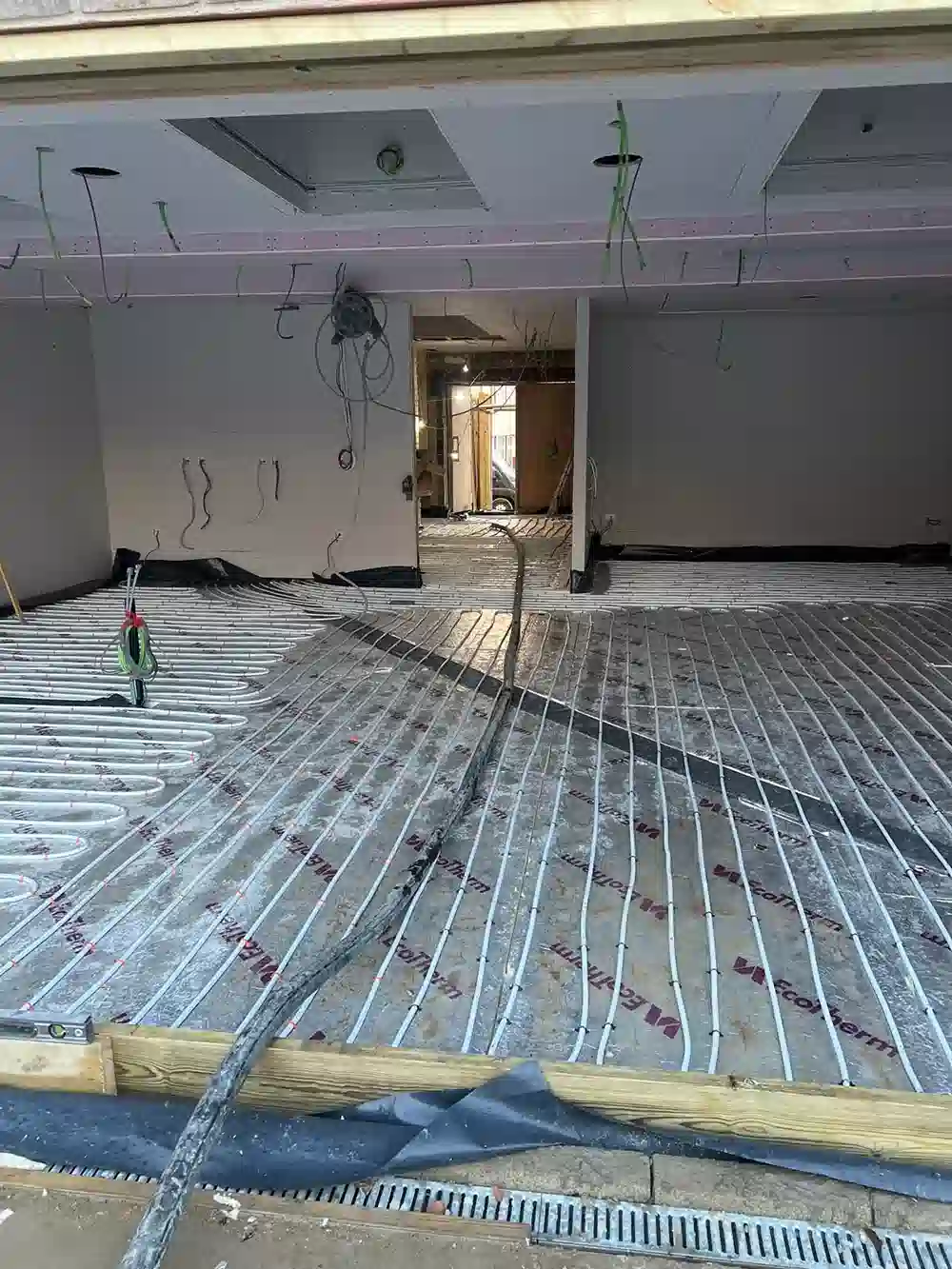
The pipes sit on insulation, clipped down by the heating installer and pressure tested before we arrive. The screed then has to encase them completely. Any air pocket around a pipe slows the heat spreading through the floor and leaves cold patches. Pumped screed runs in around each pipe and beneath the clips, and that is a big reason it suits heated floors.
Cover above the pipe is the critical figure. With liquid screed, allow 25mm or more above the pipe crown, so a typical house floor ends up 45 to 50mm deep. Sand and cement is bulkier, with about 45mm needed above the pipework alone. Too thin over the pipes invites cracks along their line, while too thick leaves the room sluggish to heat.
We inspect the insulation boards, membrane and perimeter strip on the day, before any screed goes in. The edge strip matters on heated floors because the screed expands and contracts as it warms and cools. For the material itself, read our liquid screed page for Corsham. A screed is not a heating system, so the pipe layout, manifold and controls stay with your installer throughout.
Adding heating to older Corsham houses and garden rooms
Retrofitting is harder than building new because floor height is fixed. Doors, stair treads and skirting set the finished level, and insulation, pipes and screed all have to fit below it. This is where the slimmer build-up of a pumped screed can decide whether heating fits at all. In older stone cottages with lime or flag floors, the damp and breathability questions need answering before heating goes in at all.
Garden rooms and heated extensions are simpler, since the build-up can be designed from the start.
Commissioning is the same in every case. Around day 7, calcium sulphate can usually start taking a little heat, but a sand and cement floor stays cold for 21 days or more. The heating then comes up gradually over several days, following the installer's schedule, before tiles or wood go down. We give written guidance on the heat-up so nobody switches straight to full temperature.
For thickness figures in full, see the screed thickness guide. For a cement floor in wet areas or a small room, our sand and cement screed in Corsham page has the details.
Underfloor Heating Screed prices in Corsham
Liquid screed over underfloor heating: £20 to £35 per m² supplied and laid (trade2base, June 2026), so £700 to £1,230 for 35 m². trade2base gives these figures excluding VAT. See our floor screeding cost guide or screed calculator.
Who lays your underfloor heating screed in Corsham
K & B Screeding’s own team, led by director Donatas Bardisevicius. Founded 2019, company 12298780.
See what customers say in our Google reviews and on our testimonials page.
Underfloor Heating Screed from Slough to Corsham
Corsham is about 66.8 miles west of our Slough base as the crow flies, with postcodes including SN13. The nearest towns to it are Chippenham (3.5 miles), Melksham (4.7 miles), Calne (7.8 miles) and Trowbridge (7.9 miles).
More on underfloor heating screed, part of our screeding services.