
Heated extensions on post-war Devizes homes
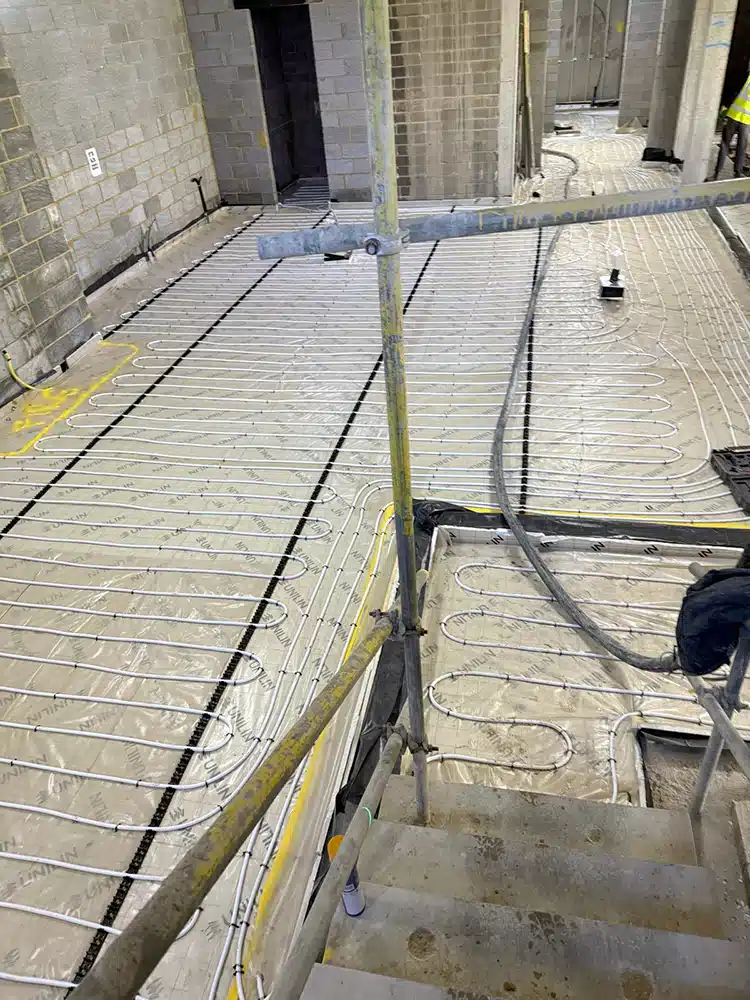
An extension or a ground floor rebuild is the easiest time to fit underfloor heating, because the whole build-up can be designed together. From the bottom up it runs: base, membrane, insulation, the heating pipes clipped down by your installer, an edge strip around the walls, and then the screed.
Without a good screed, the heating will not perform. It has to encase every pipe with no voids, spread heat evenly and give a flat surface for the finish. A liquid screed flows around pipes and clips and fills fully, so it is the common choice. A sand and cement screed works too, compacted carefully around the pipes.
The depth of screed sitting over the pipes is the number to watch. For a pumped floor, the minimum is 25mm above the pipe, so the full depth comes to 45 to 50mm. Sand and cement is thicker again, at about 45mm over the pipe. Less than that risks cracking along the pipe lines, and more slows the heat response.
Before we pour, the installer should have pressure tested the pipes. On our side, we look over the insulation boards, the membrane sheet and the strip around the walls, and bring any that are missing. Garden rooms follow the same rules, since the build-up can be planned from the slab upwards.
For the pumped option in detail, see liquid screed in Devizes. The pipe layout, manifold and controls remain the installer's responsibility from start to finish.
Retrofit heating in older Devizes and listed homes
Fitting heating under an existing floor is a question of height. The finished floor must still meet doors, stairs and skirting, so insulation, pipes and screed have to fit below that line. Liquid screed's thinner cover often makes a retrofit possible where sand and cement would sit too high.
In the listed centre, Georgian and Victorian houses may have suspended timber floors or solid floors with no membrane. Any change there should be agreed with the listing in mind before heating is planned, and a solid floor rebuild is a bigger job than a straight swap.
Newer houses are simpler. Homes built since 2000 make up 30% of Devizes, and when those ground floors are refitted, the existing build-up may already include insulation.
Commissioning follows the material. Low heat can usually go on a calcium sulphate floor from about day 7, whereas sand and cement sits unheated for 21 days or more. Either way, the temperature is raised slowly over several days to the installer's schedule, and the floor is moisture tested before finishes go down. Our screed thickness guide has the depth table, and the Devizes anhydrite flow screed page explains calcium sulphate grades.
Underfloor Heating Screed prices in Devizes
Liquid screed over underfloor heating: £20 to £35 per m² supplied and laid (trade2base, June 2026), so £700 to £1,230 for 35 m². trade2base gives these figures excluding VAT. See our floor screeding cost guide or screed calculator.
Who lays your underfloor heating screed in Devizes
K & B Screeding’s own team, led by director Donatas Bardisevicius. Founded 2019, company 12298780.
See what customers say in our Google reviews and on our testimonials page.
Underfloor Heating Screed from Slough to Devizes
Devizes is about 59.6 miles west-south-west of our Slough base as the crow flies, with postcodes including SN10. The nearest towns to it are Calne (6 miles), Melksham (6.3 miles), Chippenham (9 miles) and Trowbridge (9.5 miles).
More on underfloor heating screed, part of our screeding services.